Batrachoseps kawia
Sequoia Slender Salamander
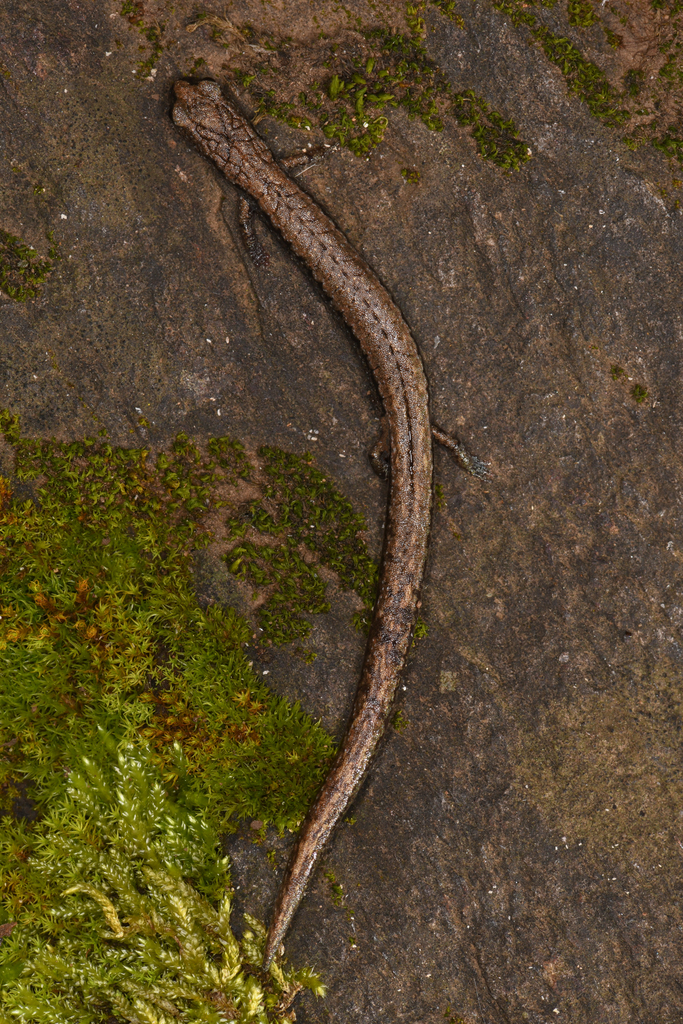
(c) Trevor Van Loon, some rights reserved (CC BY) · licence
Family: Plethodontidae · Class: Amphibia · Order: Caudata
Conservation status: G2 S2
Batrachoseps kawia (Sequoia Slender Salamander) is a California animal in the Plethodontidae family.
The Sequoia slender salamander (Batrachoseps kawia) is a small, elongate terrestrial salamander endemic to the southern Sierra Nevada of California. Adults measure 38 to 57 mm (1.5 to 2.2 inches) in snout-vent length, with a total length including tail of 76 to 114 mm (3.0 to 4.5 inches). The species exhibits the characteristic body proportions of the genus Batrachoseps, with extremely long legs relative to body size and a constriction at the base of the tail. Dorsal coloration ranges from reddish-brown to dark brown with a distinctive lighter dorsal stripe that may be bronze, tan, or reddish. The ventral surface is typically lighter, appearing gray to whitish. Batrachoseps kawia occurs in a narrow elevational band from approximately 350 to 2,200 meters (1,150 to 7,200 feet) in the southern Sierra Nevada. The species' range extends from Fresno County south to Tulare County, with populations documented in the Giant Sequoia National Monument and Sequoia National Forest. Historical records indicate the species was more widely distributed, but current populations appear fragmented across suitable habitat patches within this range. This salamander inhabits mixed coniferous forests dominated by ponderosa pine, white fir, and giant sequoia. The species requires specific microhabitat conditions, typically found under logs, bark, and rock talus in areas with high moisture retention. Sequoia slender salamanders are most commonly encountered in north-facing slopes and canyon bottoms where humidity levels remain elevated during dry periods. The species shows strong associations with decomposing organic matter and appears dependent on consistent soil moisture levels throughout its activity period. Sequoia slender salamanders are nocturnal and primarily active during spring and fall when surface conditions remain moist. Like other plethodontid salamanders, they lack lungs and respire entirely through their skin and mouth lining, requiring high humidity for survival. The species feeds on small invertebrates including springtails, mites, small beetles, and fly larvae. Reproduction is terrestrial, with females depositing small clutches of eggs in moist soil or under decaying logs during late spring. Development is direct, with young emerging as miniature adults without an aquatic larval stage. Sexual maturity is reached in 3 to 4 years. Batrachoseps kawia is classified as imperiled with a Global Rank of G2 and State Rank of S2, indicating the species faces a high risk of extinction. Population declines have been attributed to habitat fragmentation from logging operations, fire suppression altering natural forest structure, and climate change reducing moisture availability in montane environments. The species' limited dispersal ability and specific habitat requirements make populations particularly vulnerable to local extirpations. Long-term monitoring studies suggest some populations have experienced significant reductions since the 1970s, though comprehensive surveys are limited. Forest management practices that maintain canopy cover and preserve coarse woody debris are considered essential for species persistence.
Classification
Class: Amphibia · Order: Caudata · Family: Plethodontidae
Conservation status
G2 S2
Frequently asked questions
How is Batrachoseps kawia classified?
Batrachoseps kawia belongs to class Amphibia, order Caudata, family Plethodontidae.
What family does Batrachoseps kawia belong to?
Batrachoseps kawia is in the Plethodontidae family.
Is Batrachoseps kawia protected or of conservation concern?
Batrachoseps kawia carries the following status: G2 S2.
What is Batrachoseps kawia?
The Sequoia slender salamander (Batrachoseps kawia) is a small, elongate terrestrial salamander endemic to the southern Sierra Nevada of California.
Is Batrachoseps kawia found in California?
Yes. Batrachoseps kawia is recorded in California in The California Species Project's catalogue.
Related species
Other California species in the same genus, family, or bioregion.
Data from The California Species Project — 14,000+ California species with verified data from CNPS, CDFW, USFWS, and more.