Batrachoseps luciae
Santa Lucia Mountains Slender Salamander
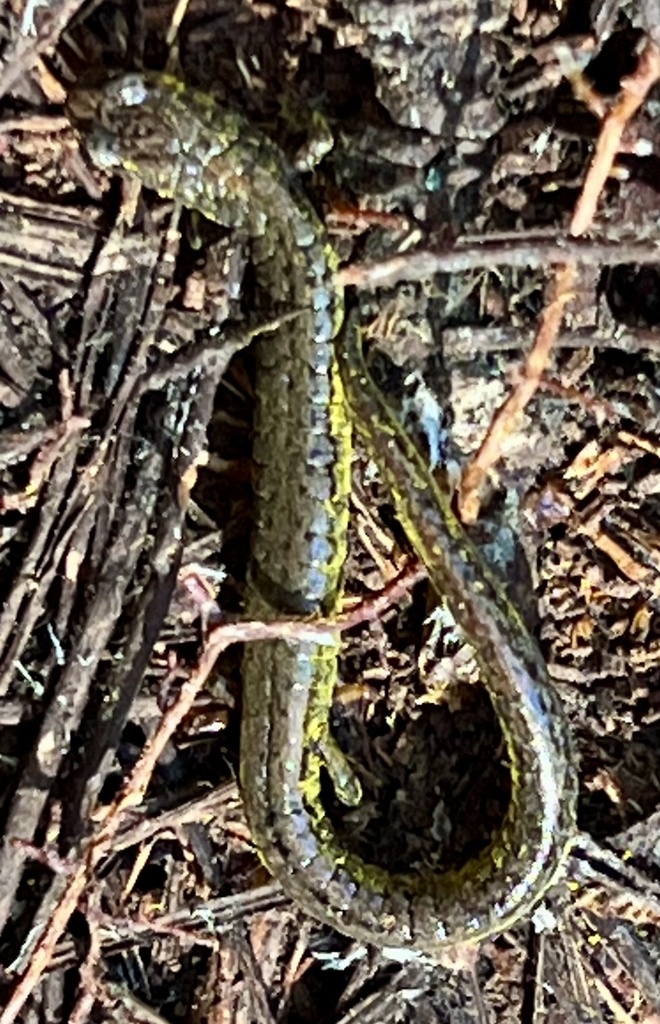
no rights reserved · CC0
Family: Plethodontidae · Class: Amphibia · Order: Caudata
Conservation status: G3 S3
Batrachoseps luciae (Santa Lucia Mountains Slender Salamander) is a California animal in the Plethodontidae family.
The Santa Lucia Mountains slender salamander (Batrachoseps luciae) is a small terrestrial amphibian endemic to the Santa Lucia Range of central California. Adults typically measure 32 to 44 millimeters (1.3 to 1.7 inches) in snout-vent length, with a total length including tail reaching 76 to 89 millimeters (3.0 to 3.5 inches). The species exhibits the characteristic body plan of plethodontid salamanders, with a slender build, short legs, and relatively long tail. Dorsal coloration ranges from dark brown to blackish, often with a lighter reddish-brown dorsal stripe. The ventral surface is typically dark gray to black with fine white speckling. This species is restricted to the Santa Lucia Mountains along the central California coast, occurring primarily in Monterey and San Luis Obispo counties. The range extends from the Carmel River drainage southward to the vicinity of Cambria. Historical records indicate the species occurs at elevations from near sea level to approximately 1,220 meters (4,000 feet). The distribution is patchy and closely associated with specific microhabitat conditions within the coastal mountain range. Santa Lucia Mountains slender salamanders inhabit moist environments under surface cover objects including logs, rocks, bark, and leaf litter. The species shows strong association with mixed evergreen forests and oak woodlands, particularly areas dominated by coast redwood (Sequoia sempervirens), tanoak (Notholithocarpus densiflorus), and coast live oak (Quercus agrifolia). Suitable habitat requires consistent moisture retention and moderate temperatures year-round. The salamanders are typically found within 50 meters of permanent or seasonal water sources. Like other plethodontid salamanders, this species is lungless and conducts gas exchange through the skin and mouth lining, requiring moist conditions for survival. Adults are nocturnal and emerge from daytime retreats during periods of high humidity to forage for small invertebrates including springtails, mites, small beetles, and fly larvae. Reproduction is terrestrial, with females depositing clusters of 6 to 12 eggs in moist soil or under decaying logs during late fall and winter months. Eggs undergo direct development without an aquatic larval stage, hatching as miniature adults after approximately 6 to 8 months of development. The Santa Lucia Mountains slender salamander is ranked G3 S3, indicating the species is vulnerable to extirpation globally and within California. Population estimates are not available, but suitable habitat is limited and fragmented throughout the range. Primary threats include habitat loss and fragmentation from residential and agricultural development, particularly in lower elevation areas. Fire suppression activities and altered fire regimes may impact habitat quality by changing forest structure and moisture retention. Climate change poses additional risks through increased temperature and drought stress, which can reduce habitat suitability and fragment populations. The species' limited dispersal ability and specific habitat requirements make it particularly vulnerable to environmental changes. No specific conservation measures are currently in place, though portions of the range occur within protected areas including state parks and national forest lands.
Classification
Class: Amphibia · Order: Caudata · Family: Plethodontidae
Conservation status
G3 S3
Frequently asked questions
How is Batrachoseps luciae classified?
Batrachoseps luciae belongs to class Amphibia, order Caudata, family Plethodontidae.
What family does Batrachoseps luciae belong to?
Batrachoseps luciae is in the Plethodontidae family.
Is Batrachoseps luciae protected or of conservation concern?
Batrachoseps luciae carries the following status: G3 S3.
What is Batrachoseps luciae?
The Santa Lucia Mountains slender salamander (Batrachoseps luciae) is a small terrestrial amphibian endemic to the Santa Lucia Range of central California.
Is Batrachoseps luciae found in California?
Yes. Batrachoseps luciae is recorded in California in The California Species Project's catalogue.
Related species
Other California species in the same genus, family, or bioregion.
Data from The California Species Project — 14,000+ California species with verified data from CNPS, CDFW, USFWS, and more.