Batrachoseps major
Southern California Slender Salamander, Garden Slender Salamander
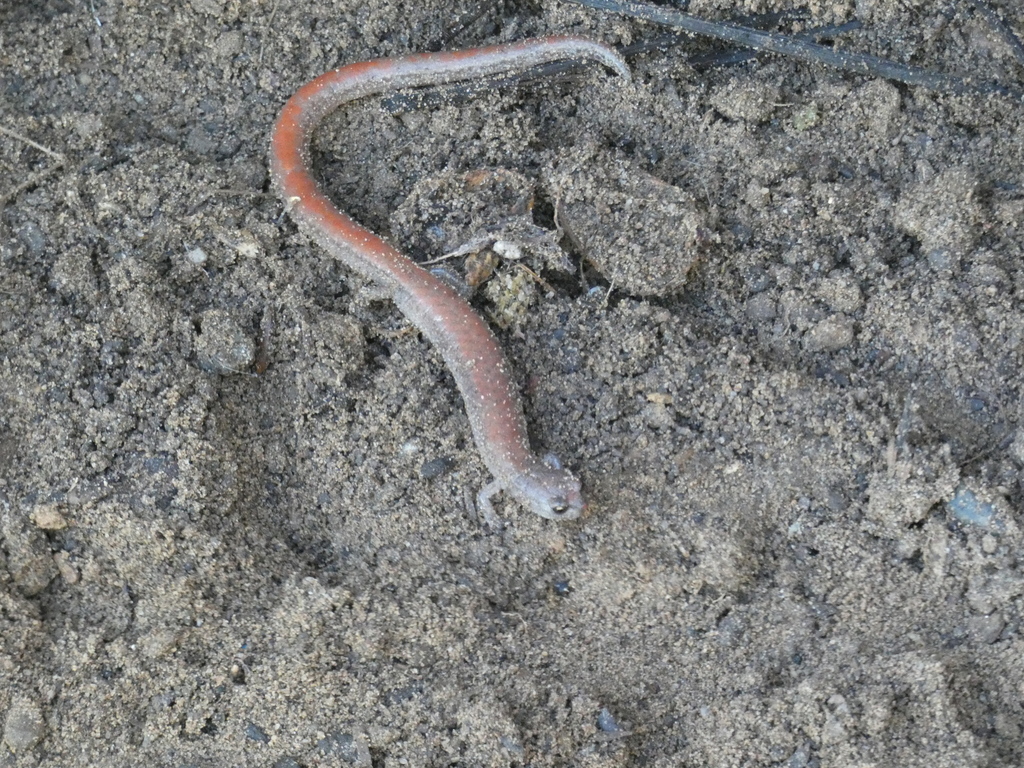
no rights reserved · CC0
Family: Plethodontidae · Class: Amphibia · Order: Caudata
Batrachoseps major (Southern California Slender Salamander, Garden Slender Salamander) is a California animal in the Plethodontidae family.
The Southern California slender salamander (Batrachoseps major) is a small, elongate terrestrial salamander endemic to southern California. Adults typically measure 38 to 57 mm (1.5 to 2.2 inches) in snout-vent length, with a total length including tail of 75 to 100 mm (3.0 to 3.9 inches). The body is extremely slender with proportionally short legs and a long, constricted tail that comprises approximately half the total body length. Coloration varies from dark brown to reddish-brown dorsally, with a lighter bronze or tan dorsal stripe extending from the head to the tail tip. The ventral surface is typically pale gray to white with fine dark speckling. This species occurs exclusively in southern California, with a fragmented distribution extending from Ventura County south through Los Angeles, Orange, Riverside, and San Bernardino counties into northern Baja California, Mexico. The range includes the Transverse and Peninsular mountain ranges, with elevations from near sea level to approximately 2,100 meters (6,900 feet). Populations are documented from the Santa Monica Mountains, San Gabriel Mountains, San Bernardino Mountains, and various coastal ranges. Historical records indicate a more continuous distribution, but urban development has isolated many populations. Southern California slender salamanders inhabit a variety of mesic microhabitats within Mediterranean scrub, chaparral, oak woodland, and coniferous forest communities. They require moist conditions and are typically found under logs, rocks, bark, leaf litter, and in talus slopes. The species shows strong substrate preferences for areas with permanent moisture retention, often occurring near seeps, springs, or north-facing slopes that maintain higher humidity levels. They demonstrate notable fossorial behavior, utilizing underground retreats during dry periods. As lungless salamanders, Southern California slender salamanders respire entirely through their skin and must maintain moisture for gas exchange. They are primarily nocturnal and most active during cool, humid conditions from October through April. The species feeds on small invertebrates including mites, springtails, small beetles, and fly larvae. Reproduction occurs through direct development without an aquatic larval stage. Females deposit clusters of 4 to 19 eggs in underground chambers or beneath cover objects during winter months. Eggs develop over 4 to 6 months, with juveniles emerging as miniature adults during spring and early summer. The Southern California slender salamander faces significant conservation challenges despite lacking formal protection status. Primary threats include habitat fragmentation and loss due to urban development, fire suppression practices that alter natural fire cycles, and climate change effects including increased aridity and temperature extremes. Many populations exist as small, isolated fragments separated by inhospitable developed areas. Research indicates that some populations may have experienced local extirpations, particularly in heavily urbanized portions of the range. The species' limited dispersal ability and specific moisture requirements make it particularly vulnerable to habitat modification and climate-related stressors. Conservation efforts focus on habitat protection and restoration within existing open space preserves.
Classification
Class: Amphibia · Order: Caudata · Family: Plethodontidae
Frequently asked questions
How is Batrachoseps major classified?
Batrachoseps major belongs to class Amphibia, order Caudata, family Plethodontidae.
What family does Batrachoseps major belong to?
Batrachoseps major is in the Plethodontidae family.
What is Batrachoseps major?
The Southern California slender salamander (Batrachoseps major) is a small, elongate terrestrial salamander endemic to southern California.
Is Batrachoseps major found in California?
Yes. Batrachoseps major is recorded in California in The California Species Project's catalogue.
Related species
Other California species in the same genus, family, or bioregion.
Data from The California Species Project — 14,000+ California species with verified data from CNPS, CDFW, USFWS, and more.