Batrachoseps major aridus
Desert Slender Salamander
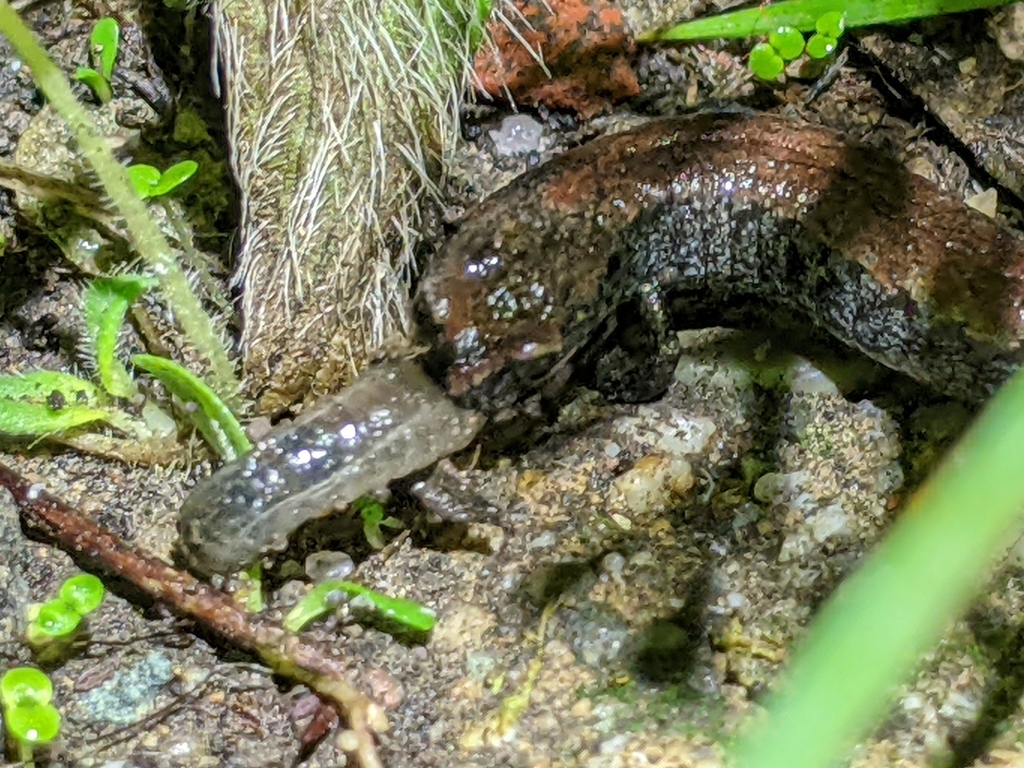
(c) Ken-ichi Ueda, some rights reserved (CC BY) · licence
Family: Plethodontidae · Class: Amphibia · Order: Caudata
Conservation status: SE · Endangered · G4T1 S1
Batrachoseps major aridus (Desert Slender Salamander) is a California animal in the Plethodontidae family.
The Desert Slender Salamander is a small terrestrial amphibian endemic to two isolated canyon locations in southern California. Adults measure less than 100 mm (4 inches) in total length, with females being slightly larger than males (USFWS). The species exhibits typical slender salamander morphology with an elongated, cylindrical body and relatively short legs. Body coloration and pattern details remain poorly documented in scientific literature. This subspecies has an extremely restricted range, occurring only in Hidden Palm Canyon and Guadalupe Canyon in Riverside County, California (USFWS). Both locations are encompassed within the Santa Rosa and San Jacinto Mountains National Monument area. The species represents an isolated desert population of the more widespread Southern California Slender Salamander complex, with some taxonomic authorities treating it as Batrachoseps major aridus rather than a full species (AmphibiaWeb). Desert Slender Salamanders inhabit rocky canyon environments in desert localities, typically on north-facing slopes where moisture retention is enhanced. The species requires microhabitats with adequate moisture and cover, likely utilizing rock crevices, leaf litter, and other protected areas during periods of low humidity. Specific elevation ranges and detailed habitat requirements have not been thoroughly documented. Like other members of the genus Batrachoseps, this salamander is an invertivore feeding on small arthropods including flies, ants, insects, spiders, snails, and sowbugs (NatureServe). The species is apparently most active at night, though activity patterns remain poorly understood. Reproduction occurs during winter months, with breeding taking place from December through January. Females deposit strings of 10-20 eggs, and development is entirely terrestrial with no aquatic larval stage (NatureServe). When threatened, individuals exhibit the characteristic defensive behavior of coiling their body. The Desert Slender Salamander was listed as federally endangered on June 4, 1973, making it one of the earliest amphibians to receive federal protection. The species maintains endangered status under both federal and California state regulations as of December 2025. Its extremely limited distribution to just two canyon systems makes it highly vulnerable to habitat disturbance, climate change, and other environmental pressures. The small population size and restricted range represent primary conservation concerns. Population estimates and trends remain poorly documented, reflecting the challenges of studying this secretive species in remote desert canyons. Conservation efforts focus on habitat protection within the National Monument boundaries, though specific recovery actions and population monitoring protocols have not been well established. The taxonomic uncertainty regarding its relationship to Batrachoseps major adds complexity to conservation planning, with some authorities recognizing it as a distinct species while others treat it as a subspecies of the more widespread Southern California Slender Salamander.
Classification
Class: Amphibia · Order: Caudata · Family: Plethodontidae
Conservation status
SE · Endangered · G4T1 S1
Frequently asked questions
How is Batrachoseps major aridus classified?
Batrachoseps major aridus belongs to class Amphibia, order Caudata, family Plethodontidae.
What family does Batrachoseps major aridus belong to?
Batrachoseps major aridus is in the Plethodontidae family.
Is Batrachoseps major aridus protected or of conservation concern?
Batrachoseps major aridus carries the following status: SE · Endangered · G4T1 S1.
What is Batrachoseps major aridus?
The Desert Slender Salamander is a small terrestrial amphibian endemic to two isolated canyon locations in southern California.
Is Batrachoseps major aridus found in California?
Yes. Batrachoseps major aridus is recorded in California in The California Species Project's catalogue.
Related species
Other California species in the same genus, family, or bioregion.
Data from The California Species Project — 14,000+ California species with verified data from CNPS, CDFW, USFWS, and more.