Batrachoseps minor
Lesser Slender Salamander
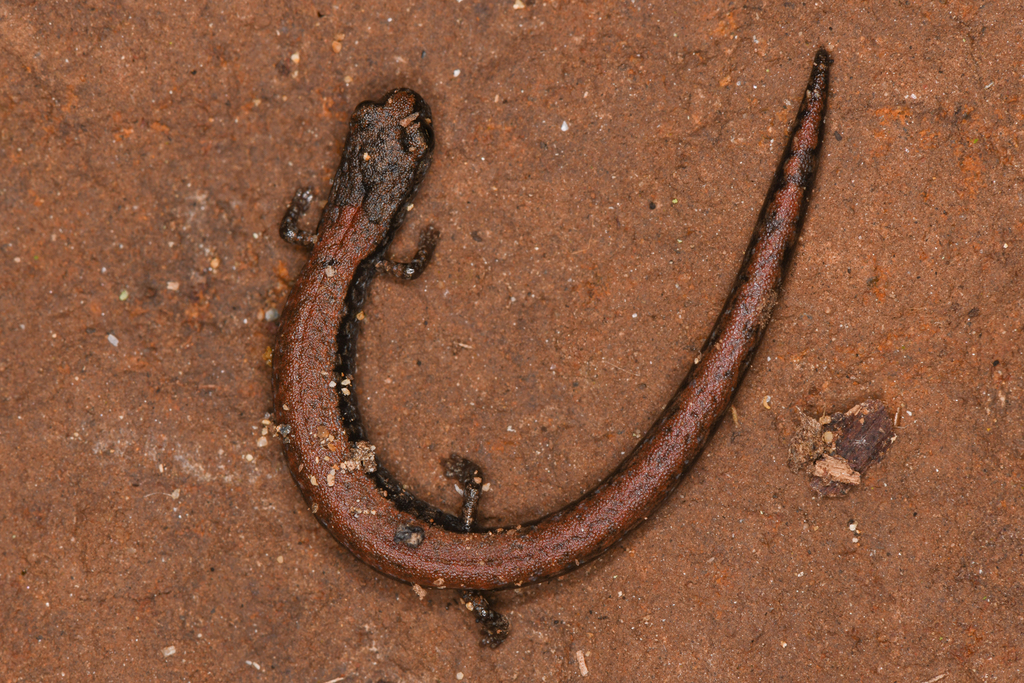
(c) Trevor Van Loon, some rights reserved (CC BY) · licence
Family: Plethodontidae · Class: Amphibia · Order: Caudata
Conservation status: G1 S1
Batrachoseps minor (Lesser Slender Salamander) is a California animal in the Plethodontidae family.
The Lesser Slender Salamander (Batrachoseps minor) is a small terrestrial salamander endemic to a highly restricted range in California. Adults typically measure 35 to 45 mm (1.4 to 1.8 inches) in snout-vent length, with total length including tail reaching 75 to 90 mm (3.0 to 3.5 inches). The species exhibits the characteristic body form of the genus Batrachoseps, with an extremely slender build, short legs, and a long tail that comprises approximately 60% of total body length. Dorsal coloration ranges from dark brown to reddish-brown with a distinctive bronze or copper-colored dorsal stripe extending from the head to the tail tip. The ventral surface is typically lighter, ranging from pale gray to yellowish. The Lesser Slender Salamander has one of the most restricted distributions of any North American salamander species. According to NatureServe, the species is known from fewer than five locations in the Santa Lucia Mountains of Monterey County, California. The entire known range encompasses less than 20 square kilometers, with populations occurring at elevations between 300 and 900 meters (980 to 2,950 feet). Historical records suggest the species may have had a slightly broader distribution within the Santa Lucia Range, but habitat loss has further reduced its occurrence. This species inhabits moist microhabitats within coast redwood (Sequoia sempervirens) and mixed evergreen forests. Individuals are typically found under logs, bark, leaf litter, and moss in areas with consistent moisture and cool temperatures. The species requires specific soil conditions with high organic content and adequate moisture retention. Suitable habitat is characterized by dense canopy cover that maintains stable humidity levels and protects against temperature extremes. The salamander shows preference for north-facing slopes and canyon bottoms where moisture persists longer during dry periods. Lesser Slender Salamanders are completely terrestrial throughout their life cycle, lacking an aquatic larval stage. Development is direct, with eggs laid in small clusters of 3 to 8 in moist soil or under decaying logs during late fall and winter months. Females likely reproduce biennially, and sexual maturity is reached at approximately 2 to 3 years of age. The species is nocturnal and surface-active during periods of high humidity, particularly after rainfall. Diet consists primarily of small invertebrates including springtails, mites, small beetles, and other arthropods found in leaf litter and soil. The Lesser Slender Salamander is ranked G1 S1, indicating it is critically imperiled both globally and within California. The species faces severe threats from habitat destruction due to logging, urban development, and recreational activities in the Santa Lucia Mountains. Climate change poses additional risks through altered precipitation patterns and increased frequency of drought conditions that could eliminate the moist microhabitats essential for survival. The small population size and extremely limited range make the species particularly vulnerable to stochastic events. Current population estimates suggest fewer than 1,000 individuals remain across all known locations, with some populations consisting of fewer than 50 adults.
Classification
Class: Amphibia · Order: Caudata · Family: Plethodontidae
Conservation status
G1 S1
Frequently asked questions
How is Batrachoseps minor classified?
Batrachoseps minor belongs to class Amphibia, order Caudata, family Plethodontidae.
What family does Batrachoseps minor belong to?
Batrachoseps minor is in the Plethodontidae family.
Is Batrachoseps minor protected or of conservation concern?
Batrachoseps minor carries the following status: G1 S1.
What is Batrachoseps minor?
The Lesser Slender Salamander (Batrachoseps minor) is a small terrestrial salamander endemic to a highly restricted range in California.
Is Batrachoseps minor found in California?
Yes. Batrachoseps minor is recorded in California in The California Species Project's catalogue.
Related species
Other California species in the same genus, family, or bioregion.
Data from The California Species Project — 14,000+ California species with verified data from CNPS, CDFW, USFWS, and more.