Batrachoseps pacificus
Channel Islands Slender Salamander
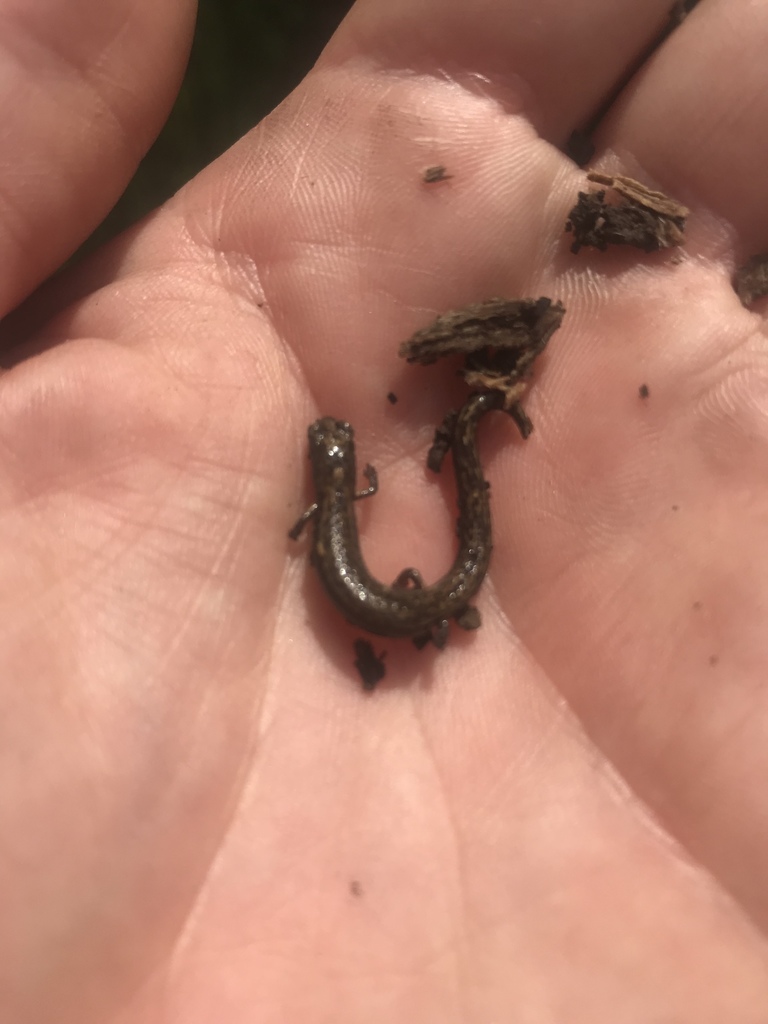
no rights reserved · CC0
Family: Plethodontidae · Class: Amphibia · Order: Caudata
Conservation status: G3G4 S3S4
Batrachoseps pacificus (Channel Islands Slender Salamander) is a California animal in the Plethodontidae family.
The Channel Islands slender salamander (Batrachoseus pacificus) is a small, terrestrial amphibian endemic to the California Channel Islands. Adults typically measure 35 to 50 mm (1.4 to 2.0 inches) in snout-vent length, with a total length including tail reaching 80 to 110 mm (3.1 to 4.3 inches). The body is elongate and slender with relatively short limbs and a long, cylindrical tail. Coloration varies from dark brown to nearly black dorsally, with lighter brown or reddish-brown sides. The ventral surface is typically lighter, ranging from gray to pale brown. Like other plethodontid salamanders, this species lacks lungs and respires entirely through the skin and buccal cavity. The Channel Islands slender salamander is restricted to three of the California Channel Islands: Santa Cruz, Santa Rosa, and Anacapa Islands. This endemic distribution represents one of the most geographically limited ranges of any North American salamander species. The species occurs from sea level to approximately 400 meters (1,312 feet) elevation, with populations documented across various habitat types on each island. Habitat requirements include areas with sufficient moisture retention and cover objects. The species is found under rocks, logs, leaf litter, and other surface debris in oak woodlands, grasslands, and scrub communities. Individuals require microhabitats that maintain adequate humidity during dry periods, as their permeable skin makes them vulnerable to desiccation. The Mediterranean climate of the Channel Islands, with wet winters and dry summers, influences the species' activity patterns and habitat selection. Channel Islands slender salamanders are nocturnal and primarily active during the wet season from November through April. During dry periods, individuals retreat to underground refugia or beneath surface cover where moisture is retained. The species is completely terrestrial, with direct development and no aquatic larval stage. Females deposit small clutches of 4 to 12 eggs in moist soil or under cover objects during winter months. Eggs develop directly into miniature adults without a free-swimming tadpole stage, an adaptation common among plethodontid salamanders. Diet consists primarily of small arthropods including mites, springtails, small beetles, and other invertebrates found in leaf litter and soil. The species is assigned a global rank of G3G4 (vulnerable to apparently secure) and a state rank of S3S4, indicating moderate conservation concern. While not federally or state listed, the restricted island distribution makes populations vulnerable to localized threats. Primary concerns include habitat degradation from introduced species, particularly feral pigs on Santa Cruz Island that disturb soil and vegetation, and non-native plants that alter habitat structure. Climate change poses additional risks through potential shifts in precipitation patterns and increased drought frequency. Conservation efforts focus on invasive species control and habitat restoration on the Channel Islands, managed by the National Park Service and The Nature Conservancy.
Classification
Class: Amphibia · Order: Caudata · Family: Plethodontidae
Conservation status
G3G4 S3S4
Frequently asked questions
How is Batrachoseps pacificus classified?
Batrachoseps pacificus belongs to class Amphibia, order Caudata, family Plethodontidae.
What family does Batrachoseps pacificus belong to?
Batrachoseps pacificus is in the Plethodontidae family.
Is Batrachoseps pacificus protected or of conservation concern?
Batrachoseps pacificus carries the following status: G3G4 S3S4.
What is Batrachoseps pacificus?
The Channel Islands slender salamander (Batrachoseus pacificus) is a small, terrestrial amphibian endemic to the California Channel Islands.
Is Batrachoseps pacificus found in California?
Yes. Batrachoseps pacificus is recorded in California in The California Species Project's catalogue.
Related species
Other California species in the same genus, family, or bioregion.
Data from The California Species Project — 14,000+ California species with verified data from CNPS, CDFW, USFWS, and more.