Batrachoseps relictus
Relictual slender salamander
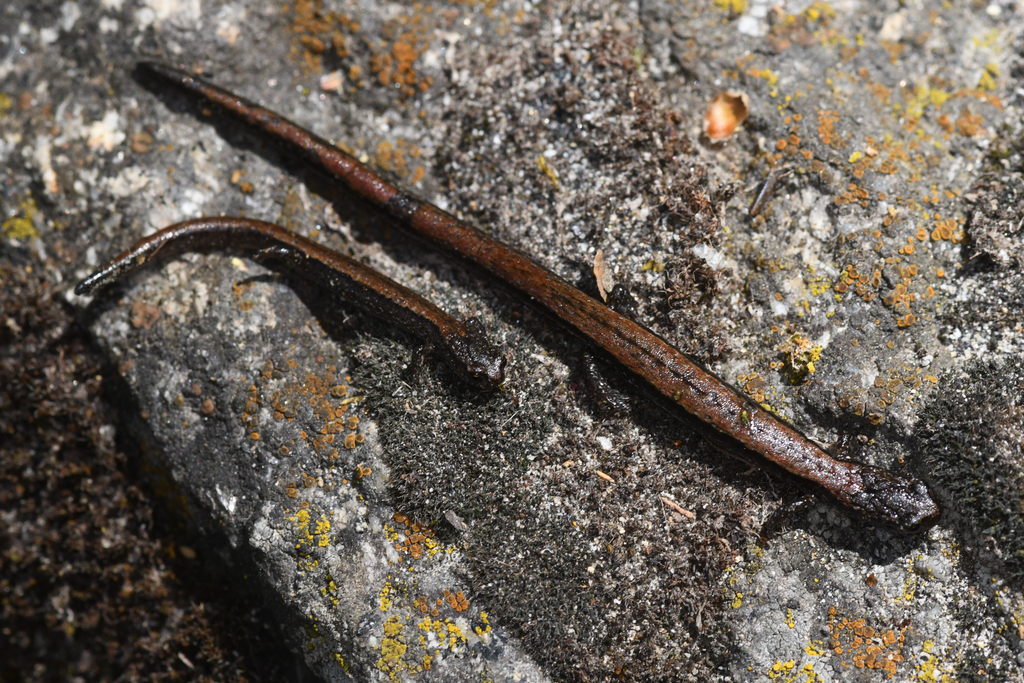
(c) Trevor Van Loon, some rights reserved (CC BY) · licence
Family: Plethodontidae · Class: Amphibia · Order: Caudata
Conservation status: Proposed Endangered · G1 S1
Batrachoseps relictus (Relictual slender salamander) is a California animal in the Plethodontidae family.
The relictual slender salamander (Batrachoseps relictus) is a small terrestrial salamander endemic to a highly restricted area in central California. Adults typically measure 35 to 45 mm (1.4 to 1.8 inches) in snout-vent length, with total length including tail reaching 75 to 95 mm (3.0 to 3.7 inches). The species exhibits the characteristic elongated body plan of the genus Batrachoseps, with a narrow head, slender trunk, and proportionally long tail. Coloration consists of a dark brown to black dorsal surface with lighter lateral stripes, and a pale ventral surface. The limbs are notably short relative to body size, and the digits are webbed at their bases. The relictual slender salamander has one of the most restricted ranges of any North American salamander species. The species is known only from the Kern River watershed in Kern County, California, specifically from the Greenhorn Mountains and adjacent areas of the southern Sierra Nevada. Historical records indicate the species once occurred across a broader area within this region, but current populations are limited to scattered localities at elevations between 975 and 2,135 meters (3,200 to 7,000 feet). This salamander inhabits mixed coniferous forests dominated by ponderosa pine, incense cedar, and white fir. Microhabitat requirements include areas with adequate moisture retention, such as talus slopes, rocky outcrops, and fallen logs. The species is typically found under rocks, bark, or woody debris in areas with permanent or semi-permanent moisture. Substrate preferences include decomposing organic matter and loose soil with high humidity levels. The species appears to require specific moisture and temperature conditions that limit its distribution even within suitable forest types. The relictual slender salamander is lungless, breathing entirely through its skin and mouth lining, which requires consistently moist conditions. Like other plethodontid salamanders, it is entirely terrestrial with direct development, laying eggs in terrestrial environments that hatch directly into miniature adults without an aquatic larval stage. Reproduction likely occurs during late fall or early winter when moisture levels are highest. Diet consists primarily of small invertebrates including springtails, mites, small beetles, and other arthropods found in the leaf litter and soil layers. The species exhibits limited dispersal capability due to its moisture requirements and small body size. The U.S. Fish and Wildlife Service proposed listing the relictual slender salamander as endangered in 2023, citing severe population decline and habitat loss. The species receives a Global rank of G1 (critically imperiled) and State rank of S1, indicating fewer than 1,000 individuals are estimated to remain across all populations. Primary threats include habitat degradation from logging, fire suppression activities that alter forest structure, climate change leading to increased aridity, and recreational activities that disturb microhabitat conditions. The species' extremely limited range makes it particularly vulnerable to stochastic events and localized habitat disturbance. Conservation efforts focus on habitat protection and monitoring of known populations to track population trends.
Classification
Class: Amphibia · Order: Caudata · Family: Plethodontidae
Conservation status
Proposed Endangered · G1 S1
Frequently asked questions
How is Batrachoseps relictus classified?
Batrachoseps relictus belongs to class Amphibia, order Caudata, family Plethodontidae.
What family does Batrachoseps relictus belong to?
Batrachoseps relictus is in the Plethodontidae family.
Is Batrachoseps relictus protected or of conservation concern?
Batrachoseps relictus carries the following status: Proposed Endangered · G1 S1.
What is Batrachoseps relictus?
The relictual slender salamander (Batrachoseps relictus) is a small terrestrial salamander endemic to a highly restricted area in central California.
Is Batrachoseps relictus found in California?
Yes. Batrachoseps relictus is recorded in California in The California Species Project's catalogue.
Related species
Other California species in the same genus, family, or bioregion.
Data from The California Species Project — 14,000+ California species with verified data from CNPS, CDFW, USFWS, and more.