Batrachoseps robustus
Kern Plateau Slender Salamander
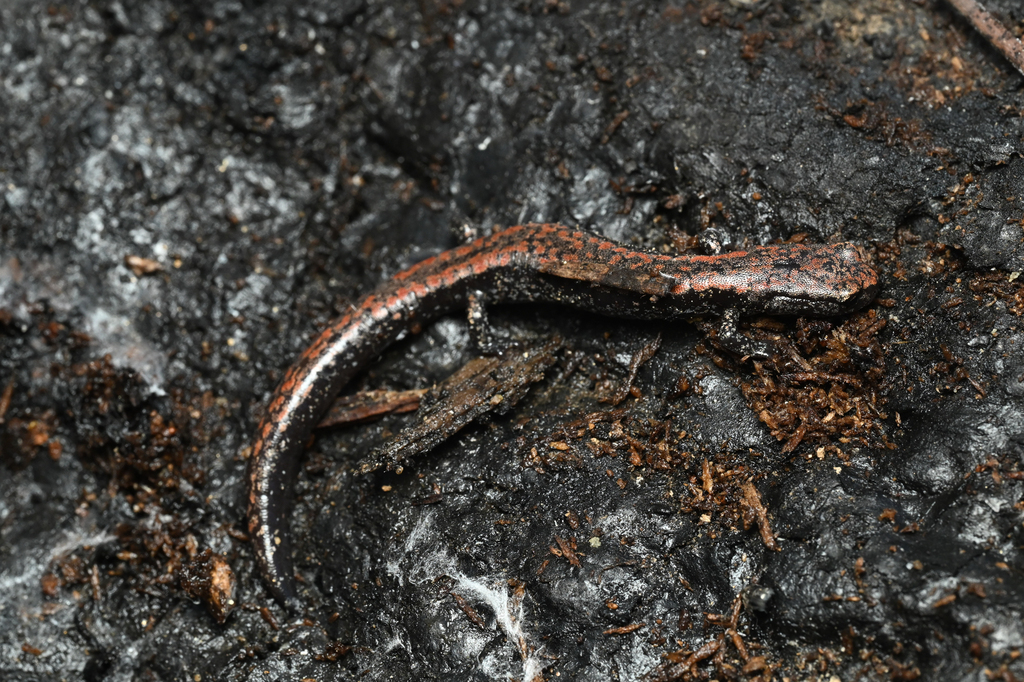
(c) Trevor Van Loon, some rights reserved (CC BY) · licence
Family: Plethodontidae · Class: Amphibia · Order: Caudata
Conservation status: G3 S3
Batrachoseps robustus (Kern Plateau Slender Salamander) is a California animal in the Plethodontidae family.
The Kern Plateau Slender Salamander (Batrachoseps robustus) is a terrestrial lungless salamander endemic to the southern Sierra Nevada of California. Adults typically measure 38 to 54 mm (1.5 to 2.1 inches) in snout-vent length, with a total length including tail of 75 to 110 mm (3.0 to 4.3 inches). The species exhibits a slender, elongated body form characteristic of the genus Batrachoseps, with relatively short legs and a long, cylindrical tail that comprises approximately half the total body length. Coloration is generally dark brown to blackish dorsally with lighter bronze or reddish-brown tones, and the ventral surface is typically gray to black. The species possesses 16 to 17 costal grooves and lacks lungs, breathing instead through the skin and mouth cavity. The Kern Plateau Slender Salamander occupies a restricted range in the southern Sierra Nevada of Kern and Tulare counties, California. The species is found primarily on the Kern Plateau and adjacent areas, with elevations ranging from approximately 1,500 to 2,800 meters (4,920 to 9,186 feet). This endemic distribution makes it one of the more geographically restricted salamander species in California, with populations documented in areas around the Kern River drainage and associated mountain slopes. Habitat requirements include mixed coniferous forests dominated by ponderosa pine, white fir, incense cedar, and black oak at middle elevations, transitioning to red fir and lodgepole pine at higher elevations. The species requires moist microhabitats and is typically found under logs, rocks, bark, and leaf litter where humidity levels remain stable. Rocky talus slopes, streamside environments, and areas with deep organic soil layers provide essential refugia during dry periods. The salamander shows strong association with decaying woody debris and areas where surface moisture is retained. Kern Plateau Slender Salamanders are nocturnal and primarily active during cooler, humid conditions from fall through spring. The species exhibits direct development, with females depositing eggs in moist terrestrial locations rather than aquatic environments. Clutch sizes typically range from 4 to 12 eggs, which are brooded by females in underground chambers or within rotting logs. Development is entirely terrestrial, with young hatching as miniature adults without an aquatic larval stage. The species feeds on small invertebrates including springtails, mites, beetles, and other arthropods found in leaf litter and soil environments. The Kern Plateau Slender Salamander is ranked G3 S3, indicating the species is vulnerable both globally and within California due to its restricted range and habitat requirements. Primary conservation concerns include habitat loss from logging operations, fire management practices, and climate change effects that may alter moisture regimes essential for the species' survival. The salamander's dependence on specific forest microhabitats and limited dispersal ability make populations particularly susceptible to habitat fragmentation. Forest management practices that maintain woody debris, canopy cover, and soil moisture are critical for species persistence.
Classification
Class: Amphibia · Order: Caudata · Family: Plethodontidae
Conservation status
G3 S3
Frequently asked questions
How is Batrachoseps robustus classified?
Batrachoseps robustus belongs to class Amphibia, order Caudata, family Plethodontidae.
What family does Batrachoseps robustus belong to?
Batrachoseps robustus is in the Plethodontidae family.
Is Batrachoseps robustus protected or of conservation concern?
Batrachoseps robustus carries the following status: G3 S3.
What is Batrachoseps robustus?
The Kern Plateau Slender Salamander (Batrachoseps robustus) is a terrestrial lungless salamander endemic to the southern Sierra Nevada of California.
Is Batrachoseps robustus found in California?
Yes. Batrachoseps robustus is recorded in California in The California Species Project's catalogue.
Related species
Other California species in the same genus, family, or bioregion.
Data from The California Species Project — 14,000+ California species with verified data from CNPS, CDFW, USFWS, and more.