Batrachoseps stebbinsi
Tehachapi slender salamander
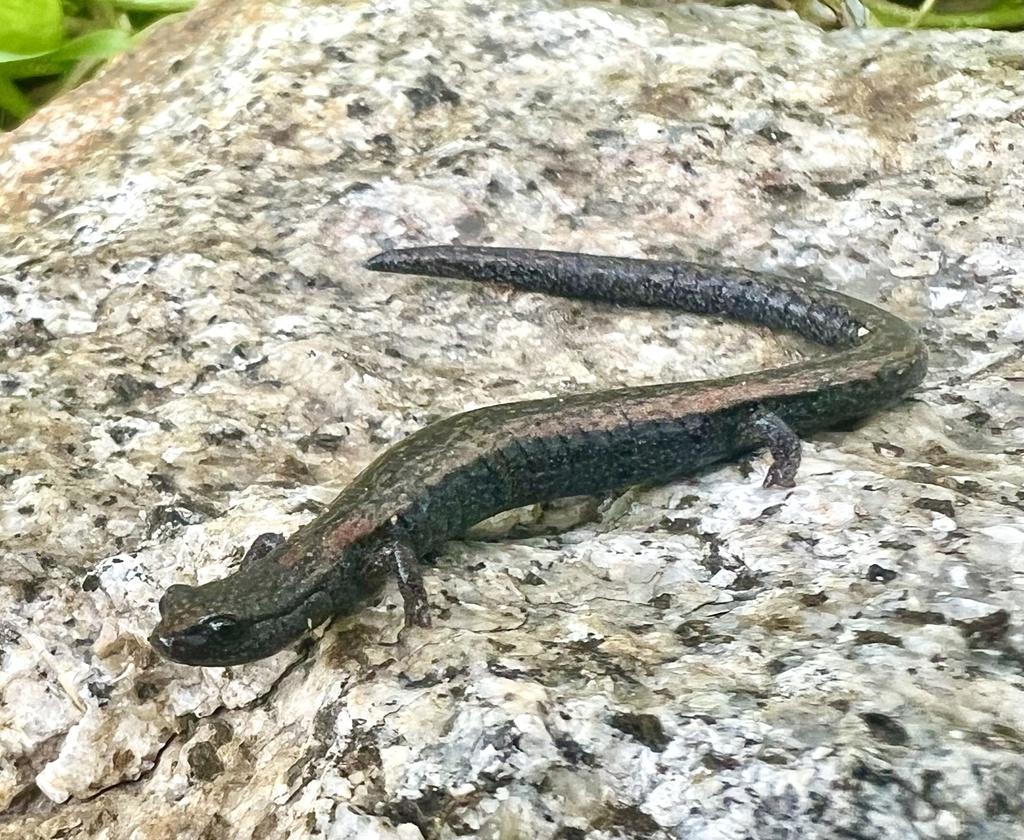
(c) nmoorhatch, some rights reserved (CC BY) · licence
Family: Plethodontidae · Class: Amphibia · Order: Caudata
Conservation status: ST · G2G3 S2
Batrachoseps stebbinsi (Tehachapi slender salamander) is a California animal in the Plethodontidae family.
The Tehachapi slender salamander (Batrachoseps stebbinsi) is a small, terrestrial plethodontid salamander endemic to the Tehachapi Mountains of southern California. Adults typically measure 35 to 50 mm (1.4 to 2.0 inches) in snout-to-vent length, with a total length including tail of 75 to 95 mm (3.0 to 3.7 inches). The species exhibits the characteristic slender body form of the genus Batrachoseps, with relatively short legs and a long, cylindrical tail. Dorsal coloration ranges from dark brown to black with a bronze or reddish-brown dorsal stripe extending from the head to the tail tip. The ventral surface is typically dark gray to black with fine white speckling. The species is restricted to the Tehachapi Mountains in Kern County, California, occurring at elevations between 1,200 and 2,100 meters (3,900 to 6,900 feet). The distribution encompasses portions of the Tehachapi Mountains including areas near Tehachapi Pass and the Brite Valley region. This limited range represents one of the most restricted distributions among California's slender salamanders, covering an area of approximately 300 square kilometers. Tehachapi slender salamanders inhabit oak woodlands, pine forests, and chaparral communities within their montane range. The species is typically found under logs, rocks, bark, and leaf litter in areas with adequate moisture retention. Preferred microhabitats include talus slopes, rock crevices, and areas beneath fallen timber in mixed coniferous forests dominated by ponderosa pine (Pinus ponderosa) and oak species (Quercus spp.). The species requires consistent moisture availability and is most active during periods of high relative humidity. Like other plethodontids, Tehachapi slender salamanders are lungless, respiring through their skin and oral cavity. The species is nocturnal and exhibits limited surface activity, spending most time in subsurface retreats. Reproduction is terrestrial, with females depositing small clutches of eggs in underground chambers or beneath objects in moist soil. Development is direct, with no aquatic larval stage. Juveniles emerge as miniature adults after approximately 60 to 90 days of embryonic development. The species feeds on small arthropods including springtails, mites, and small beetles found within the leaf litter and soil layers. The California Department of Fish and Wildlife listed the Tehachapi slender salamander as threatened in 1994 due to its extremely limited range and vulnerability to habitat modification. The species' Global/State Rank of G2G3 S2 indicates populations are imperiled to vulnerable globally and imperiled within California. Primary threats include habitat loss from urban development, mining activities, and altered fire regimes. The species' restricted distribution makes populations particularly vulnerable to localized disturbances. Climate change poses additional concerns through potential shifts in precipitation patterns and increased temperatures that could affect the moisture-dependent habitat requirements essential for salamander survival. Conservation efforts focus on habitat protection within the limited range and monitoring of known populations to assess long-term viability.
Classification
Class: Amphibia · Order: Caudata · Family: Plethodontidae
Conservation status
ST · G2G3 S2
Frequently asked questions
How is Batrachoseps stebbinsi classified?
Batrachoseps stebbinsi belongs to class Amphibia, order Caudata, family Plethodontidae.
What family does Batrachoseps stebbinsi belong to?
Batrachoseps stebbinsi is in the Plethodontidae family.
Is Batrachoseps stebbinsi protected or of conservation concern?
Batrachoseps stebbinsi carries the following status: ST · G2G3 S2.
What is Batrachoseps stebbinsi?
The Tehachapi slender salamander (Batrachoseps stebbinsi) is a small, terrestrial plethodontid salamander endemic to the Tehachapi Mountains of southern California.
Is Batrachoseps stebbinsi found in California?
Yes. Batrachoseps stebbinsi is recorded in California in The California Species Project's catalogue.
Related species
Other California species in the same genus, family, or bioregion.
Data from The California Species Project — 14,000+ California species with verified data from CNPS, CDFW, USFWS, and more.