Batrachoseps wakei
Arguello Slender Salamander
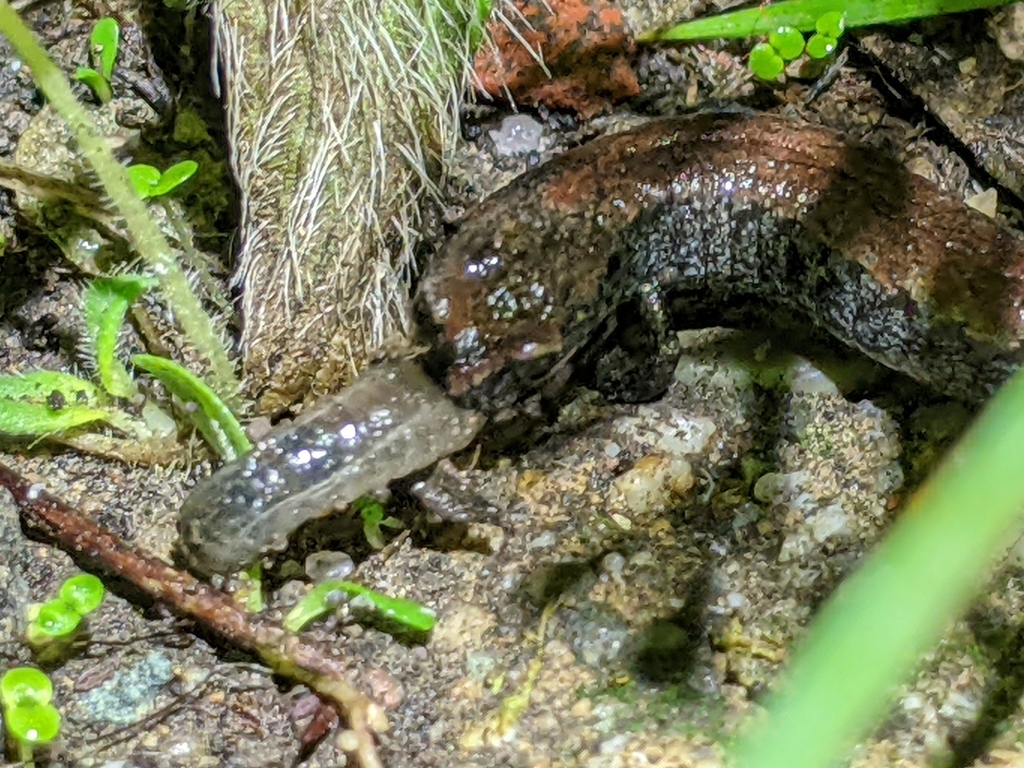
(c) Ken-ichi Ueda, some rights reserved (CC BY) · licence
Family: Plethodontidae · Class: Amphibia · Order: Caudata
Conservation status: G1 S1
Batrachoseps wakei (Arguello Slender Salamander) is a California animal in the Plethodontidae family.
The Arguello slender salamander is a small, terrestrial salamander endemic to a tiny coastal strip in Santa Barbara County, California. Adults typically measure 3.7 to 5.8 cm (1.5 to 2.3 inches) in snout-vent length, with a total length including tail reaching approximately 8.9 to 10.4 cm (3.5 to 4.1 inches). The species exhibits the characteristic elongated body form of slender salamanders, with relatively short limbs and a long, slender tail. Coloration consists of a dark brown to blackish dorsal surface with lighter brown or tan sides, and the ventral surface is typically lighter gray or brownish. The Arguello slender salamander has one of the most restricted ranges of any salamander species globally. It occurs only along a narrow coastal marine terrace at Point Arguello, Santa Barbara County, in a zone no more than 400 meters wide and 4 kilometers long (Sweet and Jockusch 2021). The total area of occupancy comprises approximately 130 hectares (1.3 square kilometers). The range extends from the south rim of Honda Canyon to an old railroad siding north of Rocky Point, with the species documented at four specific sites within this zone. This salamander inhabits coastal marine terrace environments at elevations ranging from 20 to 60 meters above sea level. The habitat consists of coastal sage scrub vegetation adjacent to sea cliffs along the Pacific Ocean. Individuals seek shelter under rocks, logs, and other surface cover objects within this coastal scrub ecosystem. The proximity to the ocean creates a moderately mesic microclimate that supports the salamander's moisture requirements. Like other members of the genus Batrachoseps, the Arguello slender salamander is presumed to be primarily active during nighttime hours and during periods of favorable moisture conditions. The species likely feeds on small invertebrates including insects, spiders, snails, and sowbugs, consistent with the diet documented for related slender salamander species. Reproduction is expected to follow the general pattern of the genus, with females depositing eggs during fall and winter months, though specific breeding biology for this recently described species has not been thoroughly documented. The Arguello slender salamander was scientifically described in 2021 and currently holds a NatureServe global conservation rank of G1, indicating it is critically imperiled (Sweet and Jockusch 2021). The species faces significant conservation challenges due to its extremely limited range and small population size. The coastal location makes the habitat vulnerable to sea level rise and coastal erosion associated with climate change. The area also experiences human activities including railroad operations and potential development pressures. As of December 2025, the species has not received federal protection under the Endangered Species Act, despite its precarious status. Phylogenetic analyses indicate the species is most closely related to Batrachoseps pacificus and B. major, representing a relict population that likely became isolated during past climate fluctuations.
Classification
Class: Amphibia · Order: Caudata · Family: Plethodontidae
Conservation status
G1 S1
Frequently asked questions
How is Batrachoseps wakei classified?
Batrachoseps wakei belongs to class Amphibia, order Caudata, family Plethodontidae.
What family does Batrachoseps wakei belong to?
Batrachoseps wakei is in the Plethodontidae family.
Is Batrachoseps wakei protected or of conservation concern?
Batrachoseps wakei carries the following status: G1 S1.
What is Batrachoseps wakei?
The Arguello slender salamander is a small, terrestrial salamander endemic to a tiny coastal strip in Santa Barbara County, California.
Is Batrachoseps wakei found in California?
Yes. Batrachoseps wakei is recorded in California in The California Species Project's catalogue.
Related species
Other California species in the same genus, family, or bioregion.
Data from The California Species Project — 14,000+ California species with verified data from CNPS, CDFW, USFWS, and more.