Battus philenor
Pipevine Swallowtail
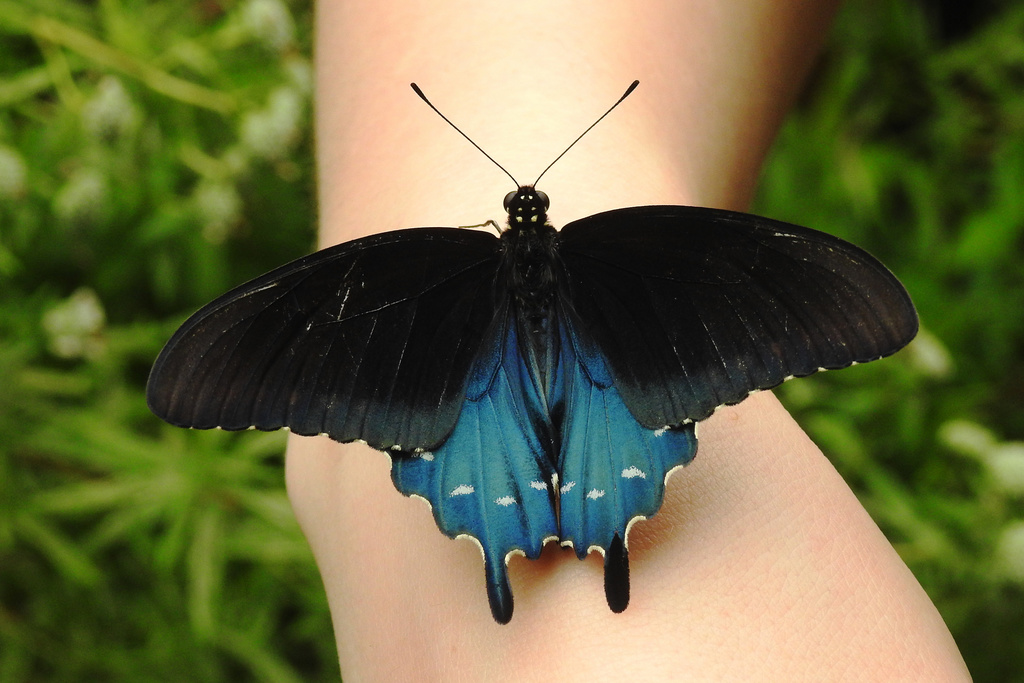
(c) Navin Sasikumar, some rights reserved (CC BY) · licence
Family: Papilionidae · Class: Insecta · Order: Lepidoptera
Battus philenor (Pipevine Swallowtail) is a California animal in the Papilionidae family.
The Pipevine Swallowtail is a large butterfly with a wingspan of 7.0 to 13.0 cm (2.8 to 5.1 inches). Males display iridescent blue-green hindwings with metallic scaling that shifts between blue and green depending on the angle of light. Females are darker, with reduced iridescence and more prominent white spotting along the wing margins. The forewings are black with small white spots near the tips. The hindwings feature distinctive orange spots on the underside, with blue iridescence restricted to males. Both sexes have red-orange bodies with black markings. The species lacks the pronounced tail extensions characteristic of many other swallowtails. Battus philenor ranges from southern Canada through the United States to southern Mexico. The species occurs as a rare stray to southern Manitoba, Canada, while its primary distribution extends through tropical lowlands south to southern Mexico. In California, populations are scattered and localized, primarily occurring in areas where native pipevine plants persist. The species shows seasonal movement patterns, with northern populations migrating southward for winter. The Pipevine Swallowtail inhabits diverse environments from sea level to approximately 1,500 meters (4,900 feet) elevation. Adults frequent open woodlands, riparian corridors, chaparral, oak woodlands, and disturbed areas where host plants occur. The species requires proximity to pipevines (Aristolochia species) for reproduction. In California, the butterfly depends on California pipevine (Aristolochia californica), while eastern populations utilize Virginia snakeroot (A. serpentaria) and other Aristolochia species. Adults are often observed in gardens and parks where pipevines are cultivated. Adults are active from February through October in California, with peak flight periods in spring and fall. Males establish territories near host plants and engage in patrolling behavior to locate females. Females lay spherical, cream-colored eggs singly on young pipevine leaves and stems. Larvae are gregarious in early instars, becoming solitary as they mature. The caterpillars are dark red to black with prominent orange tubercles and feed exclusively on Aristolochia foliage, which contains aristolochic acids that make both larvae and adults toxic to predators. This toxicity is advertised through aposematic coloration. The species completes two to three generations annually in warmer climates, overwintering as pupae in cooler regions. The Pipevine Swallowtail is not federally or state-listed, but faces population pressures from habitat loss and the decline of native pipevine plants. Urban development, agricultural conversion, and invasive plant species have reduced suitable habitat in many areas. The species benefits from conservation of riparian corridors and native plant restoration projects that include Aristolochia species. Climate change may affect the synchronization between butterfly emergence and host plant availability, particularly at range margins where populations are already marginal.
Classification
Class: Insecta · Order: Lepidoptera · Family: Papilionidae
Frequently asked questions
How is Battus philenor classified?
Battus philenor belongs to class Insecta, order Lepidoptera, family Papilionidae.
What family does Battus philenor belong to?
Battus philenor is in the Papilionidae family.
What is Battus philenor?
The Pipevine Swallowtail is a large butterfly with a wingspan of 7.0 to 13.0 cm (2.8 to 5.1 inches).
Is Battus philenor found in California?
Yes. Battus philenor is recorded in California in The California Species Project's catalogue.
Related species
Other California species in the same genus, family, or bioregion.
Data from The California Species Project — 14,000+ California species with verified data from CNPS, CDFW, USFWS, and more.