Battus polydamas
Polydamas Swallowtail
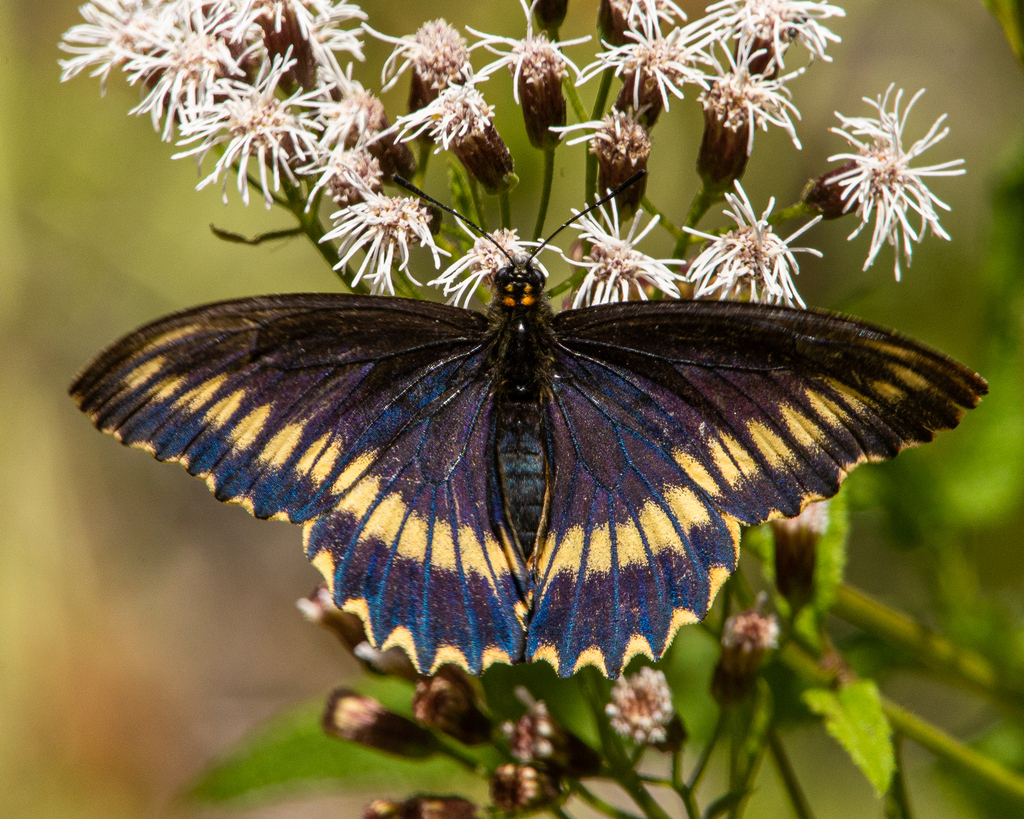
(c) Nicolás Villaseca Merino, some rights reserved (CC BY-SA) · licence
Family: Papilionidae · Class: Insecta · Order: Lepidoptera
Battus polydamas (Polydamas Swallowtail) is a California animal in the Papilionidae family.
The Polydamas Swallowtail is a medium-sized butterfly with distinctive black wings marked by metallic golden-green spots and patches. Adults measure 75 to 95 mm (3.0 to 3.7 inches) in wingspan. The forewings are predominantly black with a series of metallic spots arranged in rows across the wing surface. The hindwings lack the prominent tails characteristic of many swallowtails, instead featuring scalloped edges with metallic green scaling and red spots along the margins. Males and females are similar in appearance, though females are typically slightly larger with more rounded forewings. The species ranges from South Texas and peninsular Florida south to Argentina, representing one of the most widespread swallowtail distributions in the Americas. Strays occasionally appear north to Kentucky and Missouri, likely carried by favorable wind patterns during migration periods. In California, the species is not established as a breeding population, though rare vagrant individuals have been documented, particularly in southern counties during late summer and fall months. Polydamas Swallowtails inhabit tropical and subtropical regions, favoring disturbed areas, forest edges, gardens, and agricultural landscapes where host plants are present. The species occurs from sea level to approximately 1,500 meters elevation in mountainous regions. Adults are commonly observed in open areas with abundant nectar sources, including parks, roadsides, and cultivated gardens. This species is multivoltine in tropical regions, producing multiple generations annually with continuous breeding activity. In subtropical areas like South Texas and Florida, three to four generations occur per year from March through November. Adults are strong fliers and engage in hilltopping behavior, where males patrol elevated areas to locate mates. Females deposit spherical, cream-colored eggs singly on young leaves and shoots of pipevines (Aristolochia species). Larvae are dark brown to black with rows of orange tubercles and feed exclusively on Aristolochia foliage. The caterpillars sequester aristolochic acids from their host plants, making both larvae and adults distasteful to predators. Pupation occurs in a brown chrysalis attached to the host plant or nearby vegetation. Adults nectar on various flowers including lantana, pentas, ixora, and native wildflowers. The Polydamas Swallowtail is not federally or state listed and maintains stable populations throughout most of its range. The species benefits from its broad distribution and ability to utilize various Aristolochia species as hosts. However, localized populations may face pressure from habitat loss and urban development, particularly in areas where native pipevine populations are declining. In border regions of its North American range, populations fluctuate with climatic conditions, with warmer periods allowing temporary range expansions. The species serves as an important pollinator and represents a classic example of Müllerian mimicry, sharing warning coloration patterns with other unpalatable butterflies in its range.
Classification
Class: Insecta · Order: Lepidoptera · Family: Papilionidae
Frequently asked questions
How is Battus polydamas classified?
Battus polydamas belongs to class Insecta, order Lepidoptera, family Papilionidae.
What family does Battus polydamas belong to?
Battus polydamas is in the Papilionidae family.
What is Battus polydamas?
The Polydamas Swallowtail is a medium-sized butterfly with distinctive black wings marked by metallic golden-green spots and patches.
Is Battus polydamas found in California?
Yes. Battus polydamas is recorded in California in The California Species Project's catalogue.
Related species
Other California species in the same genus, family, or bioregion.
Data from The California Species Project — 14,000+ California species with verified data from CNPS, CDFW, USFWS, and more.