Bembix americana
American Sand Wasp
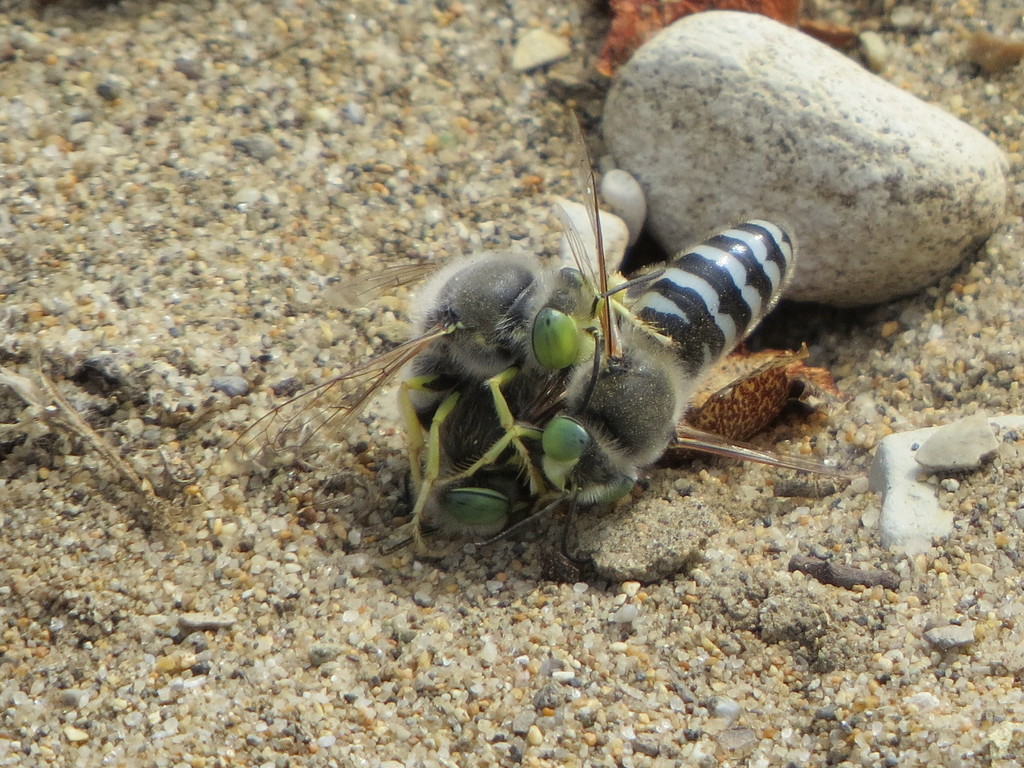
(c) Garth Harwood, some rights reserved (CC BY) · licence
Family: Bembicidae · Class: Insecta · Order: Hymenoptera
Bembix americana (American Sand Wasp) is a California animal in the Bembicidae family.
The American Sand Wasp is a solitary wasp in the family Bembicidae that exhibits typical sand wasp characteristics. Adults are medium-sized wasps with black and yellow coloration patterns, though specific morphological details vary among subspecies. The species displays the robust build characteristic of the genus Bembix, with females typically larger than males. Bembix americana occurs across much of North America, with several recognized subspecies distributed from coast to coast. The subspecies B. a. comata has been documented in California, specifically in coastal areas including the Ballona region where a nest site of approximately 300 individuals was recorded in pickleweed habitat (Schreiber 1981). The species' range extends from southern Canada through the United States, with different subspecies adapted to various regional conditions. In Arkansas, the subspecies B. a. hamata is listed as a Species of Greatest Conservation Need, indicating potential conservation concerns in some portions of its range. American Sand Wasps inhabit sandy areas where they can excavate burrows for nesting. In California, they have been documented in coastal scrubland and pickleweed marshes. The species requires loose, well-drained sandy soils suitable for digging nest burrows. These wasps prefer open areas with sparse vegetation where they can effectively hunt for prey and establish nesting colonies. The Ballona region population was found in the northeastern corner of pickleweed habitat, suggesting tolerance for saline-influenced coastal environments. As solitary wasps, females excavate individual nest burrows in sandy substrate. The species exhibits typical sand wasp behavior, with females provisioning their nests with paralyzed prey to feed developing larvae. American Sand Wasps are important predators of flies, helping control dipteran populations in their habitats (Schreiber 1981). Adults are active during warm months, with peak activity typically occurring in summer. Males establish territories and engage in mate-seeking behavior, while females focus on nest construction and provisioning activities. The conservation status of Bembix americana varies by region and subspecies. While the species appears stable across much of its range, some subspecies face localized concerns. The Arkansas subspecies B. a. hamata is designated as a Species of Greatest Conservation Need due to insufficient population data or potential decline indicators. Habitat loss through coastal development and sand extraction operations may threaten populations in developed areas. The Ballona region population demonstrates the species' importance in coastal ecosystems as both predator and component of native insect communities. Climate change effects on sandy coastal habitats could impact future distribution patterns, particularly for populations in specialized coastal environments like those documented in California's pickleweed marshes.
Classification
Class: Insecta · Order: Hymenoptera · Family: Bembicidae
Frequently asked questions
How is Bembix americana classified?
Bembix americana belongs to class Insecta, order Hymenoptera, family Bembicidae.
What family does Bembix americana belong to?
Bembix americana is in the Bembicidae family.
What is Bembix americana?
The American Sand Wasp is a solitary wasp in the family Bembicidae that exhibits typical sand wasp characteristics.
Is Bembix americana found in California?
Yes. Bembix americana is recorded in California in The California Species Project's catalogue.
More California species
This species has no close relatives in our California data — here are other species to explore.
Data from The California Species Project — 14,000+ California species with verified data from CNPS, CDFW, USFWS, and more.