Berardius bairdii
North Pacific Bottle-nosed Whale
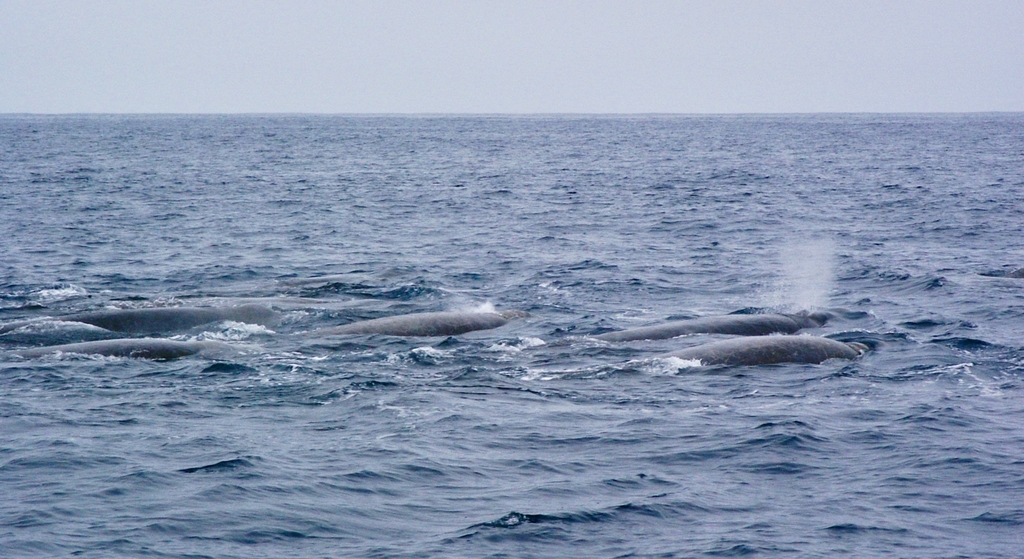
(c) Wendy St. John, some rights reserved (CC BY-SA) · licence
Family: Ziphiidae · Class: Mammalia · Order: Artiodactyla
Berardius bairdii (North Pacific Bottle-nosed Whale) is a California animal in the Ziphiidae family.
Baird's beaked whale (Berardius bairdii) is the largest member of the beaked whale family and the second-largest toothed whale species. Adults reach lengths of 10-13 meters (33-43 feet) and can weigh up to 15 metric tons (NOAA Fisheries). The species exhibits pronounced sexual dimorphism, with males significantly larger than females. The body is robust and spindle-shaped, with a small, bulbous melon and an elongated beak. Coloration ranges from dark gray to brownish-black dorsally, with lighter gray ventral surfaces. Males are distinguished by two pairs of prominent teeth protruding from the lower jaw, which become more pronounced with age and are used in intraspecific combat, resulting in extensive linear scarring across the head and body. Baird's beaked whale inhabits the temperate and subarctic waters of the North Pacific Ocean and adjacent seas, including the Bering Sea, Sea of Okhotsk, Sea of Japan, and extending south to the Sea of Cortez (NOAA Fisheries). The species occurs in California waters primarily off the continental shelf and slope, typically in waters deeper than 1,000 meters. Their distribution extends from the Aleutian Islands south to Baja California, with seasonal movements following prey availability and reproductive cycles. The species demonstrates a strong preference for deep pelagic and benthic habitats, particularly areas with steep underwater topography such as submarine canyons and seamounts. They are capable of diving to extreme depths, with recorded dives exceeding 1,400 meters and lasting up to 67 minutes (Animal Diversity Web), making them among the deepest-diving mammals. These diving capabilities allow access to deep-water prey communities unavailable to most other marine mammals. Baird's beaked whales are primarily teuthophagous and piscivorous, feeding mainly on deep-water and bottom-dwelling squid, fish, and crustaceans (SeaLifeBase). Their diet includes various cephalopod species, deep-sea fish, and benthic invertebrates. The species exhibits complex social behavior, traveling in stable groups of 6-30 individuals led by a dominant male (Animal Diversity Web). These social groups demonstrate strong site fidelity and coordinated diving patterns. Reproductive behavior includes a gestation period of approximately 17 months, among the longest of any cetacean, with calves born at approximately 4.5 meters in length (Animal Diversity Web). Currently, Baird's beaked whale does not hold federal endangered species status in United States waters. The species is classified as "Not at Risk" in Canadian waters as of 2017, with no significant threats identified (NatureServe). However, the species faces potential threats from anthropogenic noise pollution, particularly naval sonar operations, which can disrupt their echolocation-dependent foraging behavior. Deep-sea fishing operations and marine debris also pose risks to this deep-diving species. Climate change may affect prey distribution and availability in their preferred deep-water habitats, though specific population impacts remain largely unstudied due to the species' remote oceanic habitat and cryptic behavior.
Classification
Class: Mammalia · Order: Artiodactyla · Family: Ziphiidae
Frequently asked questions
How is Berardius bairdii classified?
Berardius bairdii belongs to class Mammalia, order Artiodactyla, family Ziphiidae.
What family does Berardius bairdii belong to?
Berardius bairdii is in the Ziphiidae family.
What is Berardius bairdii?
Baird's beaked whale (Berardius bairdii) is the largest member of the beaked whale family and the second-largest toothed whale species.
Is Berardius bairdii found in California?
Yes. Berardius bairdii is recorded in California in The California Species Project's catalogue.
More California species
This species has no close relatives in our California data — here are other species to explore.
Data from The California Species Project — 14,000+ California species with verified data from CNPS, CDFW, USFWS, and more.