Blatta orientalis
Oriental Cockroach
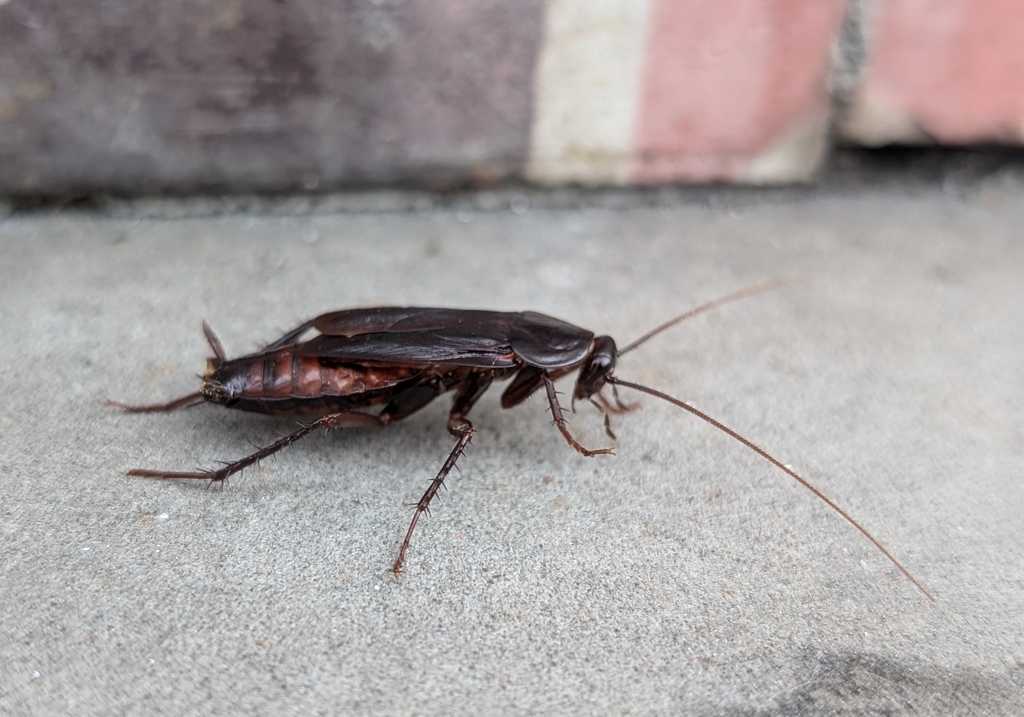
(c) Victor Heng, some rights reserved (CC BY) · licence
Family: Blattidae · Class: Insecta · Order: Blattodea
Blatta orientalis (Oriental Cockroach) is a California animal in the Blattidae family.
The Oriental cockroach (Blatta orientalis) is a large introduced cockroach species that has become widely established across North America, including California. Adult males measure 18-29 mm (0.71-1.14 inches) in length, while females are slightly smaller at 20-27 mm (0.79-1.06 inches). The species is dark brown to black in coloration with a glossy exoskeleton. Sexual dimorphism is pronounced: males possess functional wings extending to the middle of their abdomen, while females appear nearly wingless, having only short, non-functional wing stubs (brachypterous condition) just below the head. Females have noticeably broader, more robust bodies than males. The Oriental cockroach is not native to North America, having been introduced from Asia and subsequently establishing populations throughout the continent. In California, the species has been documented in multiple counties and appears to be well-established in urban and suburban environments. The species has spread widely across temperate regions of North America since its introduction. This cockroach inhabits both indoor and outdoor environments, demonstrating considerable habitat flexibility. Outdoors, Oriental cockroaches are commonly found in sewers, drains, trash receptacles, compost piles, and leaf litter during warm weather (Animal Diversity Web). They prefer moist, cool locations and are often associated with basements, crawl spaces, and other damp areas in buildings. The species shows a strong preference for areas with high humidity and organic debris. Unlike some cockroach species that prefer warmer environments, Oriental cockroaches are more cold-tolerant and remain active at lower temperatures. Oriental cockroaches are omnivorous scavengers that feed on a wide variety of organic matter, including decaying plant material, food scraps, and various organic debris. They exhibit notable foraging behavior, with individuals observed grabbing food items and moving rapidly with them (BugGuide). The species is primarily nocturnal, becoming active after dark to search for food and mates. Reproduction involves egg cases (oothecae) that females deposit in protected locations. Development follows typical cockroach patterns with multiple nymphal stages before reaching sexual maturity. As a non-native species, the Oriental cockroach is not protected under conservation legislation and is generally considered a pest species in urban environments. The species has no special conservation status and populations appear stable throughout its introduced range. Management efforts typically focus on control rather than conservation, as the species can become a nuisance in residential and commercial settings. The Oriental cockroach's successful establishment across diverse climatic zones demonstrates its adaptability and ecological plasticity as an introduced species.
Classification
Class: Insecta · Order: Blattodea · Family: Blattidae
Frequently asked questions
How is Blatta orientalis classified?
Blatta orientalis belongs to class Insecta, order Blattodea, family Blattidae.
What family does Blatta orientalis belong to?
Blatta orientalis is in the Blattidae family.
What is Blatta orientalis?
The Oriental cockroach (Blatta orientalis) is a large introduced cockroach species that has become widely established across North America, including California.
Is Blatta orientalis found in California?
Yes. Blatta orientalis is recorded in California in The California Species Project's catalogue.
Related species
Other California species in the same genus, family, or bioregion.
Data from The California Species Project — 14,000+ California species with verified data from CNPS, CDFW, USFWS, and more.