Boloria epithore
Pacific Fritillary
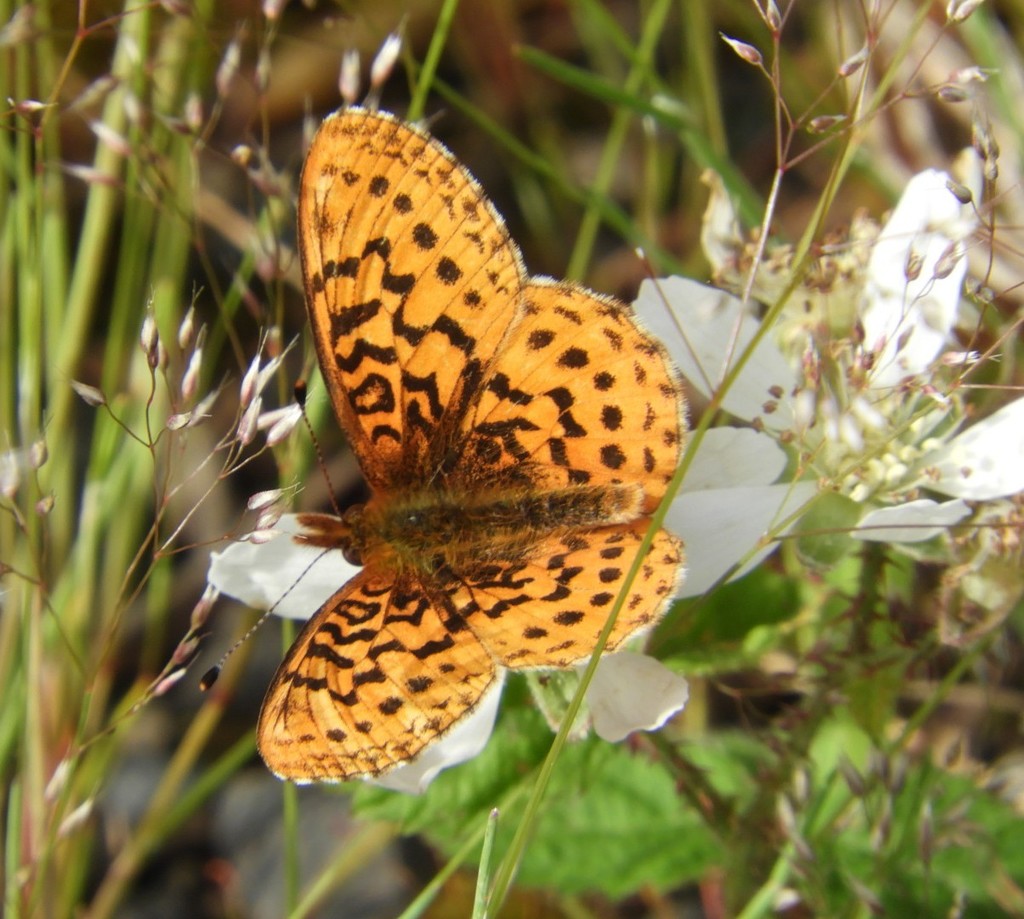
(c) Brodie Cass Talbott, some rights reserved (CC BY) · licence
Family: Nymphalidae · Class: Insecta · Order: Lepidoptera
Boloria epithore (Pacific Fritillary) is a California animal in the Nymphalidae family.
The Pacific Fritillary is a medium-sized butterfly with a wingspan ranging from 42 to 52 mm (1.7 to 2.0 inches). The dorsal wing surfaces display bright orange-brown coloration with black markings including spots, lines, and checkered borders typical of fritillary butterflies. Males tend to be smaller and more brightly colored than females. The ventral hindwings are particularly diagnostic, featuring distinctive silver spots on a mottled brown and tan background that distinguish this species from similar fritillaries. The forewings show a series of black spots and lines across the orange field, with females typically showing more subdued coloration and larger size. The Pacific Fritillary ranges from central British Columbia east and south to Alberta and Montana, extending south along the Pacific Coast to central California. In California, populations occur primarily in the northern counties including Humboldt, Del Norte, Siskiyou, and Shasta counties, with some records extending south into the Sierra Nevada. The species shows a disjunct distribution pattern, with coastal populations separated from inland montane populations. This species inhabits moist forest environments, particularly coniferous and mixed forests with adequate violet populations. Pacific Fritillaries are typically found in forest openings, meadows, clearings, and along forest edges where their host plants thrive. Elevational range extends from near sea level in coastal areas to approximately 2,100 meters (6,900 feet) in montane regions. The species requires areas with sufficient moisture to support violet growth and prefers partially shaded to semi-open conditions. Pacific Fritillaries are specialized feeders whose larvae depend entirely on violets, including Viola ocellata, V. sempervirens, and V. glabella. Adults are active from late spring through early autumn, with peak flight periods typically occurring from June through August depending on elevation and local climate conditions. Females lay eggs singly on or near violet leaves, and larvae feed exclusively on these host plants through multiple instars. The species overwinters as partially grown larvae. Adults nectar on various wildflowers including thistles, asters, and other composite flowers. Males exhibit territorial behavior and engage in patrolling flight patterns to locate females. Currently, the Pacific Fritillary does not appear on federal or state threatened species lists. However, like many forest-dependent butterflies, populations may face pressure from habitat fragmentation, logging activities, and climate change impacts on forest ecosystems. The species' dependence on specific violet species makes it vulnerable to changes in forest understory composition. Forest management practices that maintain adequate violet populations and preserve forest openings are beneficial for population persistence. Monitoring of population trends would be valuable given the species' specialized habitat requirements and potential sensitivity to environmental changes affecting Pacific Coast forest ecosystems.
Classification
Class: Insecta · Order: Lepidoptera · Family: Nymphalidae
Frequently asked questions
How is Boloria epithore classified?
Boloria epithore belongs to class Insecta, order Lepidoptera, family Nymphalidae.
What family does Boloria epithore belong to?
Boloria epithore is in the Nymphalidae family.
What is Boloria epithore?
The Pacific Fritillary is a medium-sized butterfly with a wingspan ranging from 42 to 52 mm (1.7 to 2.0 inches).
Is Boloria epithore found in California?
Yes. Boloria epithore is recorded in California in The California Species Project's catalogue.
Related species
Other California species in the same genus, family, or bioregion.
Data from The California Species Project — 14,000+ California species with verified data from CNPS, CDFW, USFWS, and more.