Bombus californicus
California Bumble Bee
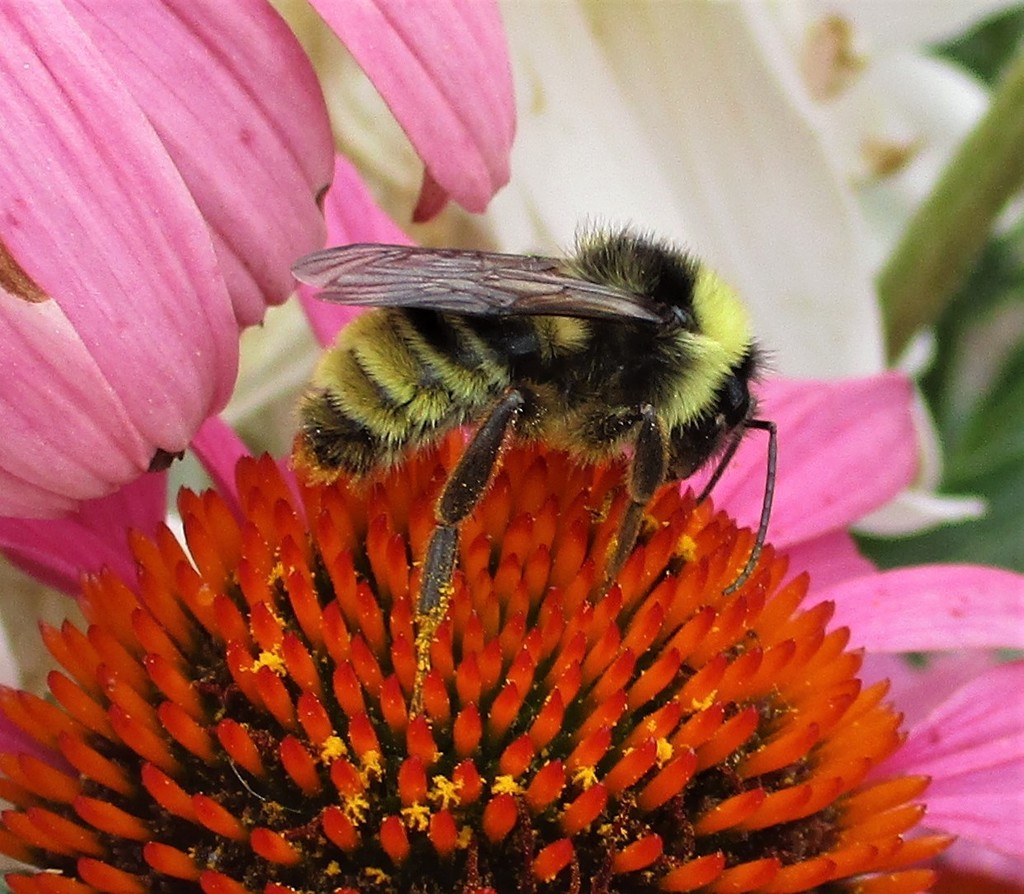
(c) sprcrkwild, some rights reserved (CC BY) · licence
Family: Apidae · Class: Insecta · Order: Hymenoptera
Bombus californicus (California Bumble Bee) is a California animal in the Apidae family.
The California bumble bee is a robust social bee belonging to the subgenus Thoracobombus, which includes only three North American species. Workers measure 10 to 15 mm (0.4 to 0.6 inches) in length, while queens are larger at 15 to 20 mm. The species displays distinctive coloration with a black head, yellow bands on the thorax, and a predominantly black abdomen. Females are distinguished by their black facial hair and black hair on the vertex, contrasting with the yellow vertex hair found in related species like Franklin's bumble bee (Colla et al. 2011). Historically, the California bumble bee was widely distributed throughout California's Central Valley and surrounding regions. The species ranges from southwestern Oregon through California, with documented populations in the Sacramento Valley extending south to the San Joaquin Valley. Elevational records span from near sea level to over 2,340 meters (7,800 feet) in mountainous areas. However, the species has experienced significant range contraction, particularly from lower elevation sites in central California. California bumble bees inhabit diverse environments including grasslands, shrublands, forest edges, and agricultural areas. They prefer areas with abundant floral resources and suitable nesting sites, typically utilizing abandoned rodent burrows for colony establishment. The species demonstrates adaptability to various vegetation types but shows preference for areas with native wildflowers and flowering shrubs. Colonies are typically established in areas with adequate leaf litter and woody debris, which provide important microhabitat features. This species exhibits typical bumble bee social behavior, with annual colony cycles beginning when overwintered queens emerge in spring to establish new nests. Queens initially forage alone, collecting pollen and nectar to provision the first brood of workers. Colony populations peak in mid to late summer before producing reproductive males and new queens. California bumble bees are important pollinators of native plants and serve as primary pollinators for several rare species, including palmate-bracted bird's beak (Chloropyron palmatum) at locations such as Springtown Alkali Sink (USFWS, 1998). Their ability to perform buzz-pollination makes them particularly valuable for certain plant species that require vibrational pollen release. Conservation concerns for the California bumble bee have increased significantly in recent decades. According to IUCN assessments, the species has experienced substantial population declines, with current relative abundance estimated at only 2.32% of historic values and an average decline of 67.51%. The species was historically common throughout the Central Valley of California but now appears to be much less abundant across its range. Primary threats include habitat loss from agricultural intensification and urban development, pesticide exposure, disease transmission from commercial bumble bee operations, and climate change effects on flowering plant phenology. The species currently lacks federal protection but is considered a species of conservation concern by multiple agencies. As of December 2025, continued monitoring and habitat conservation efforts are essential for preventing further population declines.
Classification
Class: Insecta · Order: Hymenoptera · Family: Apidae
Frequently asked questions
How is Bombus californicus classified?
Bombus californicus belongs to class Insecta, order Hymenoptera, family Apidae.
What family does Bombus californicus belong to?
Bombus californicus is in the Apidae family.
What is Bombus californicus?
The California bumble bee is a robust social bee belonging to the subgenus Thoracobombus, which includes only three North American species.
Is Bombus californicus found in California?
Yes. Bombus californicus is recorded in California in The California Species Project's catalogue.
Related species
Other California species in the same genus, family, or bioregion.
Data from The California Species Project — 14,000+ California species with verified data from CNPS, CDFW, USFWS, and more.