Bombus caliginosus
Obscure bumble bee
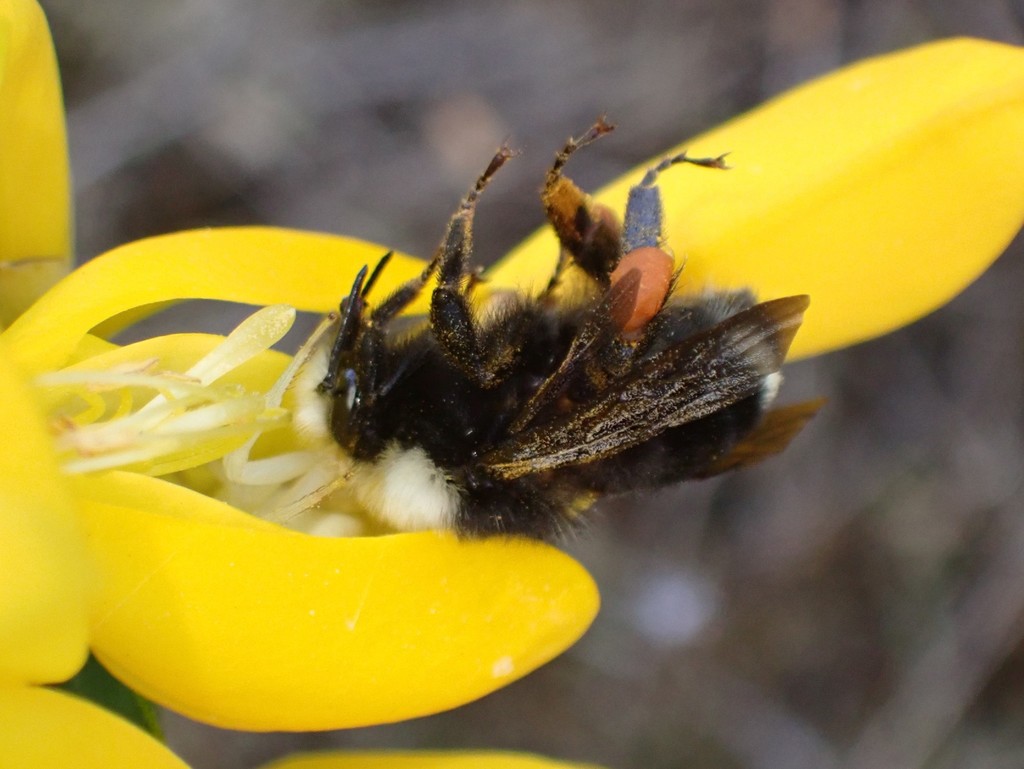
(c) giantcicada, some rights reserved (CC BY) · licence
Family: Apidae · Class: Insecta · Order: Hymenoptera
Conservation status: G2G3 S1S2
Bombus caliginosus (Obscure bumble bee) is a California animal in the Apidae family.
The obscure bumble bee is a medium-sized social bee species endemic to the Pacific Coast of North America. Workers measure approximately 12-15 mm in length, while queens are larger at 16-20 mm. The species displays typical bumble bee morphology with dense, plush hair covering the body. Coloration patterns vary geographically, but generally consist of black hair on the head with yellow and black banding on the thorax and abdomen. The hair is entirely black on the head, distinguishing it from some closely related species. The obscure bumble bee occurs along the Pacific Coast from southern California to southern British Columbia, with scattered records from the east side of California's Central Valley. In California, the species is documented from coastal counties and select inland locations. The range extends northward through Oregon and Washington to British Columbia, representing one of the more geographically restricted bumble bee distributions in western North America. Historical records indicate the species was never particularly abundant compared to other regional bumble bee species. This species inhabits coastal and near-coastal environments, including grasslands, meadows, and open woodland areas. Elevational preferences range from sea level to moderate mountain elevations, typically below 2,000 meters. Like other bumble bees, the obscure bumble bee requires three essential habitat components: diverse floral resources providing nectar and pollen from spring through autumn, undisturbed nesting sites typically in clumps of grass or other vegetation, and suitable overwintering sites for hibernating queens in decaying wood or similar protected locations. The obscure bumble bee follows the typical annual social cycle of temperate bumble bees. New queens emerge from hibernation in spring to establish colonies, initially foraging alone before the first generation of workers emerges. Colonies grow throughout summer, reaching peak size in mid to late summer when reproductive individuals are produced. The species is considered a generalist forager, visiting a variety of native and introduced flowering plants for nectar and pollen resources. Colony founding occurs from spring through early summer, with new queens and males produced in late summer before the annual colony cycle ends. The obscure bumble bee is ranked G2G3 globally and S1S2 in California, indicating it is imperiled to critically imperiled within the state. According to the Pacific Northwest Bumble Bee Atlas, this species accounted for only around 1% of observations, roughly half as common as in historical baseline data (Xerces Society 2021). The International Union for Conservation of Nature has assessed the species as Vulnerable. Primary threats include habitat loss from urban and agricultural development, pesticide exposure, disease transmission from commercial bees, and climate change impacts on floral resource timing and availability. The species faces particular vulnerability due to its restricted coastal range and naturally low abundance compared to other regional bumble bee species.
Classification
Class: Insecta · Order: Hymenoptera · Family: Apidae
Conservation status
G2G3 S1S2
Frequently asked questions
How is Bombus caliginosus classified?
Bombus caliginosus belongs to class Insecta, order Hymenoptera, family Apidae.
What family does Bombus caliginosus belong to?
Bombus caliginosus is in the Apidae family.
Is Bombus caliginosus protected or of conservation concern?
Bombus caliginosus carries the following status: G2G3 S1S2.
What is Bombus caliginosus?
The obscure bumble bee is a medium-sized social bee species endemic to the Pacific Coast of North America.
Is Bombus caliginosus found in California?
Yes. Bombus caliginosus is recorded in California in The California Species Project's catalogue.
Related species
Other California species in the same genus, family, or bioregion.
Data from The California Species Project — 14,000+ California species with verified data from CNPS, CDFW, USFWS, and more.