Bombus crotchii
Crotch's bumble bee
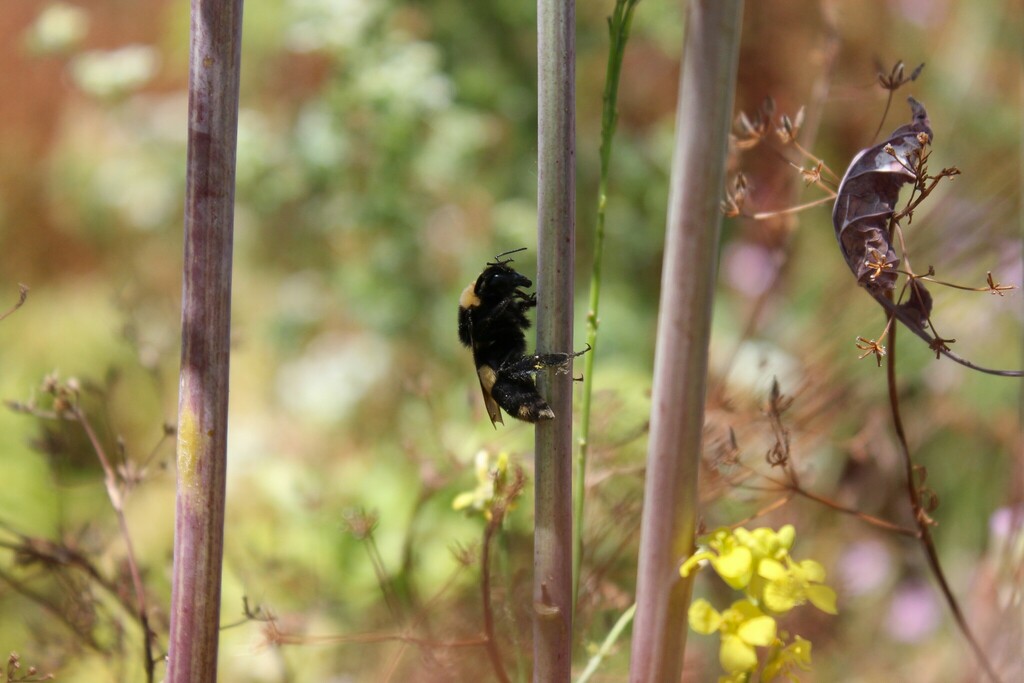
(c) Amelia Tauber, some rights reserved (CC BY) · licence
Family: Apidae · Class: Insecta · Order: Hymenoptera
Conservation status: G2 S2
Bombus crotchii (Crotch's bumble bee) is a California animal in the Apidae family.
Crotch's bumble bee is a large, robust social bee distinguished by its substantial size and deep, resonant buzzing flight. Workers and queens display the characteristic bumble bee body form with dense, branched hairs (plumage) covering the thorax and abdomen. The species exhibits sexual dimorphism typical of bumble bees, with queens significantly larger than workers and males. The species occurs primarily in California, including the Mediterranean region, Pacific Coast, Western Desert, Great Valley, and adjacent foothills through most of southwestern California. It has also been documented in southwest Nevada near the California border, and extends into Baja California and Baja California Sur, Mexico (Williams et al. 2014). Historically, the species was common throughout the Central Valley of California but now appears absent from most of this region, especially the center of its historic range (Hatfield et al. 2014). Crotch's bumble bee inhabits open grassland and scrub habitats across its range (Xerces Society 2018). The species demonstrates the typical bumble bee preference for diverse floral resources, utilizing native plants including manzanita (Arctostaphylos spp.) for early season foraging. Queens emerge as early as February in California, capable of thermoregulation through shivering of flight muscles to maintain body temperature during cool weather foraging. Like other bumble bees, B. crotchii exhibits a eusocial colony structure with distinct castes. Queens overwinter underground as solitary individuals, emerging in spring to establish new colonies. The species demonstrates buzz-pollination behavior, vibrating flight muscles at specific frequencies to release pollen from certain plant species. This capability makes them particularly valuable pollinators for both native wildflowers and agricultural crops. Colonies typically persist from spring through fall, with new reproductive individuals produced late in the season before colony senescence. Crotch's bumble bee is classified as a candidate species under the California Endangered Species Act as of December 2025. The California Department of Fish and Wildlife originally advanced the species to candidacy on June 18, 2019, though this determination faced legal challenges. Following an adverse trial court judgment, candidacy was temporarily stayed beginning February 2021. The Third District Court of Appeal subsequently reversed the trial court judgment, and candidacy was reinstated on September 30, 2022. The species carries global and state conservation ranks of G2 S2, indicating significant conservation concern. Population analyses suggest sharp declines in both relative abundance and persistence over the past decade. Current range size relative to historic distribution measures 74.67%, indicating substantial range contraction (Xerces Society). The species has experienced an estimated average decline of 63.99%, with current relative abundance at only 15.60% of historic values (Xerces Society 2014). Primary threats likely include habitat loss, agricultural intensification, pesticide exposure, and climate change impacts on floral resource availability and timing. The species' decline mirrors broader patterns observed in North American bumble bee populations, with several western species experiencing similar precipitous population reductions.
Classification
Class: Insecta · Order: Hymenoptera · Family: Apidae
Conservation status
G2 S2
Frequently asked questions
How is Bombus crotchii classified?
Bombus crotchii belongs to class Insecta, order Hymenoptera, family Apidae.
What family does Bombus crotchii belong to?
Bombus crotchii is in the Apidae family.
Is Bombus crotchii protected or of conservation concern?
Bombus crotchii carries the following status: G2 S2.
What is Bombus crotchii?
Crotch's bumble bee is a large, robust social bee distinguished by its substantial size and deep, resonant buzzing flight.
Is Bombus crotchii found in California?
Yes. Bombus crotchii is recorded in California in The California Species Project's catalogue.
Related species
Other California species in the same genus, family, or bioregion.
Data from The California Species Project — 14,000+ California species with verified data from CNPS, CDFW, USFWS, and more.