Bombus fervidus
Golden northern bumble bee
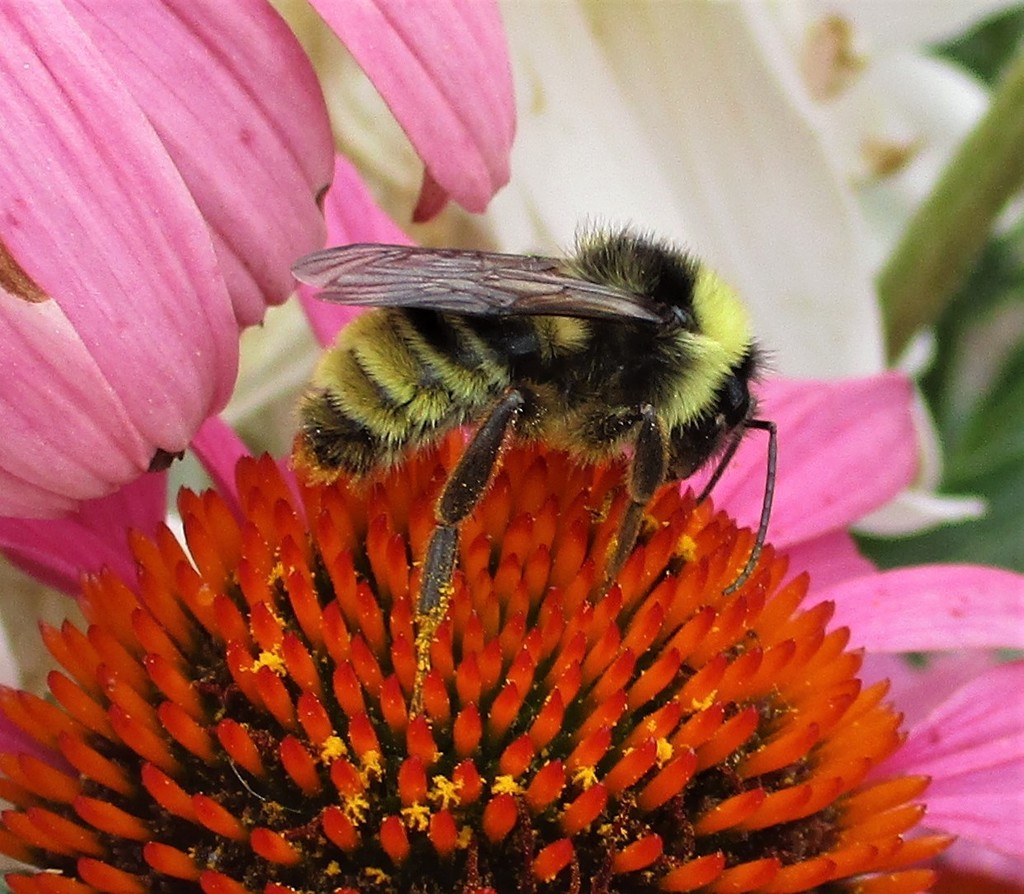
(c) sprcrkwild, some rights reserved (CC BY) · licence
Family: Apidae · Class: Insecta · Order: Hymenoptera
Bombus fervidus (Golden northern bumble bee) is a California animal in the Apidae family.
The golden northern bumble bee (Bombus fervidus) belongs to the subgenus Thoracobombus and is characterized by its distinctive yellow and black coloration pattern. Workers and queens display prominent yellow bands across the thorax with varying amounts of yellow on the abdomen, typically concentrated on the middle segments (T-4). Females possess elongated faces, distinguishing them from related species with rounder facial profiles. The species exhibits the typical bumble bee social structure with queens measuring larger than workers, though specific measurements for this species are not well documented in the literature. Bombus fervidus maintains one of the most extensive distributions among North American bumble bees, with a near cross-continental range. The species occurs from the Canadian Maritimes and eastern United States westward through the Great Plains and southern Canada to the Pacific Coast and Western Desert regions. In the western United States, populations are documented across California, Arizona, Nevada, and Oregon, where the species is formally recognized in conservation planning efforts. This species inhabits diverse ecosystems ranging from subtropical to boreal zones, reflecting its broad climatic tolerance. The golden northern bumble bee occupies various habitat types including grasslands, meadows, agricultural areas, riparian zones, shrub-scrub communities, and woodland edges. Like other members of Thoracobombus, this species typically nests above ground and possesses a relatively long tongue, enabling it to access nectar from deep-flowered plants. The species shows particular associations with plant genera including Cirsium, Castilleja, Trifolium, Vicia, Delphinium, Penstemon, Carduus, Prunella, Agastache, and Thermopsis. Golden northern bumble bees form annual eusocial colonies consisting of a single overwintered queen, female workers, and males produced later in the season. Queens emerge in spring to establish new colonies, with peak activity extending from spring through autumn when continuous blooming resources are required. The species demonstrates considerable foraging range, with bumble bees generally capable of flight distances between 275 and 750 meters from their nest sites. Colony establishment requires substantial habitat areas, with studies suggesting 800 to 2,500 acres of suitable habitat may be necessary to support healthy populations. Conservation assessments indicate mixed regional trends for Bombus fervidus. The species maintains a global conservation status of G3G4 (vulnerable to apparently secure) according to NatureServe, with national and state rankings of N4? and S4? respectively, indicating apparent security but with some uncertainty. The IUCN Red List categorizes the species as Vulnerable based on a 2014 assessment. Recent analyses suggest the species has experienced moderate population declines, with current relative abundance at approximately 50% of historical values and an average decline of 24.11% range-wide. However, unlike some closely related species that have experienced severe declines, B. fervidus retains 88.62% of its current range size relative to historic distribution and maintains 88.98% persistence in current range occupancy. The species faces ongoing threats from habitat loss, fragmentation, and agricultural intensification, though its broad ecological tolerance and extensive range provide some resilience compared to more specialized bumble bee species.
Classification
Class: Insecta · Order: Hymenoptera · Family: Apidae
Frequently asked questions
How is Bombus fervidus classified?
Bombus fervidus belongs to class Insecta, order Hymenoptera, family Apidae.
What family does Bombus fervidus belong to?
Bombus fervidus is in the Apidae family.
What is Bombus fervidus?
The golden northern bumble bee (Bombus fervidus) belongs to the subgenus Thoracobombus and is characterized by its distinctive yellow and black coloration pattern.
Is Bombus fervidus found in California?
Yes. Bombus fervidus is recorded in California in The California Species Project's catalogue.
Related species
Other California species in the same genus, family, or bioregion.
Data from The California Species Project — 14,000+ California species with verified data from CNPS, CDFW, USFWS, and more.