Bombus insularis
Indiscriminate Cuckoo Bumble Bee
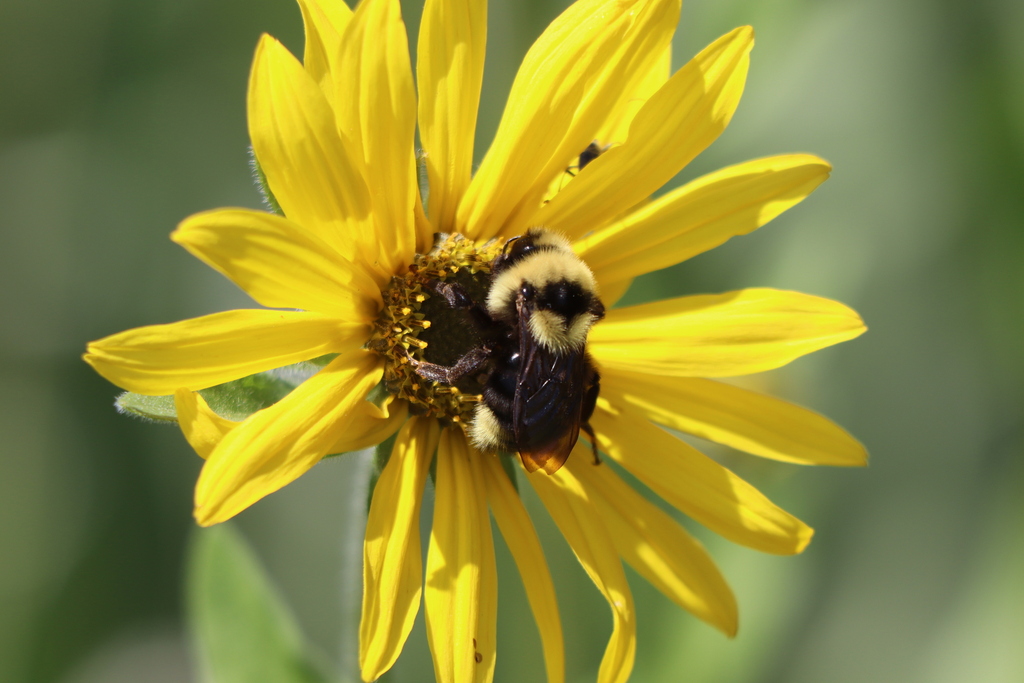
no rights reserved · CC0
Family: Apidae · Class: Insecta · Order: Hymenoptera
Bombus insularis (Indiscriminate Cuckoo Bumble Bee) is a California animal in the Apidae family.
The Indiscriminate Cuckoo Bumble Bee is a parasitic bumble bee species that lacks the worker caste typical of other bumble bees. Females measure 8 to 25 mm in length, while males are generally smaller at 13 to 16 mm. The species exhibits variable coloration patterns, but females can be distinguished by their yellow facial hair and vertex (top of head), contrasting with the black facial hair of similar species like Bombus suckleyi (Xerces Society 2018). Unlike typical bumble bees, females lack corbiculae (pollen baskets) on their hind legs since they do not collect pollen or provision nests. Bombus insularis occurs broadly across northern and montane North America, with populations documented from eastern Canada west to the Pacific Coast. The species extends southward at higher elevations through major mountain ranges including the Appalachians, Rocky Mountains, Cascades, and other montane systems (Pacific Northwest Bumble Bee Atlas 2021). In the western United States, the species has been observed most frequently in the Cascade, Northern Cascade, Northern Rockies, and Idaho Batholith ecoregions. The species also occurs in Eurasia, representing a Holarctic distribution pattern. This species inhabits diverse montane and northern temperate environments, typically associated with higher elevation habitats. In western rangelands, B. insularis occurs in areas supporting diverse floral resources, though specific habitat requirements remain poorly documented due to the species' relatively low abundance and secretive parasitic lifestyle. As a cuckoo bumble bee belonging to the subgenus Psithyrus, B. insularis exhibits obligate nest parasitism behavior. Females do not establish their own colonies but instead usurp nests of other bumble bee species across multiple subgenera, earning the common name "indiscriminate" due to this broad host range (NatureServe 2019). After successfully taking over a host nest, the parasitic female eliminates or suppresses the original queen, and the host workers subsequently tend to the offspring of the replacement queen. Males and new reproductive females emerge later in the season, with activity typically recorded from late spring through early fall. The species currently holds a conservation status of Least Concern according to IUCN assessments (IUCN 2014). Analysis indicates the current range size remains at 89.31% of historic range, with persistence at 88.98% of historic occupancy levels. However, relative abundance has declined to approximately 50% of historic values, representing an average decline of 24.11% range-wide. In the Pacific Northwest Bumble Bee Atlas surveys, B. insularis accounted for approximately 3% of observations, consistent with historical relative abundance patterns in the region. The species faces typical threats affecting bumble bees generally, including habitat loss, pesticide exposure, and climate change impacts on montane ecosystems. Due to its parasitic lifestyle, B. insularis populations are also vulnerable to declines in host species populations, creating indirect conservation dependencies on the health of entire bumble bee communities.
Classification
Class: Insecta · Order: Hymenoptera · Family: Apidae
Frequently asked questions
How is Bombus insularis classified?
Bombus insularis belongs to class Insecta, order Hymenoptera, family Apidae.
What family does Bombus insularis belong to?
Bombus insularis is in the Apidae family.
What is Bombus insularis?
The Indiscriminate Cuckoo Bumble Bee is a parasitic bumble bee species that lacks the worker caste typical of other bumble bees.
Is Bombus insularis found in California?
Yes. Bombus insularis is recorded in California in The California Species Project's catalogue.
Related species
Other California species in the same genus, family, or bioregion.
Data from The California Species Project — 14,000+ California species with verified data from CNPS, CDFW, USFWS, and more.