Bombus morrisoni
Morrison bumble bee
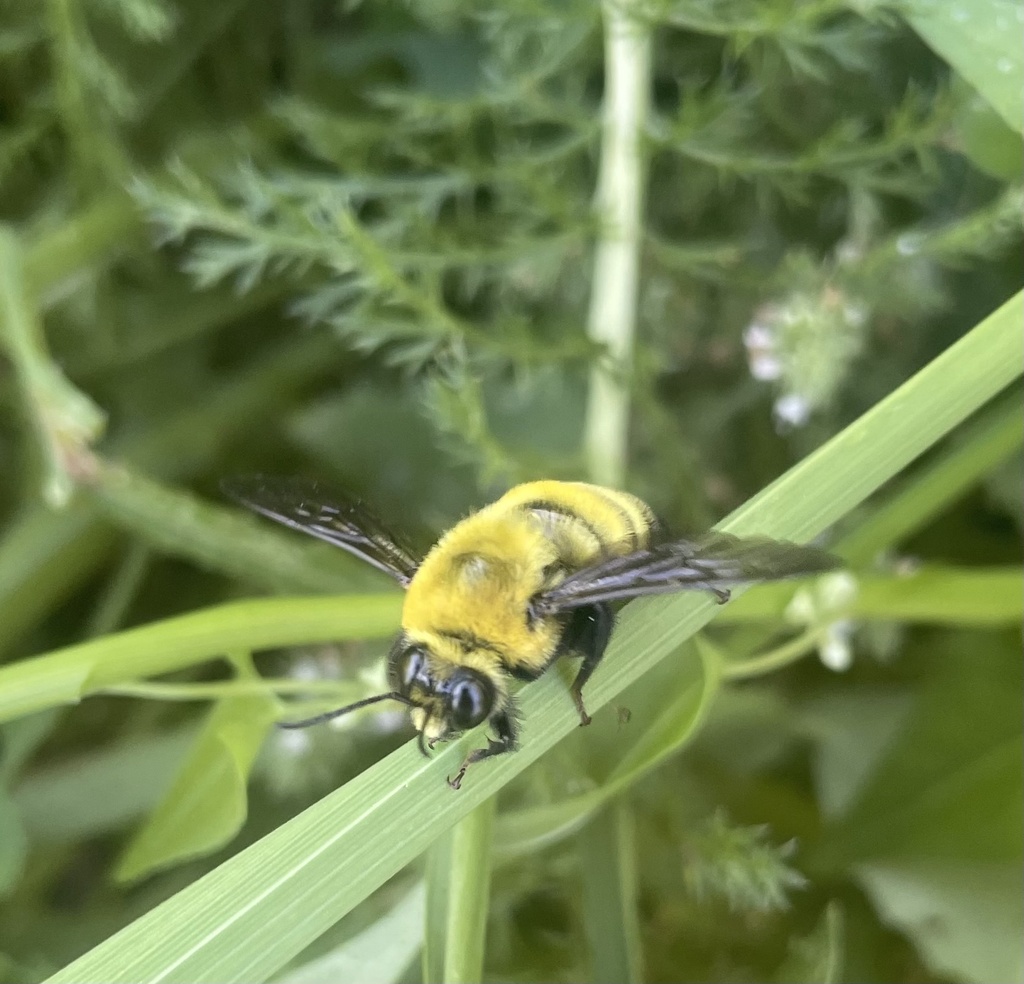
(c) Kayla, some rights reserved (CC BY) · licence
Family: Apidae · Class: Insecta · Order: Hymenoptera
Conservation status: G3 S1S2
Bombus morrisoni (Morrison bumble bee) is a California animal in the Apidae family.
The Morrison bumble bee is a medium-sized social bee species with queens measuring 22 to 26 mm in length and workers ranging from 12 to 22 mm (Xerces Society 2023). Queens and workers share similar coloration patterns, with dense hair covering their bodies. Like other social bumble bees, Morrison bumble bees live in colonies consisting of a queen, her offspring workers, and near the end of the season, reproductive males and new queens. Historically, this species occurred throughout the western United States from California east of the Sierra-Cascade Ranges to southern British Columbia, extending east to New Mexico and Texas, and north to western South Dakota. The species has also been sporadically documented west of the Sierra-Cascade crest in Oregon and California. Current distribution analysis indicates the species has experienced significant range contraction, with current range size at approximately 82% of historic range and persistence in current range at only 27% of historic occupancy (Xerces Society 2014). Morrison bumble bees inhabit diverse ecosystems including grasslands, sagebrush steppe, and woodland edges (Xerces Society 2023). The species demonstrates broad elevation tolerance, though specific elevation ranges have not been well documented in available literature. Habitat associations include flower-rich meadows and areas with abundant floral resources, typically within 100 meters of high-quality foraging habitat. As generalist pollinators, Morrison bumble bees collect pollen and nectar from numerous flowering plant species, serving as important contributors to both wildland and agricultural ecosystem stability. The species exhibits typical bumble bee social behavior, with colonies initiated by overwintered queens in spring. Nesting sites occur in various habitat types including open areas, forest edges, and transitions between habitat types, usually in loose organic material or underground cavities. Queens overwinter in shaded areas with loose organic material on slopes without dense vegetation. The Morrison bumble bee faces significant conservation challenges and may have declined by as much as 75% across its range (Xerces Society 2023). Current relative abundance compared to historic values stands at approximately 17% (Xerces Society 2014). Primary threats include habitat loss and degradation, overgrazing, pesticide exposure, disease, and climate change effects. The species is designated as a Species of Greatest Conservation Need in California, Colorado, Idaho, and Washington, and is listed as USFS Sensitive for Region 6 and BLM Sensitive in Oregon and Washington. In 2023, the Xerces Society submitted a petition for federal listing under the Endangered Species Act, and the U.S. Fish and Wildlife Service issued a positive 90-day finding, indicating the species warrants further consideration for protection. NatureServe currently ranks Morrison bumble bee as G3 (Vulnerable), indicating moderate risk of extinction due to restricted range and declining populations.
Classification
Class: Insecta · Order: Hymenoptera · Family: Apidae
Conservation status
G3 S1S2
Frequently asked questions
How is Bombus morrisoni classified?
Bombus morrisoni belongs to class Insecta, order Hymenoptera, family Apidae.
What family does Bombus morrisoni belong to?
Bombus morrisoni is in the Apidae family.
Is Bombus morrisoni protected or of conservation concern?
Bombus morrisoni carries the following status: G3 S1S2.
What is Bombus morrisoni?
The Morrison bumble bee is a medium-sized social bee species with queens measuring 22 to 26 mm in length and workers ranging from 12 to 22 mm (Xerces Society 2023).
Is Bombus morrisoni found in California?
Yes. Bombus morrisoni is recorded in California in The California Species Project's catalogue.
Related species
Other California species in the same genus, family, or bioregion.
Data from The California Species Project — 14,000+ California species with verified data from CNPS, CDFW, USFWS, and more.