Bombus occidentalis
Western bumble bee
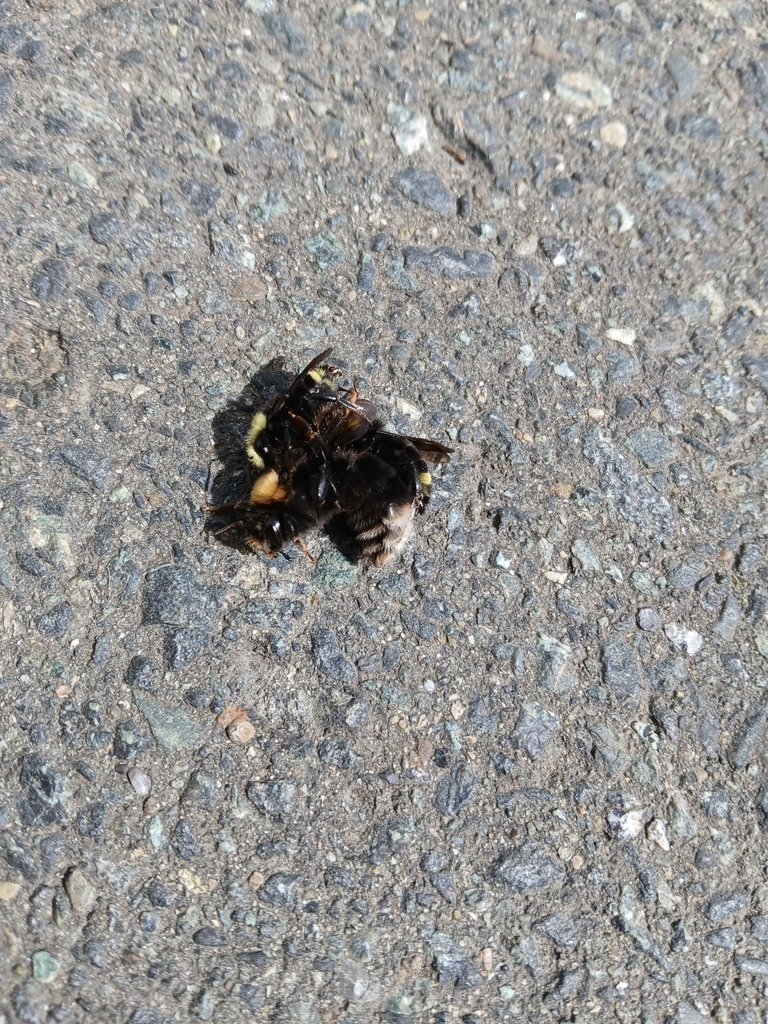
(c) Chris Fluit, some rights reserved (CC BY) · licence
Family: Apidae · Class: Insecta · Order: Hymenoptera
Conservation status: G3 S1
Bombus occidentalis (Western bumble bee) is a California animal in the Apidae family.
The western bumble bee is a large, robust social bee measuring 8 to 27 millimeters (0.3 to 1.1 inches) in length depending on caste. Queens are the largest individuals, followed by workers and males. The species displays the typical black and yellow coloration pattern of bumble bees, with a distinctive white band on the abdomen and yellow patches on the thorax. Workers and queens can be distinguished from similar species by their specific color patterns and size. Historically, Bombus occidentalis was broadly distributed in western North America, occurring along the Pacific coast and western interior from Arizona, New Mexico, and California north through the Pacific Northwest into Alaska. Eastward, the distribution extended to the northwestern Great Plains and southern Saskatchewan. Prior to 1998, the species was common and widespread throughout western United States and western Canada, including northern California, Oregon, Washington, Alaska, Idaho, Montana, western Nebraska, western North Dakota, western South Dakota, Wyoming, Utah, Colorado, northern Arizona, and New Mexico. Western bumble bees inhabit meadows and grasslands with abundant floral resources. They occur across a range of elevations, with historical records from low-elevation coastal sites to montane environments. The species requires habitats with rich supplies of floral resources providing continuous blooming from spring through autumn. Landscape-level habitat quality significantly influences population success, as isolated habitat patches are insufficient to support viable populations. Nests are typically constructed underground in tunnels up to 2.1 meters long, lined with dried grass, hair, small leaves, moss, or bird feathers. Nest entrances measure 2 to 4 centimeters in diameter and are often located on flat or nearly flat ground with slopes below 10 degrees. Like other Bombus species, western bumble bees are highly social, forming annual colonies consisting of a single overwintered queen, female workers, and males. The flight season extends from spring through late summer, with colonies founded by queens emerging from hibernation. Workers forage on diverse native plant species throughout the active season. The species serves as an important pollinator for both native wildflowers and agricultural crops. The western bumble bee is listed as a candidate species for protection in California. According to the California Department of Fish and Wildlife, the species was originally advanced to candidacy by the Fish and Game Commission on June 18, 2019. The candidacy determination was challenged in court and temporarily stayed beginning February 2021 following an adverse trial court judgment. The Third District Court of Appeal reversed the trial court judgment, and candidacy was reinstated on September 30, 2022. The species has a global rank of G3 (vulnerable) and California state rank of S1 (critically imperiled), and is also listed in Arizona and Oregon. Since 1998, populations have undergone drastic decline throughout some areas of the former range, with particularly significant range losses in central California to southern British Columbia west of the Sierra-Cascade Ranges, especially from lower elevation sites in California, western Oregon, and western Washington.
Classification
Class: Insecta · Order: Hymenoptera · Family: Apidae
Conservation status
G3 S1
Frequently asked questions
How is Bombus occidentalis classified?
Bombus occidentalis belongs to class Insecta, order Hymenoptera, family Apidae.
What family does Bombus occidentalis belong to?
Bombus occidentalis is in the Apidae family.
Is Bombus occidentalis protected or of conservation concern?
Bombus occidentalis carries the following status: G3 S1.
What is Bombus occidentalis?
The western bumble bee is a large, robust social bee measuring 8 to 27 millimeters (0.3 to 1.1 inches) in length depending on caste.
Is Bombus occidentalis found in California?
Yes. Bombus occidentalis is recorded in California in The California Species Project's catalogue.
Related species
Other California species in the same genus, family, or bioregion.
Data from The California Species Project — 14,000+ California species with verified data from CNPS, CDFW, USFWS, and more.