Bombus pensylvanicus
American bumble bee
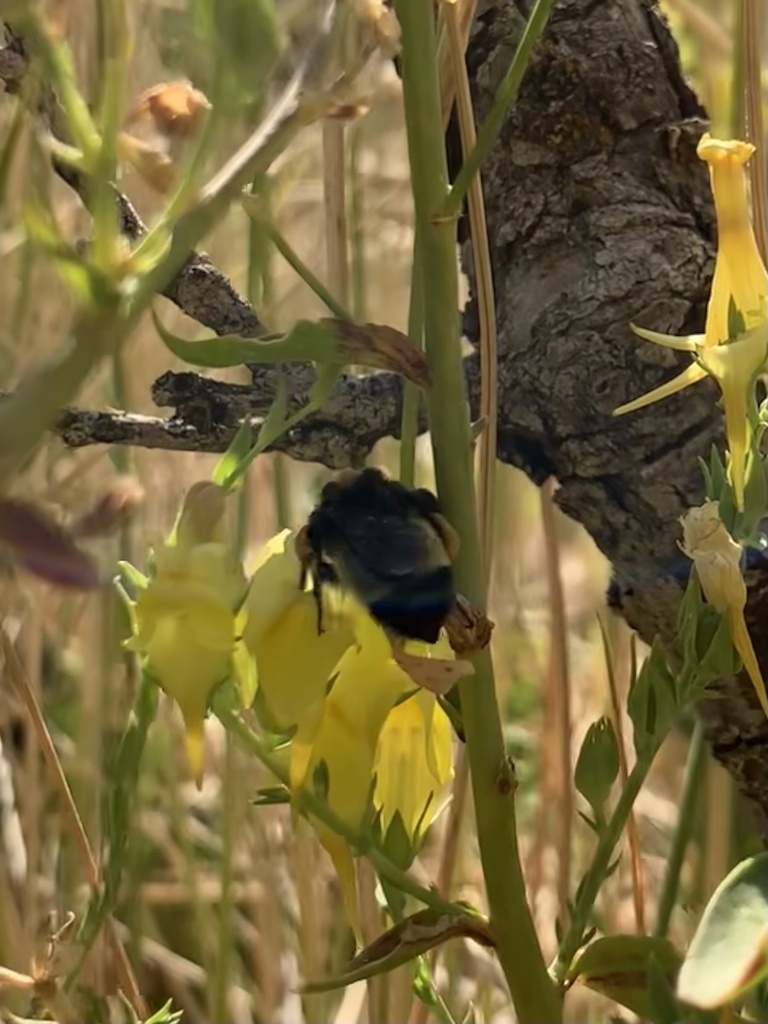
(c) Zach Earl, some rights reserved (CC BY) · licence
Family: Apidae · Class: Insecta · Order: Hymenoptera
Conservation status: G3G4 S2
Bombus pensylvanicus (American bumble bee) is a California animal in the Apidae family.
The American bumble bee is a relatively large, fuzzy social insect with distinctive black and yellow coloration. The species exhibits a black head, three yellow bands across the thorax, and a black posterior region (Colla et al. 2011). As a member of the subgenus Thoracobombus, it can be distinguished from the two other North American species in this subgenus, B. fervidus and B. californicus. Bombus pensylvanicus is widespread in the eastern United States and Great Plains regions, throughout the central United States and extreme southern Canada. Though absent from much of the Mountain West, it is found in the Desert West and adjacent areas of California and Oregon. The species occurs across a broad elevational range, with the desert subspecies B. pensylvanicus sonorus documented ascending as much as 1,000 vertical meters daily while foraging (Schmidt and Jacobson 2005). In California, the species is ranked S2 (imperiled), indicating significant conservation concern at the state level. The American bumble bee inhabits grasslands, farmlands, and other open areas (Williams et al. 2014). The species requires three essential habitat components: diverse and abundant flowers providing nectar and pollen from spring through autumn, undisturbed nesting sites in grass clumps located near floral resources, and overwintering sites in decaying wood for hibernating queens positioned close to spring flowering plants. Research indicates that land cover, agriculture, and landscape-scale factors significantly influence habitat suitability (Liczner and Colla 2020). Like most Bombus species, American bumble bees are highly social, forming annual colonies consisting of a single queen, female workers, and males. Workers typically forage within 600 to 1,700 meters of their colonies, though shorter foraging distances are considered safer and more energy-efficient (Dramstad 1996, Hines and Hendrix 2005). The species serves as an important pollinator for both native plants and agricultural crops, with potential devastating impacts on pollination services should populations continue declining. The American bumble bee faces significant conservation challenges across portions of its range. According to IUCN assessments, the species has experienced substantial declines, with current relative abundance at only 11.44% of historic values and an average decline of 51.38% (IUCN Assessments 2014). The current range size relative to historic distribution is 81.18%, indicating considerable range contraction. The U.S. Fish and Wildlife Service is reviewing the species' status as part of a pollinator cohort assessment, and it has been designated as a candidate species under the Endangered Species Act in several states including California, Arizona, Nevada, and Oregon. Primary threats include habitat loss from agricultural conversion and urban development, pesticide exposure particularly from neonicotinoids, disease transmission from commercially managed bees, and climate change effects on flowering phenology and habitat availability.
Classification
Class: Insecta · Order: Hymenoptera · Family: Apidae
Conservation status
G3G4 S2
Frequently asked questions
How is Bombus pensylvanicus classified?
Bombus pensylvanicus belongs to class Insecta, order Hymenoptera, family Apidae.
What family does Bombus pensylvanicus belong to?
Bombus pensylvanicus is in the Apidae family.
Is Bombus pensylvanicus protected or of conservation concern?
Bombus pensylvanicus carries the following status: G3G4 S2.
What is Bombus pensylvanicus?
The American bumble bee is a relatively large, fuzzy social insect with distinctive black and yellow coloration.
Is Bombus pensylvanicus found in California?
Yes. Bombus pensylvanicus is recorded in California in The California Species Project's catalogue.
Related species
Other California species in the same genus, family, or bioregion.
Data from The California Species Project — 14,000+ California species with verified data from CNPS, CDFW, USFWS, and more.