Bombus rufocinctus
Red-belted Bumble Bee
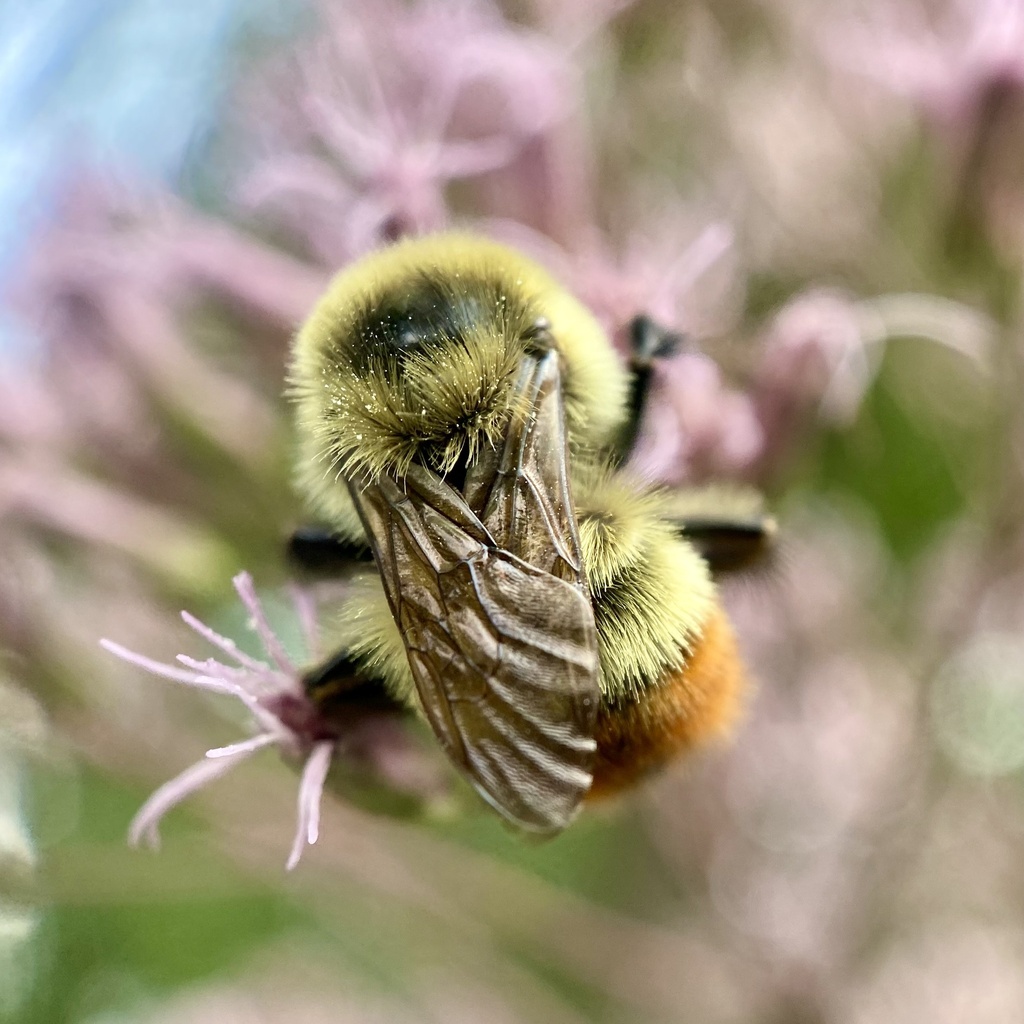
(c) Michelle Orcutt, some rights reserved (CC BY) · licence
Family: Apidae · Class: Insecta · Order: Hymenoptera
Bombus rufocinctus (Red-belted Bumble Bee) is a California animal in the Apidae family.
The Red-belted Bumble Bee is a medium-sized social bee with highly variable coloration patterns. Queens measure 22 to 25 mm in length, while workers and males are smaller. The species displays black facial hair with a yellow vertex on the head. The thorax typically shows yellow coloration on the front portion (scutum) with black hairs between and below the wings. The abdomen features a distinctive pattern with the first segment black, the second segment yellow, and subsequent segments varying in coloration between black and whitish or yellowish-orange tones. This species exhibits extensive color variation and can be confused with several other bumble bee species due to morphological similarities. Bombus rufocinctus has a widespread distribution across North America, occurring throughout southern Canada and most of the United States except for the southeastern regions (NatureServe 2014). The species extends from southeastern British Columbia south to eastern California and eastward across the continent. In the Pacific Northwest, the Red-belted Bumble Bee has been documented across various elevational gradients and habitat types (Xerces Society Pacific Northwest Atlas 2021). This species inhabits diverse habitat types including agricultural areas, grasslands, meadows, riparian zones, shrub-scrub communities, and woodland-forest edges. The Red-belted Bumble Bee demonstrates adaptability to both natural and human-modified landscapes. Nesting sites occur in underground cavities and on the ground surface, typically within approximately 100 meters of high-quality foraging habitat with abundant floral resources (Xerces Society Habitat Management 2021). Queens select overwintering sites in loose organic material within shaded areas and slopes without dense vegetation. Red-belted Bumble Bees are generalist foragers with short tongue length, visiting a wide variety of flowering plants. Primary food plants include clovers (Trifolium), sweet clovers (Melilotus), thistles (Cirsium), goldenrods (Solidago), Eupatorium, and asters (Xerces Society 2018). Additional documented plant associations include penstemon species (Penstemon rydbergii) and various other native wildflowers. The species follows typical bumble bee social organization with annual colonies founded by overwintering queens in spring. Flight activity extends from early spring through late summer, with peak abundance varying by geographic location and local environmental conditions. According to IUCN assessments, Bombus rufocinctus maintains a preliminary conservation status of Least Concern, with current range size at approximately 87% of historic range and persistence in current range at about 86% of historic occupancy (Xerces Society 2014). However, the species has experienced an average decline of approximately 30%, with current relative abundance at 38% of historic values. Some regional declines have been documented, particularly in southern Ontario and portions of the eastern range (Xerces Society 2019). Primary threats include habitat loss, pesticide exposure, pathogens, and climate change effects. The species' adaptability to various habitat types and generalist foraging behavior may provide some resilience against environmental pressures, though continued monitoring remains important for detecting population trends.
Classification
Class: Insecta · Order: Hymenoptera · Family: Apidae
Frequently asked questions
How is Bombus rufocinctus classified?
Bombus rufocinctus belongs to class Insecta, order Hymenoptera, family Apidae.
What family does Bombus rufocinctus belong to?
Bombus rufocinctus is in the Apidae family.
What is Bombus rufocinctus?
The Red-belted Bumble Bee is a medium-sized social bee with highly variable coloration patterns.
Is Bombus rufocinctus found in California?
Yes. Bombus rufocinctus is recorded in California in The California Species Project's catalogue.
Related species
Other California species in the same genus, family, or bioregion.
Data from The California Species Project — 14,000+ California species with verified data from CNPS, CDFW, USFWS, and more.