Bombycilla garrulus
Bohemian Waxwing
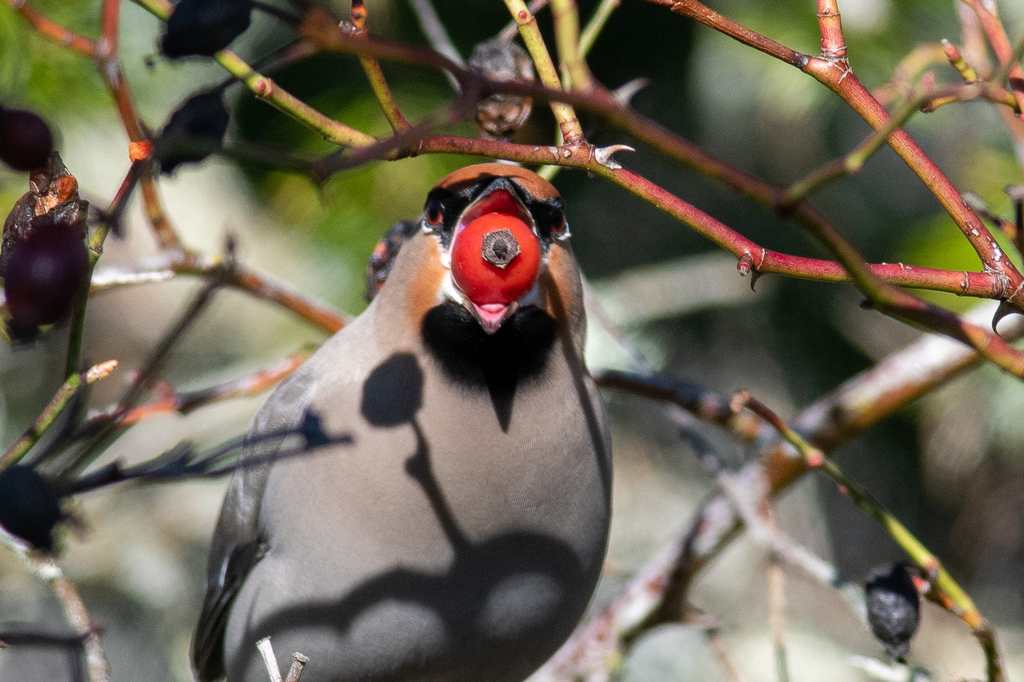
no rights reserved · CC0
Family: Bombycillidae · Class: Aves · Order: Passeriformes
Bombycilla garrulus (Bohemian Waxwing) is a California animal in the Bombycillidae family.
The Bohemian Waxwing is a medium-sized songbird measuring 18-21 cm (7.1-8.3 inches) in length with a wingspan of 32-35.5 cm (12.6-14.0 inches). Adults weigh between 40-79 grams (1.4-2.8 ounces). The species displays soft, silky plumage with overall gray-brown coloration. A prominent black mask extends from the bill through the eye, bordered by white markings. The head features a distinctive pointed crest that can be raised or lowered. Adults show bright yellow terminal tail bands and waxy red tips on the secondary wing feathers, from which the species derives its common name. Males typically display more prominent red wing tips than females, with some individuals showing up to 18 waxy appendages. Bohemian Waxwings breed primarily in the boreal forests of Alaska and northwestern Canada, with their range extending into northern Eurasia. In California, the species occurs as an irregular winter visitor, typically appearing during irruptive years when northern food sources become scarce. According to eBird data, sightings in California are most frequent in the northern counties, including Siskiyou, Modoc, and Lassen counties, though birds may appear as far south as the Central Valley during major irruptions. These movements are highly unpredictable, with some winters producing no California records while others yield hundreds of individuals. During winter visits to California, Bohemian Waxwings utilize a variety of habitats including riparian woodlands, suburban areas with berry-producing trees, orchards, and parks. The species shows strong preference for areas with abundant fruit sources, particularly native mountain ash, elderberry, and introduced ornamental trees such as crabapple and pyracantha. Birds typically forage at elevations from sea level to 2,000 meters (6,500 feet) in the state. Bohemian Waxwings are highly social, forming flocks that range from small groups of 10-20 individuals to massive aggregations exceeding 1,000 birds during major irruptions. Their diet consists primarily of fruits and berries, supplemented with insects during the breeding season. The species exhibits nomadic behavior, moving in response to fruit availability rather than following traditional migration routes. Courtship behaviors include ritualized food passing between mates. Breeding occurs from May through August in northern habitats, with females constructing cup-shaped nests in conifer trees. Clutch size ranges from 3-7 eggs, typically 4-5, with an incubation period of 12-16 days. The Bohemian Waxwing is not federally listed and maintains stable populations across its primary range. The species is classified as Least Concern by the International Union for Conservation of Nature. Population trends in North America appear stable, though long-term monitoring is complicated by the species' irregular distribution patterns. Climate change may affect the timing and extent of irruptive movements, potentially altering winter distribution patterns in California. The species faces minimal direct threats, though habitat loss in breeding areas and collision mortality during large-scale movements present localized concerns.
Classification
Class: Aves · Order: Passeriformes · Family: Bombycillidae
Frequently asked questions
How is Bombycilla garrulus classified?
Bombycilla garrulus belongs to class Aves, order Passeriformes, family Bombycillidae.
What family does Bombycilla garrulus belong to?
Bombycilla garrulus is in the Bombycillidae family.
What is Bombycilla garrulus?
The Bohemian Waxwing is a medium-sized songbird measuring 18-21 cm (7.1-8.3 inches) in length with a wingspan of 32-35.5 cm (12.6-14.0 inches).
Is Bombycilla garrulus found in California?
Yes. Bombycilla garrulus is recorded in California in The California Species Project's catalogue.
Related species
Other California species in the same genus, family, or bioregion.
Data from The California Species Project — 14,000+ California species with verified data from CNPS, CDFW, USFWS, and more.