Bonasa umbellus
Ruffed Grouse
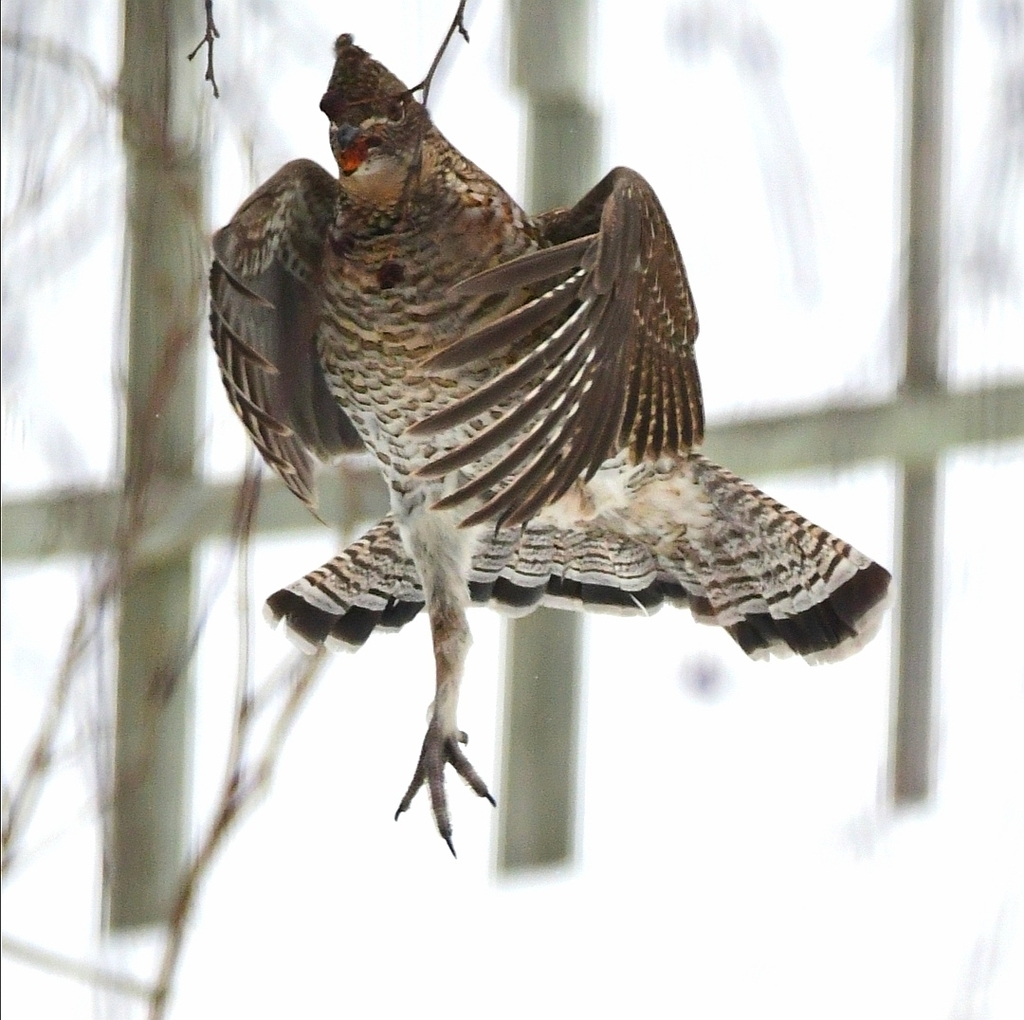
(c) Alexis Williams, some rights reserved (CC BY) · licence
Family: Phasianidae · Class: Aves · Order: Galliformes
Conservation status: WL · G5 S3S4
Bonasa umbellus (Ruffed Grouse) is a California animal in the Phasianidae family.
The Ruffed Grouse (Bonasa umbellus) is a medium-sized gallinaceous bird measuring 40-50 cm (16-20 inches) in length with a wingspan of 50-64 cm (20-25 inches). Adults weigh 450-750 grams (1-1.7 pounds), with males typically larger than females. The plumage exhibits cryptic coloration with mottled brown, gray, and buff tones that provide excellent camouflage against forest floors. The species displays two distinct color morphs: a gray phase and a red phase, with the red morph more common in southern populations. Males possess prominent black neck ruffs that are erected during courtship displays, along with fan-shaped tails marked by a distinctive dark subterminal band. Historically, Ruffed Grouse occupied montane forests throughout much of California's mountainous regions. The species currently maintains populations in the Sierra Nevada, Cascade Range, and scattered locations in northern California mountains. According to the California Department of Fish and Wildlife, the species has experienced range contraction from historical levels, with populations now primarily restricted to higher elevation forests between 1,200-2,400 meters (4,000-8,000 feet). The species is absent from the Central Valley and southern California mountains. Ruffed Grouse inhabit mature mixed coniferous and deciduous forests characterized by dense understory vegetation. Preferred habitat includes areas with aspen groves, which provide critical food resources, along with adjacent coniferous stands offering thermal cover. The species requires edge habitats where forest openings meet dense cover, typically in areas with 60-80% canopy closure. Microhabitat features include fallen logs for drumming sites, dense shrub layers for nesting, and diverse plant communities supporting varied food sources throughout the year. This non-migratory species exhibits strong seasonal behavioral patterns. Males establish territories in early spring, performing distinctive drumming displays on elevated logs to attract mates and warn competitors. The drumming sound, created by rapid wingbeats, can be heard up to 0.4 km (0.25 miles) away. Females construct ground nests in dense vegetation, typically at the base of trees or logs, laying 8-14 buff-colored eggs in April through June. Incubation lasts 24-26 days, with only females tending the precocial young. Diet varies seasonally, consisting of buds, catkins, and leaves in spring and summer, shifting to fruits and seeds in fall, and relying heavily on conifer needles during winter months. Ruffed Grouse are not federally listed but hold a California Watch List (WL) designation, indicating potential conservation concern despite their global security ranking of G5. The state ranking of S3 reflects moderate conservation concern about population status in California, where the species exists at the southern edge of its range. Primary threats include habitat loss from logging practices that eliminate mature forest structure, fire suppression leading to forest succession away from preferred early-successional habitats, and climate change impacts on montane ecosystems. Forest management practices that maintain habitat heterogeneity and preserve aspen groves are essential for sustaining California populations.
Classification
Class: Aves · Order: Galliformes · Family: Phasianidae
Conservation status
WL · G5 S3S4
Frequently asked questions
How is Bonasa umbellus classified?
Bonasa umbellus belongs to class Aves, order Galliformes, family Phasianidae.
What family does Bonasa umbellus belong to?
Bonasa umbellus is in the Phasianidae family.
Is Bonasa umbellus protected or of conservation concern?
Bonasa umbellus carries the following status: WL · G5 S3S4.
What is Bonasa umbellus?
The Ruffed Grouse (Bonasa umbellus) is a medium-sized gallinaceous bird measuring 40-50 cm (16-20 inches) in length with a wingspan of 50-64 cm (20-25 inches).
Is Bonasa umbellus found in California?
Yes. Bonasa umbellus is recorded in California in The California Species Project's catalogue.
Related species
Other California species in the same genus, family, or bioregion.
Data from The California Species Project — 14,000+ California species with verified data from CNPS, CDFW, USFWS, and more.