Brachygenys californiensis
California Salema
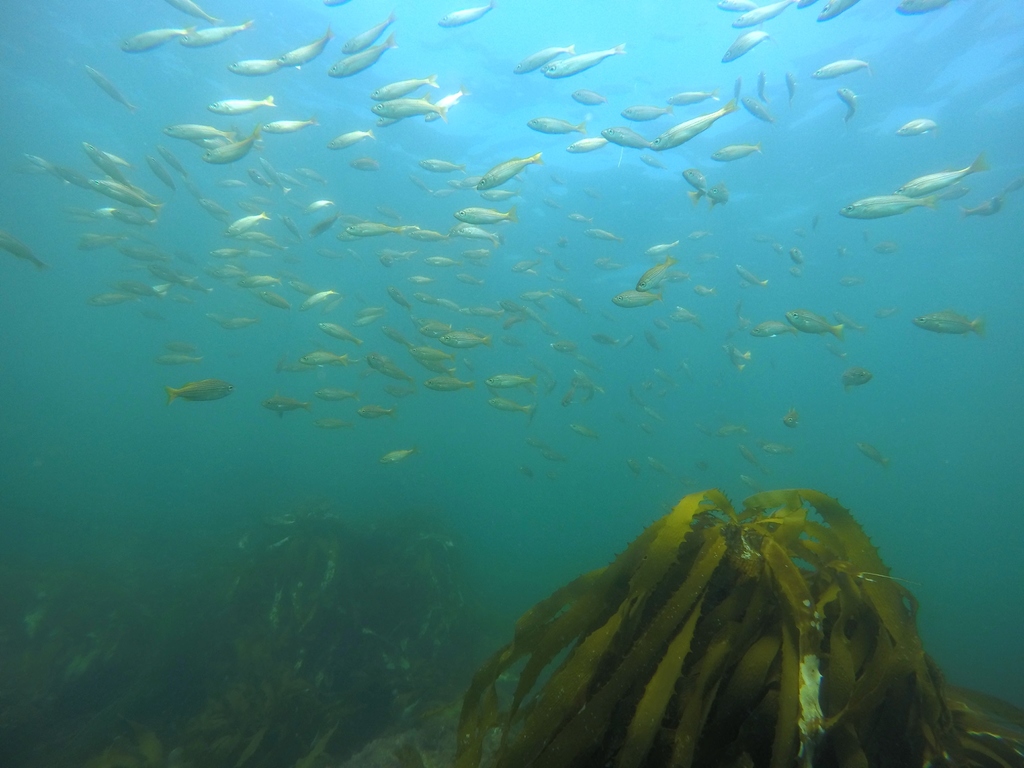
no rights reserved · CC0
Family: Haemulidae · Class: Actinopterygii · Order: Perciformes
Brachygenys californiensis (California Salema) is a California animal in the Haemulidae family.
The California salema (Brachygenys californiensis) is a marine ray-finned fish in the grunt family Haemulidae. This species exhibits a distinctive high body profile with a convex dorsal outline, giving it a characteristic humpbacked appearance. The body shape and proportions distinguish it from other Pacific grunt species, though specific size measurements have not been well documented in the available literature. The California salema occurs in the eastern Pacific Ocean, with its range extending along the Pacific coast. The species is distributed from the southern Gulf of California southward, though the exact northern and southern limits of its range require further documentation. This distribution places it within the warm-temperate and subtropical marine waters of the eastern Pacific. This species inhabits rocky marine environments and kelp forest ecosystems. According to FishBase, California salema occur among rocks and high up in kelp beds, showing a preference for structured benthic habitats (FishBase). The species is found in inshore marine waters, though specific depth ranges have not been precisely documented. The kelp forest association suggests the species requires areas with substantial vertical structure and potentially cooler water temperatures typical of these productive marine ecosystems. California salema exhibit schooling behavior and are typically found in groups rather than as solitary individuals (FishBase). The species demonstrates primarily nocturnal feeding patterns, though they occasionally forage during daylight hours (FishBase). As members of the grunt family, they likely feed on various benthic invertebrates, following the omnivorous feeding pattern typical of Haemulidae. Young individuals may feed predominantly on planktonic organisms, transitioning to benthic prey as they mature, consistent with the general ecology of grunt species (FishBase). Limited information exists regarding the species' reproduction, growth rates, and population dynamics. The schooling behavior suggests social organization during at least some life stages, which may be related to feeding efficiency or predator avoidance. The nocturnal feeding pattern indicates adaptation to exploit prey resources that are more available or vulnerable during darkness. The conservation status of the California salema has not been formally assessed by major conservation organizations. No federal or state listing status has been assigned to this species. The lack of comprehensive population data and ecological studies makes it difficult to evaluate potential threats or conservation needs. As with many marine fish species in the eastern Pacific, potential concerns could include fishing pressure, habitat modification, and climate change effects on kelp forest ecosystems. However, specific threats to this species have not been identified or studied. Scientific documentation for this species remains limited compared to more commercially or ecologically prominent marine fishes. The information presented here is based on available sources including FishBase and taxonomic databases. Further research is needed to better understand the species' biology, population status, and ecological requirements.
Classification
Class: Actinopterygii · Order: Perciformes · Family: Haemulidae
Frequently asked questions
How is Brachygenys californiensis classified?
Brachygenys californiensis belongs to class Actinopterygii, order Perciformes, family Haemulidae.
What family does Brachygenys californiensis belong to?
Brachygenys californiensis is in the Haemulidae family.
What is Brachygenys californiensis?
The California salema (Brachygenys californiensis) is a marine ray-finned fish in the grunt family Haemulidae.
Is Brachygenys californiensis found in California?
Yes. Brachygenys californiensis is recorded in California in The California Species Project's catalogue.
Related species
Other California species in the same genus, family, or bioregion.
Data from The California Species Project — 14,000+ California species with verified data from CNPS, CDFW, USFWS, and more.