Brachymesia furcata
Red-tailed Pennant
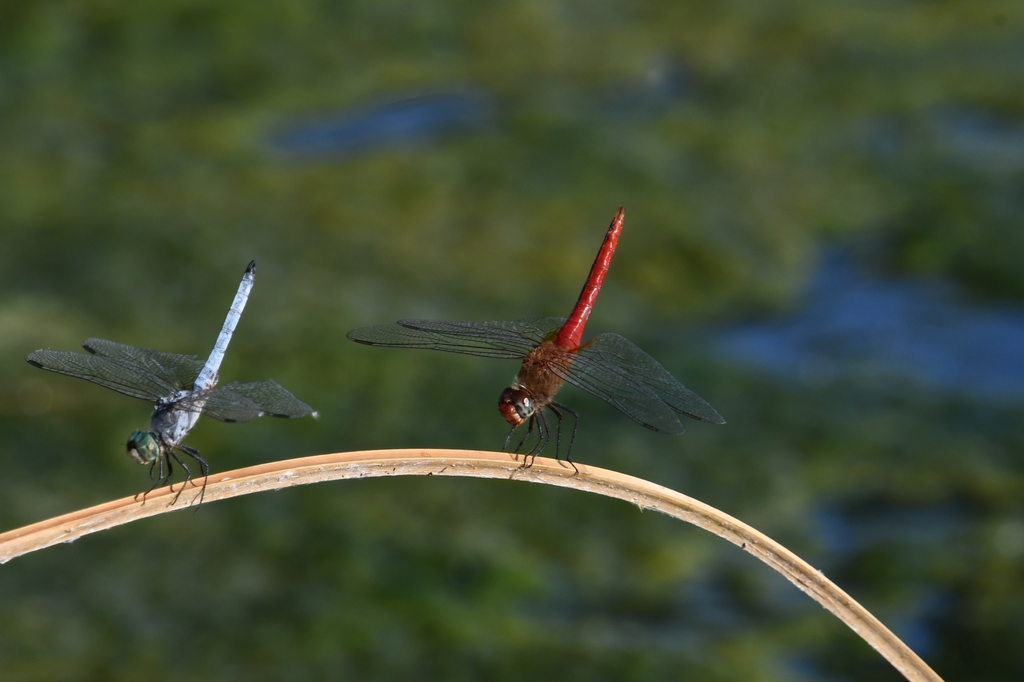
(c) Mike Ostrowski, some rights reserved (CC BY-SA) · licence
Family: Libellulidae · Class: Insecta · Order: Odonata
Brachymesia furcata (Red-tailed Pennant) is a California animal in the Libellulidae family.
The Red-tailed Pennant (Brachymesia furcata) is a medium-sized dragonfly in the family Libellulidae, commonly known as skimmers. Adults measure approximately 51 mm (2 inches) in length with a wingspan of 76 mm (3 inches). The species exhibits sexual dimorphism in coloration. Males display distinctive reddish coloration on the abdomen, particularly the posterior segments that give the species its common name. The thorax is brownish with pale lateral stripes. Females and immature individuals are generally duller, with brownish coloration throughout and less pronounced red tones. Both sexes have clear wings with prominent dark wing tips and reddish-brown pterostigmas. The eyes are typically reddish-brown to dark red in mature individuals. The Red-tailed Pennant has an extensive range throughout the Americas. According to iNaturalist, the species is found across the Caribbean, Central America, North America, and South America. In North America, the species ranges from the southern United States through Mexico. The northern extent of its range includes parts of the southeastern and south-central United States, with populations documented in Texas and other Gulf Coast states. California represents the western edge of its North American distribution, where it occurs sporadically and may be considered vagrant or extremely localized. This species inhabits a variety of freshwater environments, showing preference for still or slow-moving waters. Red-tailed Pennants are typically found around ponds, lakes, marshes, and slow streams with abundant emergent and aquatic vegetation. They favor areas with muddy or sandy substrates and often occur in habitats with cattails, sedges, and other wetland plants. The species can tolerate varying water quality conditions and has been observed in both natural and artificial water bodies, including irrigation ditches and constructed wetlands. Red-tailed Pennants are active fliers that exhibit typical libellulid behavior. Males establish territories over suitable breeding habitat, perching on emergent vegetation or low structures near water. They engage in aggressive territorial displays, chasing away other males and potential competitors. Mating occurs through the characteristic dragonfly tandem formation, with pairs remaining connected during egg-laying. Females deposit eggs directly into water or on floating vegetation through dipping behavior while in tandem with males. Adults are generalist predators, capturing flying insects including mosquitoes, midges, flies, and small flying ants. They hunt from perches and through active flight, demonstrating the rapid acceleration and maneuverability characteristic of skimmer dragonflies. The Red-tailed Pennant does not appear on federal or state endangered species lists and is not assigned conservation rankings, suggesting stable populations across its broad range. However, like many freshwater-dependent species, populations may face localized threats from habitat loss, water pollution, and climate change. Wetland destruction and degradation pose the primary conservation concerns for this species, particularly in rapidly developing regions. The species' wide distribution and apparent habitat flexibility likely contribute to its overall stability, though specific population monitoring data for California is limited.
Classification
Class: Insecta · Order: Odonata · Family: Libellulidae
Frequently asked questions
How is Brachymesia furcata classified?
Brachymesia furcata belongs to class Insecta, order Odonata, family Libellulidae.
What family does Brachymesia furcata belong to?
Brachymesia furcata is in the Libellulidae family.
What is Brachymesia furcata?
The Red-tailed Pennant (Brachymesia furcata) is a medium-sized dragonfly in the family Libellulidae, commonly known as skimmers.
Is Brachymesia furcata found in California?
Yes. Brachymesia furcata is recorded in California in The California Species Project's catalogue.
Related species
Other California species in the same genus, family, or bioregion.
Data from The California Species Project — 14,000+ California species with verified data from CNPS, CDFW, USFWS, and more.