Brachyramphus brevirostris
Kittlitz's Murrelet
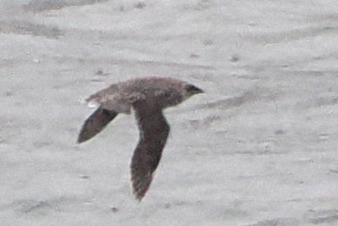
no rights reserved · CC0
Family: Alcidae · Class: Aves · Order: Charadriiformes
Brachyramphus brevirostris (Kittlitz's Murrelet) is a California animal in the Alcidae family.
Kittlitz's Murrelet is a small, compact seabird measuring 21 to 25 cm (8.3 to 9.8 inches) in length with a wingspan of 44 cm (17.3 inches). During breeding season, adults display distinctive mottled brown, black, and buff plumage on the upperparts that provides effective camouflage against rocky substrates. The underparts are white with dark barring extending onto the flanks. Non-breeding adults show a cleaner white below with dark gray upperparts and a distinctive white collar. The bill is short, straight, and dark, while the legs are positioned far back on the body, characteristic of alcids. In flight, the species shows rapid wingbeats and white wing linings. Kittlitz's Murrelet has an extremely limited global range, breeding primarily in Alaska and the Russian Far East. In California, the species occurs as a rare visitor along the coast, with most records from northern California waters. According to eBird and other citizen science databases, California observations are typically from fall through early spring, with individuals occasionally recorded as far south as Monterey Bay. The species' core breeding range extends from Prince William Sound, Alaska, westward through the Aleutian Islands. This species inhabits nearshore marine waters adjacent to glaciated coastal mountains and fjords. Unlike other murrelets that nest in old-growth forests, Kittlitz's Murrelet nests on bare rock surfaces, scree slopes, and cliff ledges at elevations up to 300 meters above sea level. Nesting sites are typically within 75 kilometers of tidewater glaciers. At sea, the species forages in shallow waters less than 100 meters deep, often in areas influenced by glacial runoff and upwelling. Kittlitz's Murrelet feeds primarily on small schooling fish including sand lance, herring, and juvenile cod, along with euphausid shrimp and other marine invertebrates. The species is an excellent underwater swimmer, using its wings for propulsion while diving. Breeding occurs from May through August, with females laying a single egg on bare rock or sparse vegetation. The cryptically colored egg and chick match closely with the rocky substrate. Both parents share incubation duties over 30 days, and the semi-precocial chick fledges after 24 to 27 days. The species is considered near threatened globally, with population declines documented across much of its range. Climate change poses the primary threat through glacier retreat, which alters marine food webs and reduces suitable nesting habitat near tidewater glaciers. Additional threats include oil spills, fisheries bycatch, and disturbance at nesting colonies. The species experienced significant population declines in Prince William Sound following the 1989 Exxon Valdez oil spill, though specific population estimates vary among studies. In California waters, the species remains an uncommon visitor with no evidence of breeding activity.
Classification
Class: Aves · Order: Charadriiformes · Family: Alcidae
Frequently asked questions
How is Brachyramphus brevirostris classified?
Brachyramphus brevirostris belongs to class Aves, order Charadriiformes, family Alcidae.
What family does Brachyramphus brevirostris belong to?
Brachyramphus brevirostris is in the Alcidae family.
What is Brachyramphus brevirostris?
Kittlitz's Murrelet is a small, compact seabird measuring 21 to 25 cm (8.3 to 9.8 inches) in length with a wingspan of 44 cm (17.3 inches).
Is Brachyramphus brevirostris found in California?
Yes. Brachyramphus brevirostris is recorded in California in The California Species Project's catalogue.
Related species
Other California species in the same genus, family, or bioregion.
Data from The California Species Project — 14,000+ California species with verified data from CNPS, CDFW, USFWS, and more.