Brachyramphus marmoratus
Marbled murrelet
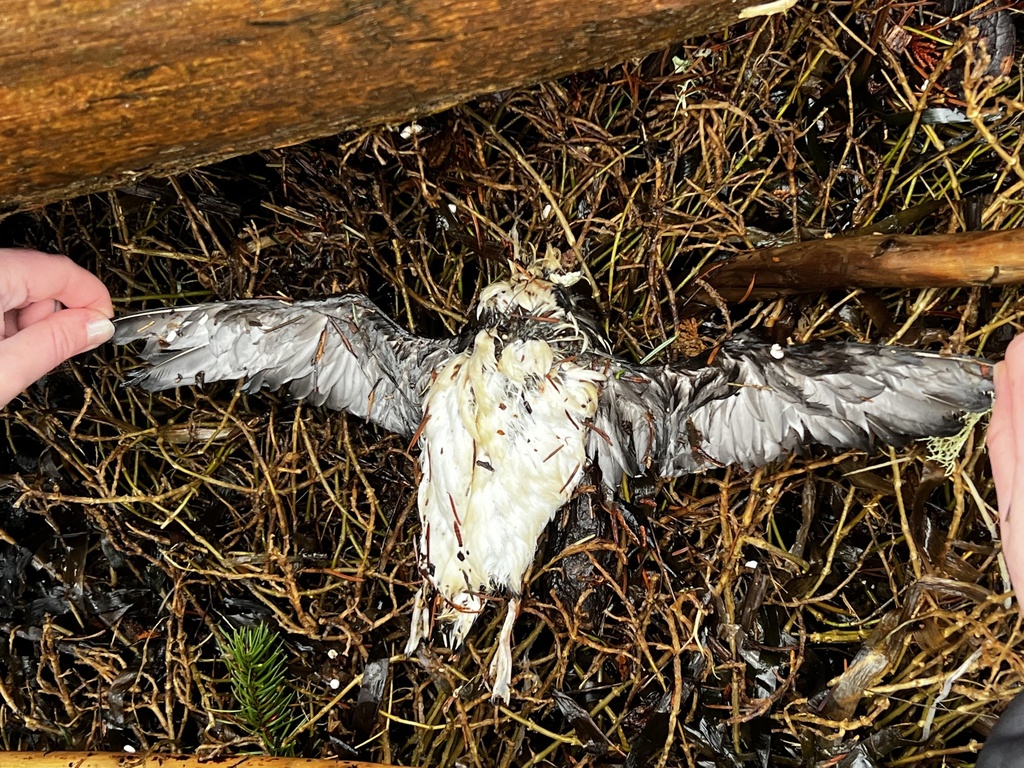
(c) Aiva Noringseth, some rights reserved (CC BY) · licence
Family: Alcidae · Class: Aves · Order: Charadriiformes
Conservation status: SE · Threatened · G3 S2
Brachyramphus marmoratus (Marbled murrelet) is a California animal in the Alcidae family.
The marbled murrelet is a small seabird measuring 23 to 25 cm (9 to 10 inches) in length with a wingspan of 38 to 41 cm (15 to 16 inches). Adults weigh 200 to 250 grams (7 to 9 ounces). During the breeding season, the species exhibits mottled brown and white plumage on the upperparts with white underparts heavily barred with dark brown, providing camouflage against tree bark. In winter plumage, adults display darker upperparts with white underparts and a distinctive white collar around the neck. The bill is straight, dark, and sharply pointed, adapted for capturing small fish underwater. Marbled murrelets occur along the Pacific coast from the Aleutian Islands in Alaska south to central California. In California, the species is found from Del Norte County south to Monterey County, with the largest populations concentrated in old-growth forest areas of the North Coast. The species also inhabits coastal waters of Oregon, Washington, and British Columbia. Historical populations likely extended further south along the California coast before extensive old-growth forest logging. This species requires two distinct habitat types: marine waters for foraging and old-growth or mature coniferous forests for nesting. At sea, marbled murrelets inhabit nearshore waters typically within 2 km (1.2 miles) of shore, preferring areas with depths less than 30 meters (98 feet). For nesting, the species selects large branches of old-growth conifers, particularly Douglas-fir, redwood, and Sitka spruce, typically at heights of 23 to 60 meters (75 to 197 feet) above ground. Nest sites are characterized by platforms with moss or other organic matter, often located more than 15 km (9 miles) inland. Marbled murrelets are pursuit divers, using their wings for underwater propulsion while foraging for small schooling fish, particularly anchovies, sardines, herring, and smelt. During the breeding season, adults may fly up to 80 km (50 miles) between marine foraging areas and inland nest sites. The species exhibits a unique breeding strategy among alcids, nesting solitarily on tree branches rather than in colonies on cliffs or burrows. Females lay a single egg between April and September, with peak laying occurring in May and June. Both parents share incubation duties for 28 to 30 days and feed the chick for 27 to 40 days until fledging. The marbled murrelet was listed as threatened under the Endangered Species Act in 1992 and as endangered in California. According to USFWS population estimates, fewer than 20,000 individuals remain range-wide, with California supporting approximately 5,000 to 6,000 individuals as of recent surveys. Primary threats include old-growth forest loss, which has eliminated an estimated 95% of suitable nesting habitat in California and the Pacific Northwest. Additional threats include oil spills, gill net entanglement, climate change effects on prey availability, and increased predation at nest sites due to forest fragmentation. Recovery efforts focus on protecting remaining old-growth forests and managing second-growth forests to develop suitable nesting habitat over time.
Classification
Class: Aves · Order: Charadriiformes · Family: Alcidae
Conservation status
SE · Threatened · G3 S2
Frequently asked questions
How is Brachyramphus marmoratus classified?
Brachyramphus marmoratus belongs to class Aves, order Charadriiformes, family Alcidae.
What family does Brachyramphus marmoratus belong to?
Brachyramphus marmoratus is in the Alcidae family.
Is Brachyramphus marmoratus protected or of conservation concern?
Brachyramphus marmoratus carries the following status: SE · Threatened · G3 S2.
What is Brachyramphus marmoratus?
The marbled murrelet is a small seabird measuring 23 to 25 cm (9 to 10 inches) in length with a wingspan of 38 to 41 cm (15 to 16 inches).
Is Brachyramphus marmoratus found in California?
Yes. Brachyramphus marmoratus is recorded in California in The California Species Project's catalogue.
Related species
Other California species in the same genus, family, or bioregion.
Data from The California Species Project — 14,000+ California species with verified data from CNPS, CDFW, USFWS, and more.