Branchinecta longiantenna
Longhorn fairy shrimp
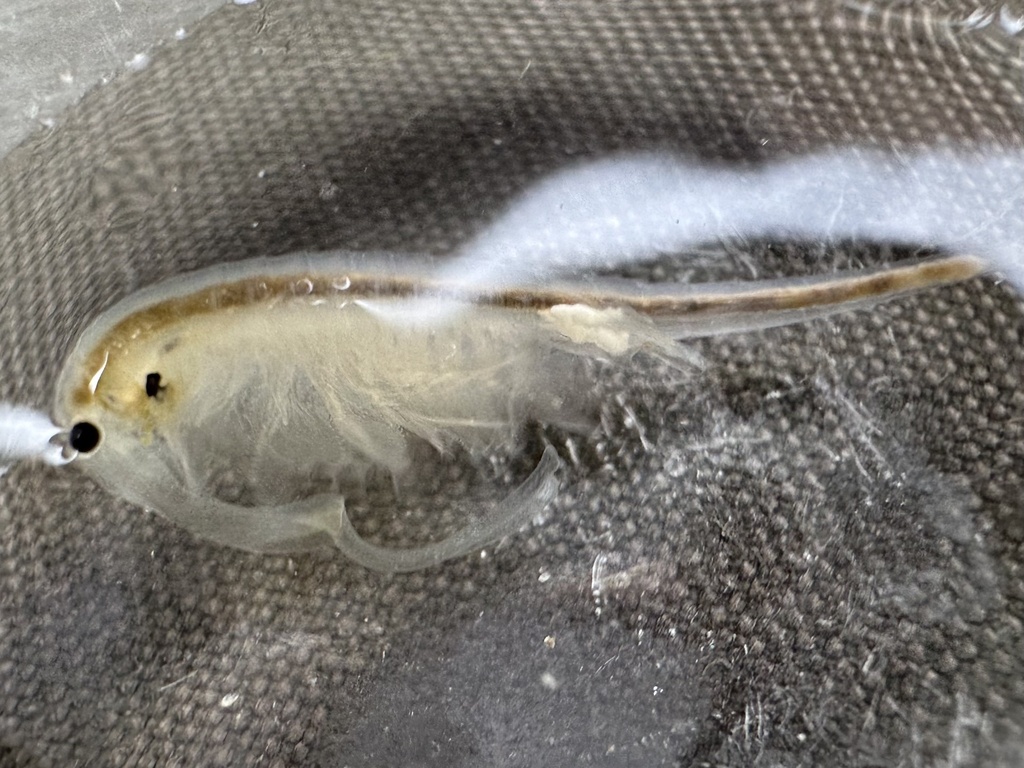
no rights reserved · CC0
Family: Branchinectidae · Class: Branchiopoda · Order: Anostraca
Conservation status: Endangered · G2 S2
Branchinecta longiantenna (Longhorn fairy shrimp) is a California animal in the Branchinectidae family.
The longhorn fairy shrimp is a small freshwater crustacean endemic to California's Central Valley and adjacent regions. Adult males measure 0.55 to 1.1 inches (14 to 27 mm) in length, while females range from 0.6 to 1.0 inches (14.5 to 23 mm). Males are distinguished by their exceptionally long second antennae, which measure 0.3 to 0.4 inches (6.7 to 10.4 mm) in length—approximately twice as long relative to body size as other Branchinecta species (USFWS 2003). Females are recognized by their distinctive cylindrical brood pouch. Historically, the longhorn fairy shrimp's range and habitat requirements remain poorly understood due to its extreme rarity. The species was first collected in 1937 from a sandstone outcrop pool on the Souza Ranch in Contra Costa County but was not formally described until 1990 (USFWS 2003). Currently, the species is known from only five widely separated locations: the Altamont Pass area in Contra Costa and Alameda Counties, the western and northern boundaries of Soda Lake on the Carrizo Plain in San Luis Obispo County, Kesterson National Wildlife Refuge in Merced County, and two additional sites near Tracy, California (USFWS 2025). The extent of historical distribution is unknown, and extensive surveys have never revealed populations in southern California. Longhorn fairy shrimp inhabit clear to turbid freshwater vernal pools and temporary water bodies. They occur in diverse pool types including water-filled depressions in sandstone outcrops, grass-bottomed pools in Merced County, and claypan pools around Soda Lake in San Luis Obispo County (USFWS 2025). The species has been found at elevations ranging from near sea level to several thousand feet, demonstrating some tolerance for varying environmental conditions. As with other fairy shrimp species, longhorn fairy shrimp likely have a short life cycle tied to the seasonal filling and drying of their temporary aquatic habitats. They presumably feed on algae, bacteria, and organic detritus filtered from the water column. Reproduction occurs during the brief periods when pools contain water, with females producing drought-resistant cysts that survive the dry season and hatch when pools refill. The U.S. Fish and Wildlife Service listed the longhorn fairy shrimp as endangered in 1994, with critical habitat designated in 2005 covering approximately 1,087,862 acres (USFWS 2010). The species faces severe population decline and habitat loss. Comprehensive surveys conducted by Sugnet (1993) found only 3 occurrences out of 3,092 locations surveyed, while Helm (1998) documented the species in only 9 of 4,008 wetlands sampled (USFWS 2003). Primary threats include habitat destruction from urban development, agriculture, and water management practices that alter the hydrology of vernal pools. The species' extremely limited distribution and small population size make it particularly vulnerable to local extinctions from habitat disturbance or climatic changes affecting pool hydrology.
Classification
Class: Branchiopoda · Order: Anostraca · Family: Branchinectidae
Conservation status
Endangered · G2 S2
Frequently asked questions
How is Branchinecta longiantenna classified?
Branchinecta longiantenna belongs to class Branchiopoda, order Anostraca, family Branchinectidae.
What family does Branchinecta longiantenna belong to?
Branchinecta longiantenna is in the Branchinectidae family.
Is Branchinecta longiantenna protected or of conservation concern?
Branchinecta longiantenna carries the following status: Endangered · G2 S2.
What is Branchinecta longiantenna?
The longhorn fairy shrimp is a small freshwater crustacean endemic to California's Central Valley and adjacent regions.
Is Branchinecta longiantenna found in California?
Yes. Branchinecta longiantenna is recorded in California in The California Species Project's catalogue.
Related species
Other California species in the same genus, family, or bioregion.
Data from The California Species Project — 14,000+ California species with verified data from CNPS, CDFW, USFWS, and more.