Brephidium exilis
Western Pygmy-Blue
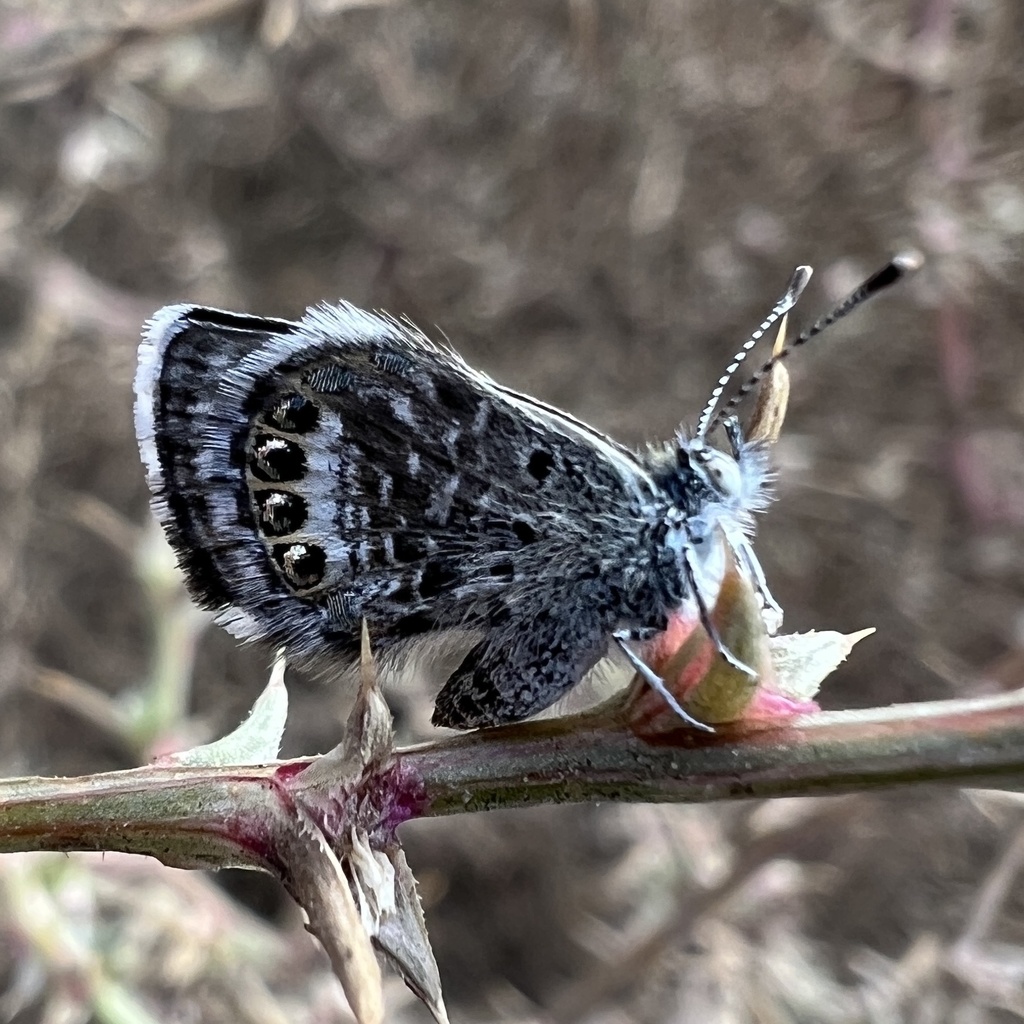
(c) Anne Parker, some rights reserved (CC BY) · licence
Family: Lycaenidae · Class: Insecta · Order: Lepidoptera
Brephidium exilis (Western Pygmy-Blue) is a California animal in the Lycaenidae family.
The Western Pygmy-Blue is one of North America's smallest butterflies, with a wingspan measuring only 12 to 16 millimeters (0.5 to 0.6 inches). The upper wing surfaces are copper-brown to bronze in males and brownish-gray in females, often with a subtle bluish sheen near the wing bases. The undersides display a pale grayish-white ground color with scattered black spots outlined in white, and small orange crescents along the hindwing margins. Both sexes possess short, thread-like tails on the hindwings and distinctive white-fringed wing edges. This species exhibits an extensive range across western North America, from central California east to southern Nevada, central Arizona, central New Mexico, and west Texas. The distribution extends south through southern California and Baja California into Mexico, reaching as far as Venezuela. Western Pygmy-Blues demonstrate strong migratory behavior, with populations expanding seasonally into Arkansas, Nebraska, and Oregon during favorable conditions. Western Pygmy-Blues inhabit diverse environments including desert washes, alkaline flats, disturbed agricultural areas, roadsides, and urban edges where host plants occur. The species thrives in areas with sparse vegetation and saline or alkaline soils, from sea level to approximately 1,500 meters (5,000 feet) elevation. Adults are most commonly observed in open, sunny locations with low-growing herbaceous vegetation. Larvae feed exclusively on plants in the goosefoot family (Chenopodiaceae), with primary hosts including pigweed (Chenopodium album) and various saltbush species (Atriplex). Females deposit single, pale blue eggs on flower buds, leaves, or stems of host plants. The small, green caterpillars feed on flowers, developing seeds, and tender leaves while attended by ants that provide protection in exchange for honeydew secretions. Multiple generations occur annually in warmer regions, with continuous breeding possible in southern California and desert areas. Adults exhibit rapid, erratic flight patterns close to the ground and frequently visit small flowers for nectar, including those of their host plants. Males establish territories around host plant patches and engage in aerial courtship displays. The species demonstrates high reproductive potential, with females capable of producing multiple broods when conditions are favorable. The Western Pygmy-Blue is not federally or state-listed and maintains stable populations across most of its range. The species' association with weedy, disturbed habitats allows it to persist in agricultural and urban environments. Climate change may affect distribution patterns, potentially expanding northern range limits while creating challenges in arid regions. Habitat loss through development and intensive agriculture represents the primary conservation concern in some areas, though the species' adaptability to human-modified landscapes provides resilience. Population monitoring is limited due to the butterfly's small size and tendency to be overlooked in surveys, making population trend assessment difficult.
Classification
Class: Insecta · Order: Lepidoptera · Family: Lycaenidae
Frequently asked questions
How is Brephidium exilis classified?
Brephidium exilis belongs to class Insecta, order Lepidoptera, family Lycaenidae.
What family does Brephidium exilis belong to?
Brephidium exilis is in the Lycaenidae family.
What is Brephidium exilis?
The Western Pygmy-Blue is one of North America's smallest butterflies, with a wingspan measuring only 12 to 16 millimeters (0.5 to 0.6 inches).
Is Brephidium exilis found in California?
Yes. Brephidium exilis is recorded in California in The California Species Project's catalogue.
Related species
Other California species in the same genus, family, or bioregion.
Data from The California Species Project — 14,000+ California species with verified data from CNPS, CDFW, USFWS, and more.