Brotogeris chiriri
Yellow-chevroned Parakeet
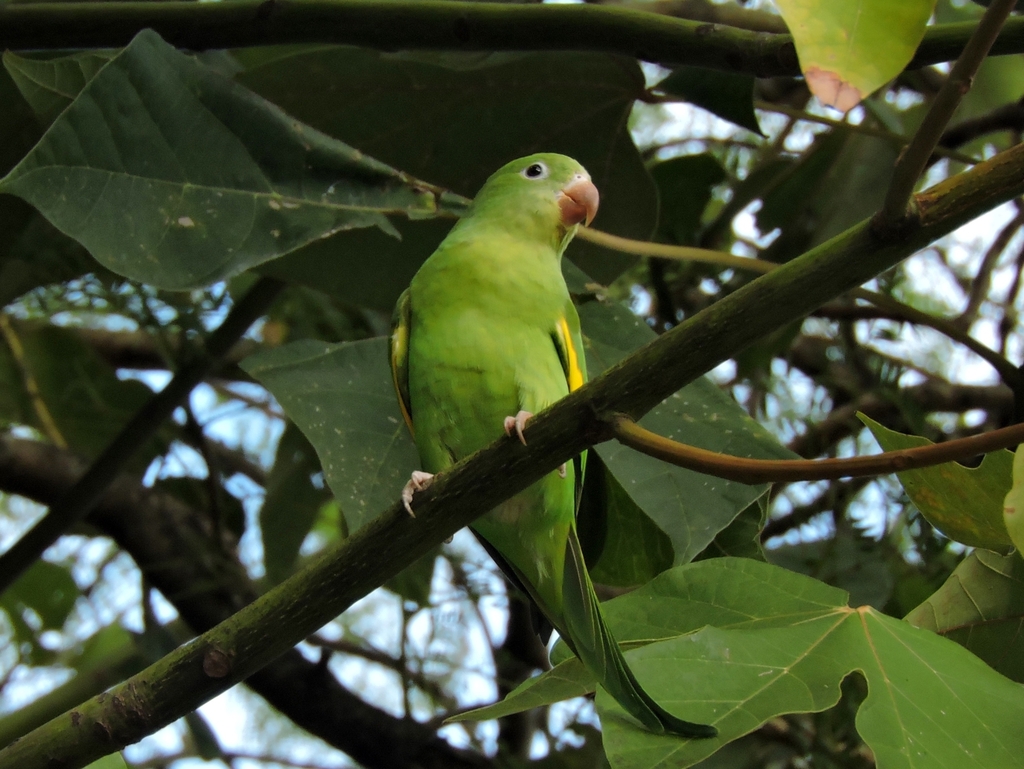
(c) Agustina Medina, some rights reserved (CC BY) · licence
Family: Psittacidae · Class: Aves · Order: Psittaciformes
Brotogeris chiriri (Yellow-chevroned Parakeet) is a California animal in the Psittacidae family.
The Yellow-chevroned Parakeet (Brotogeris chiriri) is a small, compact parrot species native to South America that has established non-native populations in California. Adults measure 20 to 25 cm (8 to 10 inches) in length and weigh approximately 60 to 70 grams. The species displays predominantly green plumage with distinctive yellow markings on the flight feathers that form chevron-shaped patterns visible during flight. The underwing coverts show bright yellow coloration, contrasting with the darker flight feathers. The bill is pale pink to horn-colored, and the eyes are dark brown. Sexual dimorphism is minimal, with males and females appearing nearly identical in size and coloration. Historically absent from North America, Yellow-chevroned Parakeets have established breeding populations in several California urban areas through cage bird escapes and releases since the 1980s. The largest populations occur in Los Angeles, Orange, and San Diego counties, with smaller numbers reported in the San Francisco Bay Area. The species has also established populations in Miami-Dade County, Florida. In California, populations are concentrated in suburban areas with abundant non-native vegetation, particularly in cities such as Los Angeles, Pasadena, San Diego, and surrounding communities. Yellow-chevroned Parakeets inhabit urban and suburban environments, showing strong preference for areas with mature exotic trees and landscaping. The species thrives in residential neighborhoods, parks, golf courses, and commercial areas with extensive planted vegetation. They demonstrate particular affinity for palm trees, eucalyptus, and various fruit-bearing ornamental plants. Elevation range in California extends from sea level to approximately 300 meters (1,000 feet). The species shows strong adaptability to modified habitats and appears to avoid native chaparral and oak woodland ecosystems. These parakeets are highly social, typically foraging and roosting in flocks of 10 to 50 individuals, though larger aggregations of over 100 birds have been documented at abundant food sources. Their diet consists primarily of fruits, seeds, flowers, and nectar from both native and non-native plant species. Documented food sources include dates from Phoenix canariensis palms, flowers from bottlebrush trees (Callistemon spp.), and fruits from ficus trees. Breeding occurs from February through July, with pairs nesting in tree cavities, palm fronds, and occasionally in nest boxes. Clutch size ranges from 3 to 5 eggs, with an incubation period of approximately 26 days. The Yellow-chevroned Parakeet is not federally listed and holds no special conservation status in California, as it is considered a non-native species. Native populations in South America are classified as Least Concern by the International Union for Conservation of Nature, with stable population trends across their natural range. In California, the species appears to be expanding its range and increasing in numbers, particularly in urban areas of Southern California. Management concerns focus primarily on potential impacts to native cavity-nesting birds and agricultural crops, though significant negative effects have not been documented to date.
Classification
Class: Aves · Order: Psittaciformes · Family: Psittacidae
Frequently asked questions
How is Brotogeris chiriri classified?
Brotogeris chiriri belongs to class Aves, order Psittaciformes, family Psittacidae.
What family does Brotogeris chiriri belong to?
Brotogeris chiriri is in the Psittacidae family.
What is Brotogeris chiriri?
The Yellow-chevroned Parakeet (Brotogeris chiriri) is a small, compact parrot species native to South America that has established non-native populations in California.
Is Brotogeris chiriri found in California?
Yes. Brotogeris chiriri is recorded in California in The California Species Project's catalogue.
Related species
Other California species in the same genus, family, or bioregion.
Data from The California Species Project — 14,000+ California species with verified data from CNPS, CDFW, USFWS, and more.