Brotogeris versicolurus
White-winged Parakeet
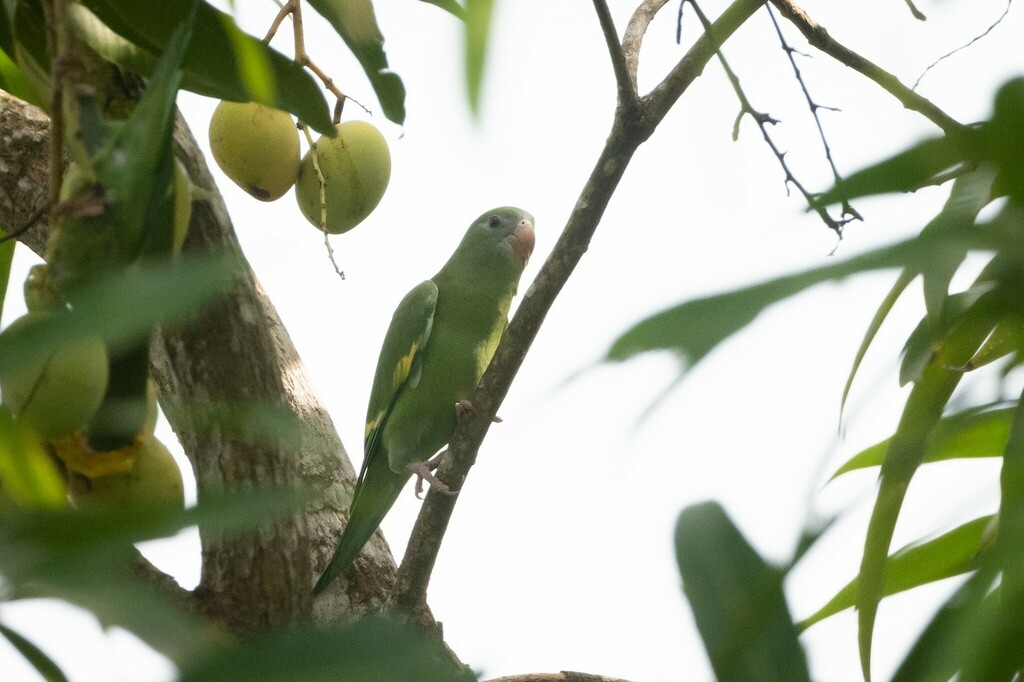
no rights reserved · CC0
Family: Psittacidae · Class: Aves · Order: Psittaciformes
Brotogeris versicolurus (White-winged Parakeet) is a California animal in the Psittacidae family.
The White-winged Parakeet (Brotogeris versicolurus) is a small neotropical parrot species that has established non-native populations in California. Adults measure 20 to 23 cm (8 to 9 inches) in total length and weigh approximately 65 to 70 grams. The species displays predominantly green plumage with a distinctive white patch on the wing coverts that is visible during flight and when wings are spread. The tail is pointed and relatively short compared to other parakeet species. Males and females appear similar, making field identification of sex difficult without close examination. Native to South America, particularly the Amazon Basin of Brazil, Peru, Colombia, and Venezuela, White-winged Parakeets were introduced to California through the pet trade during the 1960s and 1970s. Established populations now occur in several urban areas of Southern California, including Los Angeles County, Orange County, and parts of the San Francisco Bay Area. The species has also been documented in Riverside and San Bernardino Counties. Population estimates suggest several hundred to low thousands of individuals currently reside in California, with numbers fluctuating seasonally based on breeding success and local food availability. White-winged Parakeets inhabit urban and suburban environments in California, showing strong preference for areas with abundant non-native palm trees, particularly Phoenix canariensis (Canary Island Date Palm) and Washingtonia species. The species frequents parks, residential neighborhoods, golf courses, and commercial areas with mature landscaping. They typically forage and nest at heights between 5 and 20 meters above ground. The birds show tolerance for human activity and urban noise levels, often nesting in close proximity to residential areas. The species feeds primarily on palm fruits, seeds, and flowers, with Phoenix canariensis dates comprising a significant portion of their diet in California. They also consume fruits from other ornamental plants including figs, bottlebrush (Callistemon species), and eucalyptus flowers. White-winged Parakeets are highly social, typically observed in flocks of 10 to 50 individuals outside the breeding season. Breeding occurs from February through August, with peak activity during spring months. Pairs excavate nest cavities in palm fronds or use natural hollows in trees. Clutch size ranges from 4 to 6 white eggs, with incubation lasting approximately 26 days. The species exhibits strong site fidelity, often returning to successful nesting locations in subsequent years. White-winged Parakeets are not federally or state listed, as they represent a non-native species in California. Population trends appear stable within their established range, though long-term monitoring data remains limited. Primary management concerns focus on potential impacts to native cavity-nesting birds and agricultural crops, though documented negative effects remain minimal. The species' dependence on ornamental palm trees may limit range expansion, as their distribution closely follows urban development patterns with appropriate palm landscaping. Climate change may affect future distribution patterns, potentially allowing expansion into areas previously unsuitable due to temperature constraints.
Classification
Class: Aves · Order: Psittaciformes · Family: Psittacidae
Frequently asked questions
How is Brotogeris versicolurus classified?
Brotogeris versicolurus belongs to class Aves, order Psittaciformes, family Psittacidae.
What family does Brotogeris versicolurus belong to?
Brotogeris versicolurus is in the Psittacidae family.
What is Brotogeris versicolurus?
The White-winged Parakeet (Brotogeris versicolurus) is a small neotropical parrot species that has established non-native populations in California.
Is Brotogeris versicolurus found in California?
Yes. Brotogeris versicolurus is recorded in California in The California Species Project's catalogue.
Related species
Other California species in the same genus, family, or bioregion.
Data from The California Species Project — 14,000+ California species with verified data from CNPS, CDFW, USFWS, and more.