Bubo scandiacus
Snowy Owl
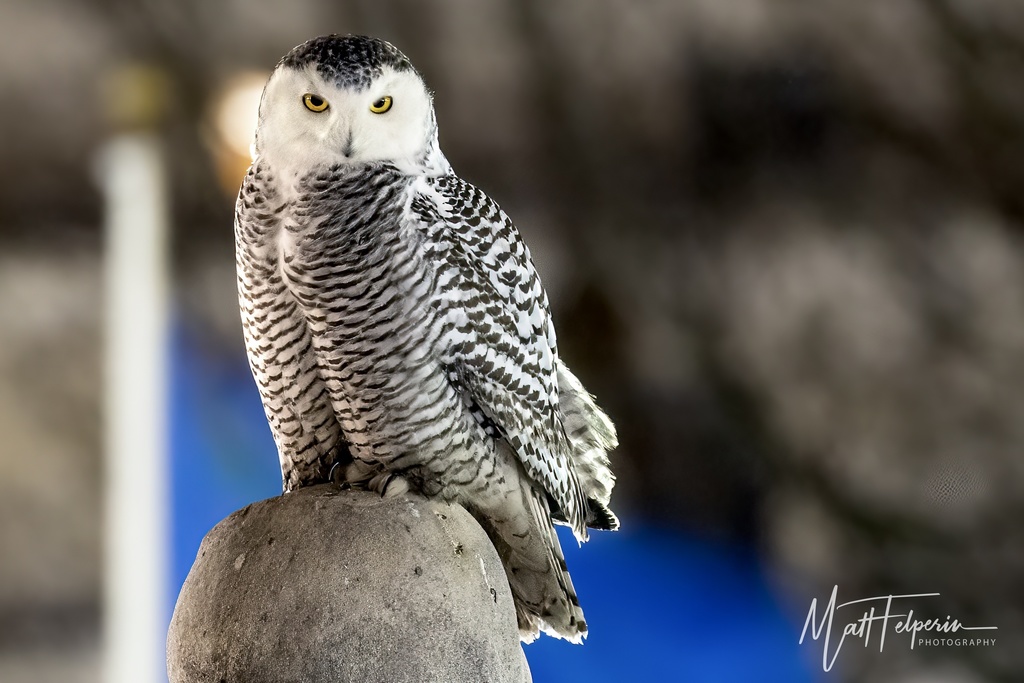
(c) Matt Felperin, some rights reserved (CC BY) · licence
Family: Strigidae · Class: Aves · Order: Strigiformes
Bubo scandiacus (Snowy Owl) is a California animal in the Strigidae family.
The Snowy Owl is a large, distinctive raptor measuring 52 to 71 cm (20 to 28 inches) in length with a wingspan of 125 to 150 cm (49 to 59 inches). Adult males weigh 1.6 to 2.9 kg (3.5 to 6.4 pounds), while females are notably larger at 2.0 to 2.9 kg (4.4 to 6.4 pounds). Males display predominantly white plumage with minimal dark barring, while females and juveniles show more extensive brown and black markings across their wings and body. The species lacks the prominent ear tufts characteristic of many owl species and features bright yellow eyes and a black bill. Their feet are heavily feathered with black talons, an adaptation for arctic conditions. Snowy Owls breed in the Arctic tundra of Alaska and northern Canada, with their range extending across northern Eurasia. In California, they occur as uncommon winter visitors, typically appearing from November through March. During irruptive years, when prey populations in the Arctic decline significantly, larger numbers move south into the continental United States. California records are concentrated in the northern Central Valley, San Francisco Bay Area, and coastal regions from Humboldt County to Monterey County. According to eBird data, the species is most frequently reported in agricultural areas of Sacramento, San Joaquin, and Yolo counties. In California, Snowy Owls utilize open habitats that resemble their native tundra environment. They prefer agricultural fields, grasslands, airports, beaches, and coastal dunes. The species often selects elevated perches including fence posts, hay bales, power lines, and low buildings for hunting and roosting. They avoid heavily forested areas and dense urban environments, instead favoring expanses of short vegetation that provide clear sightlines for prey detection. Snowy Owls are primarily crepuscular and diurnal hunters, unlike most owl species. Their diet consists mainly of small mammals, particularly voles, mice, and ground squirrels in California habitats. They employ a sit-and-wait hunting strategy, scanning from elevated perches before swooping down to capture prey with their powerful talons. During the breeding season on Arctic tundra, lemmings comprise up to 90% of their diet. Breeding occurs from May to September in the Arctic, with clutch sizes varying dramatically from 3 to 11 eggs depending on prey availability. In lemming peak years, pairs may produce larger clutches and achieve higher reproductive success. The Snowy Owl is not federally listed under the Endangered Species Act but is considered a species of conservation concern. The International Union for Conservation of Nature classifies the species as Vulnerable due to climate change impacts on Arctic breeding habitat and declining prey populations. Population estimates suggest 200,000 to 290,000 individuals globally, with cyclical fluctuations tied to prey abundance. In California, the species faces threats from vehicle strikes, power line collisions, and habitat conversion of agricultural lands. Climate change poses long-term risks by altering Arctic tundra ecosystems and potentially shifting the timing and extent of winter movements.
Classification
Class: Aves · Order: Strigiformes · Family: Strigidae
Frequently asked questions
How is Bubo scandiacus classified?
Bubo scandiacus belongs to class Aves, order Strigiformes, family Strigidae.
What family does Bubo scandiacus belong to?
Bubo scandiacus is in the Strigidae family.
What is Bubo scandiacus?
The Snowy Owl is a large, distinctive raptor measuring 52 to 71 cm (20 to 28 inches) in length with a wingspan of 125 to 150 cm (49 to 59 inches).
Is Bubo scandiacus found in California?
Yes. Bubo scandiacus is recorded in California in The California Species Project's catalogue.
Related species
Other California species in the same genus, family, or bioregion.
Data from The California Species Project — 14,000+ California species with verified data from CNPS, CDFW, USFWS, and more.