Bubo virginianus
Great Horned Owl
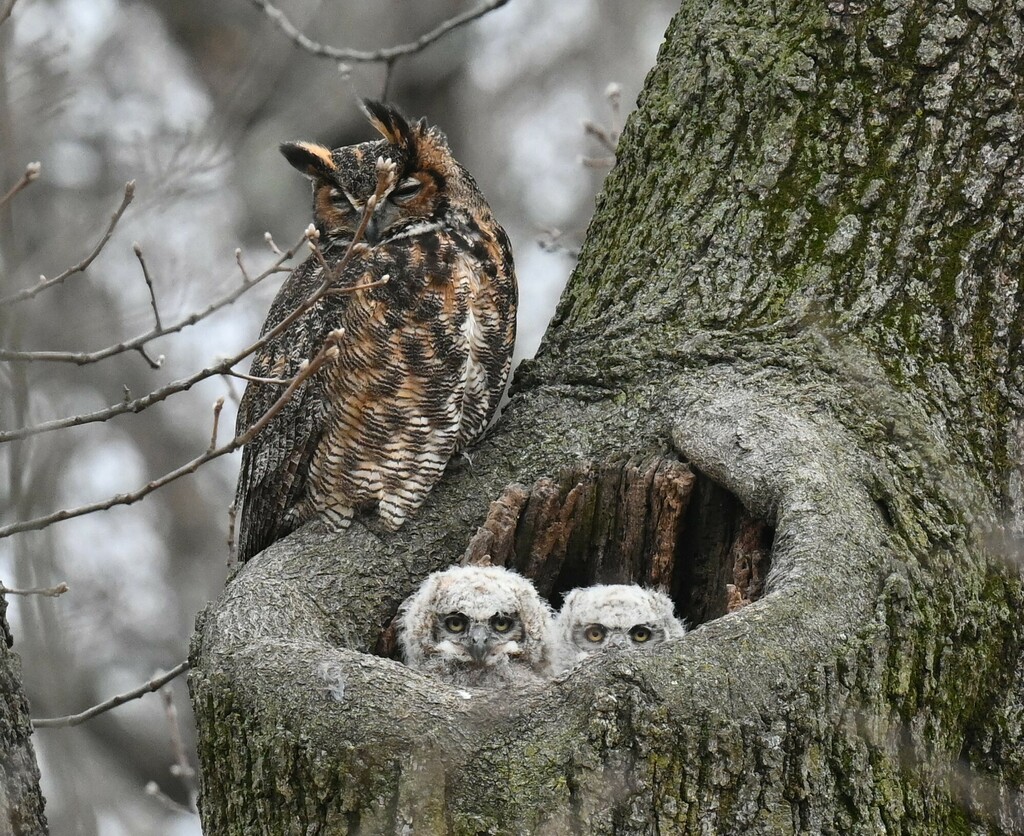
no rights reserved · CC0
Family: Strigidae · Class: Aves · Order: Strigiformes
Bubo virginianus (Great Horned Owl) is a California animal in the Strigidae family.
The Great Horned Owl (Bubo virginianus) is a large, robust raptor measuring 43 to 64 cm (17 to 25 inches) in length with a wingspan ranging from 91 to 153 cm (36 to 60 inches). Adults weigh between 0.9 to 2.5 kg (2 to 5.5 pounds), with females typically larger than males. The species is characterized by prominent ear tufts or "horns" that give it its common name, though these feathered projections are not actually ears. The facial disc is rusty-brown to gray-brown with a distinct white throat patch. Overall plumage varies considerably across subspecies and individuals, ranging from pale gray to dark brown with intricate barring and mottling. The large, bright yellow eyes face forward, providing excellent binocular vision for hunting. Great Horned Owls have one of the most extensive distributions of any owl species in the Americas, ranging from Alaska and northern Canada south to South America. In California, the species occurs throughout the state from sea level to approximately 2,700 meters (8,900 feet) elevation. According to the California Department of Fish and Wildlife, they are year-round residents found in all 58 counties, with stable populations across most of their range. This adaptable species occupies diverse habitats including deciduous and coniferous forests, woodlands, agricultural areas, parks, desert regions with scattered trees, wetlands, and urban environments. Great Horned Owls require suitable nesting sites such as large tree cavities, abandoned hawk or crow nests, cliff ledges, or human-made structures. They prefer areas that provide both perching sites for hunting and adequate prey populations. Great Horned Owls are primarily nocturnal hunters with one of the most varied diets among North American raptors. Their prey includes mammals ranging from small rodents to rabbits and skunks, birds up to the size of herons and other raptors, reptiles, amphibians, fish, and large insects. They possess exceptional hearing and silent flight capabilities due to specialized wing feather structure. Breeding occurs from December through March in California, with pairs typically monogamous and territorial. Females lay 1 to 4 eggs, most commonly 2, in nests they appropriate from other species. The incubation period lasts 28 to 35 days, performed primarily by females while males provide food. Young fledge at 6 to 7 weeks but remain dependent on parents for several months. The Great Horned Owl is not federally or state listed and maintains stable populations throughout its range. The International Union for Conservation of Nature classifies the species as Least Concern. According to the North American Breeding Bird Survey, populations have remained relatively stable from 1966 to 2019, with slight regional variations. Primary threats include habitat loss from urban development, vehicle strikes, and secondary poisoning from rodenticides. The species' adaptability to human-modified landscapes has allowed it to maintain healthy populations despite anthropogenic pressures. Climate change may affect prey availability and breeding timing, but current population trends suggest resilience to environmental changes.
Classification
Class: Aves · Order: Strigiformes · Family: Strigidae
Frequently asked questions
How is Bubo virginianus classified?
Bubo virginianus belongs to class Aves, order Strigiformes, family Strigidae.
What family does Bubo virginianus belong to?
Bubo virginianus is in the Strigidae family.
What is Bubo virginianus?
The Great Horned Owl (Bubo virginianus) is a large, robust raptor measuring 43 to 64 cm (17 to 25 inches) in length with a wingspan ranging from 91 to 153 cm (36 to 60 inches).
Is Bubo virginianus found in California?
Yes. Bubo virginianus is recorded in California in The California Species Project's catalogue.
Related species
Other California species in the same genus, family, or bioregion.
Data from The California Species Project — 14,000+ California species with verified data from CNPS, CDFW, USFWS, and more.