Bucephala albeola
Bufflehead
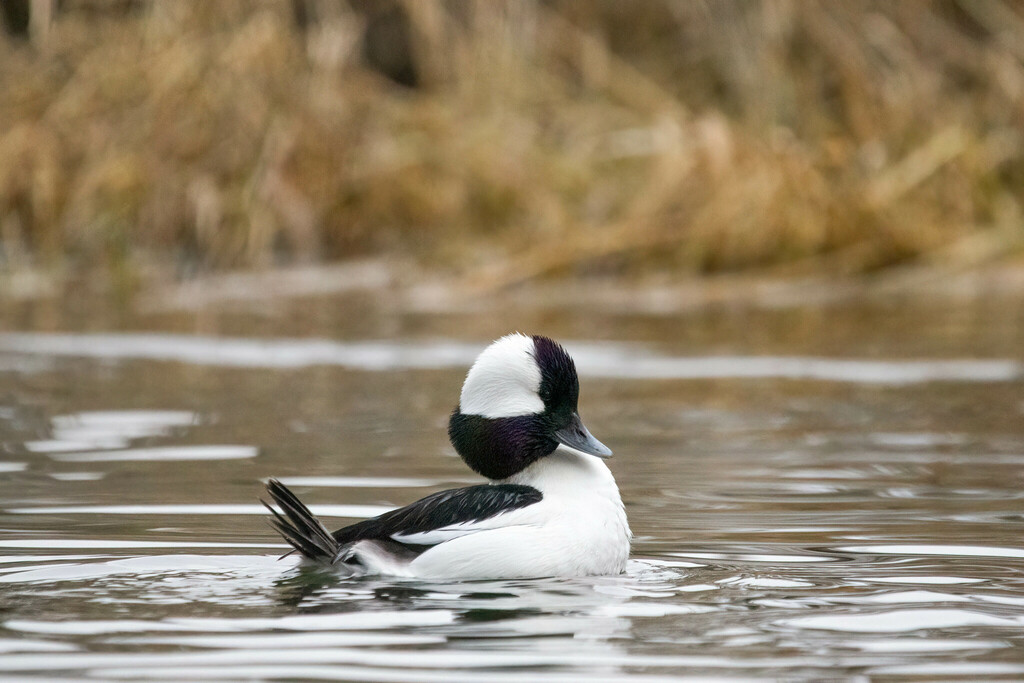
(c) Kalvin Chan, some rights reserved (CC BY) · licence
Family: Anatidae · Class: Aves · Order: Anseriformes
Bucephala albeola (Bufflehead) is a California animal in the Anatidae family.
The Bufflehead is a small diving duck characterized by distinctive sexual dimorphism in plumage. Adult males measure 35-40 cm (14-16 inches) in length with a wingspan of 55 cm (22 inches), weighing approximately 450-550 grams (1.0-1.2 pounds). Males display striking black and white coloration with an iridescent greenish-purple head marked by a prominent white triangular patch extending from below the eye to the back of the head. The back and wings are black, contrasting with bright white sides and underparts. Females are smaller, measuring 32-35 cm (13-14 inches), with brownish-gray plumage and a distinctive white oval patch on each cheek. Both sexes have relatively large heads proportional to their compact bodies and bluish-gray bills. Buffleheads breed across the boreal forests of Alaska and western Canada, extending south into the northwestern United States including northern California, Idaho, Montana, and Washington. The species winters along both Pacific and Atlantic coasts, with significant populations utilizing California's coastal waters, bays, and inland lakes from October through April. According to eBird data, Bufflehead winter abundance in California extends from San Francisco Bay south to San Diego County, with concentrations in protected coastal waters and large inland reservoirs. During breeding season, Bufflehead require freshwater lakes and ponds surrounded by mature forest containing suitable nesting cavities. The species depends on abandoned Northern Flicker holes and natural cavities in aspen, poplar, and birch trees, typically 1.5-18 meters (5-59 feet) above ground. Winter habitat includes saltwater bays, estuaries, coastal lagoons, and large freshwater lakes. In California, wintering birds frequent San Francisco Bay, Humboldt Bay, Morro Bay, and inland waters including Clear Lake and the Salton Sea. Optimal winter habitat provides depths of 1.2-4.5 meters (4-15 feet) for diving access to benthic prey. Bufflehead are accomplished divers, submerging for 12-25 seconds to depths up to 3 meters (10 feet) while foraging. Diet varies seasonally, with breeding birds consuming primarily aquatic invertebrates including chironomid larvae, damselfly nymphs, and amphipods. Winter diet shifts to mollusks, crustaceans, and small fish. Breeding occurs from May through July, with females laying 6-11 creamy white eggs in tree cavities lined with down. Incubation lasts 28-33 days, performed exclusively by females. Ducklings remain in the nest 1-2 days before jumping to water, where they are tended by the female for approximately 50-55 days until fledging. Males typically abandon territories after pair formation to molt in secluded areas. The Bufflehead is not federally or state listed and maintains stable population trends according to the North American Breeding Bird Survey. Christmas Bird Count data indicates stable to increasing winter populations in California. Primary conservation concerns include potential habitat loss from logging in breeding areas and coastal development affecting winter habitat. Climate change may alter prey availability and shift suitable habitat ranges northward. The species benefits from waterfowl hunting regulations and habitat conservation efforts through the North American Waterfowl Management Plan.
Classification
Class: Aves · Order: Anseriformes · Family: Anatidae
Frequently asked questions
How is Bucephala albeola classified?
Bucephala albeola belongs to class Aves, order Anseriformes, family Anatidae.
What family does Bucephala albeola belong to?
Bucephala albeola is in the Anatidae family.
What is Bucephala albeola?
The Bufflehead is a small diving duck characterized by distinctive sexual dimorphism in plumage.
Is Bucephala albeola found in California?
Yes. Bucephala albeola is recorded in California in The California Species Project's catalogue.
Related species
Other California species in the same genus, family, or bioregion.
Data from The California Species Project — 14,000+ California species with verified data from CNPS, CDFW, USFWS, and more.