Bucephala islandica
Barrow's Goldeneye
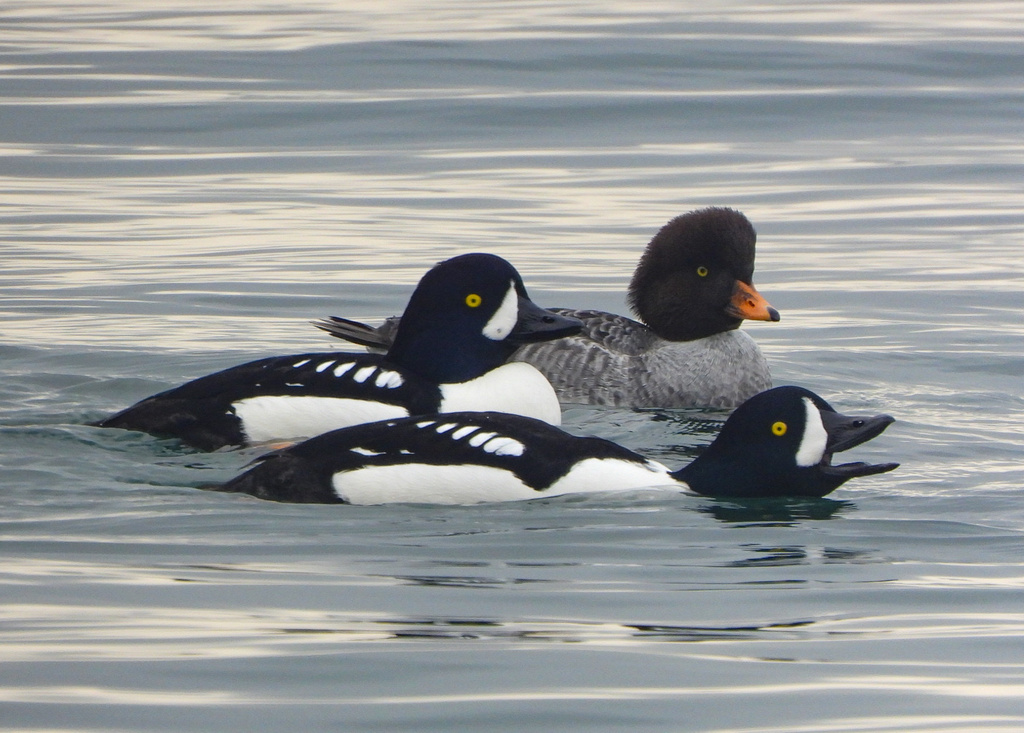
(c) Justin Flint, some rights reserved (CC BY) · licence
Family: Anatidae · Class: Aves · Order: Anseriformes
Conservation status: G5 S1
Bucephala islandica (Barrow's Goldeneye) is a California animal in the Anatidae family.
Barrow's Goldeneye (Bucephala islandica) is a medium-sized diving duck with distinctive sexual dimorphism. Adult males measure 43-51 cm (17-20 inches) in length with a wingspan of 67-78 cm (26-31 inches) and weigh 600-1,200 grams (1.3-2.6 pounds). Breeding males display glossy black heads with greenish-purple iridescence and a distinctive white crescent-shaped patch between the eye and bill, distinguishing them from the closely related Common Goldeneye which has a circular white spot. The body shows contrasting black and white plumage with a white breast and flanks marked by black scapular stripes. Females and non-breeding males are brownish-gray with chocolate-brown heads, white collars, and grayish bodies with white wing patches visible in flight. Barrow's Goldeneye has a disjunct distribution with separate breeding populations in Alaska, western Canada, the northwestern United States, and Iceland. In California, the species has extremely limited occurrence and is classified as S1 (critically imperiled) by NatureServe. The species appears primarily as a rare winter visitor to high-elevation lakes in the Sierra Nevada and Cascade ranges, with occasional records from coastal areas and the Central Valley. Historical records suggest the species was once more regular in northern California mountain lakes, but current observations are sporadic and unpredictable. The species inhabits clear, deep freshwater lakes and ponds during the breeding season, typically at elevations above 1,000 meters (3,280 feet) in forested regions. Preferred habitats feature rocky shorelines, submerged logs, and abundant aquatic invertebrates. In California, winter habitat includes high-elevation reservoirs, mountain lakes that remain ice-free, and occasionally larger rivers and coastal bays. The species requires water bodies with sufficient depth for diving, typically deeper than 2 meters (6.5 feet). Barrow's Goldeneye is a diving duck that feeds primarily on aquatic invertebrates, small fish, and crustaceans. Adults dive to depths of 2-6 meters (6.5-20 feet) to forage along lake bottoms for chironomid larvae, amphipods, and mollusks. The species is cavity-nesting, utilizing large tree cavities, nest boxes, or cliff crevices near water. Breeding occurs from May through July, with females laying 6-12 olive-green eggs. Incubation lasts 28-34 days, and ducklings fledge after 55-60 days. The species exhibits high site fidelity, with adults often returning to the same breeding lakes annually. Barrow's Goldeneye is not federally listed but faces conservation challenges throughout its range due to habitat loss and degradation. In California, the species' critical imperiled status (S1) reflects its extremely limited and irregular occurrence. Primary threats include climate change effects on high-elevation aquatic habitats, water diversions affecting lake levels, and loss of suitable nesting cavities due to forest management practices. The species' dependence on specific habitat conditions and its naturally low abundance in California make it particularly vulnerable to environmental changes. Conservation efforts focus on protecting high-elevation aquatic habitats and maintaining suitable nesting sites in montane forests.
Classification
Class: Aves · Order: Anseriformes · Family: Anatidae
Conservation status
G5 S1
Frequently asked questions
How is Bucephala islandica classified?
Bucephala islandica belongs to class Aves, order Anseriformes, family Anatidae.
What family does Bucephala islandica belong to?
Bucephala islandica is in the Anatidae family.
Is Bucephala islandica protected or of conservation concern?
Bucephala islandica carries the following status: G5 S1.
What is Bucephala islandica?
Barrow's Goldeneye (Bucephala islandica) is a medium-sized diving duck with distinctive sexual dimorphism.
Is Bucephala islandica found in California?
Yes. Bucephala islandica is recorded in California in The California Species Project's catalogue.
Related species
Other California species in the same genus, family, or bioregion.
Data from The California Species Project — 14,000+ California species with verified data from CNPS, CDFW, USFWS, and more.