Bulweria bulwerii
Bulwer's Petrel
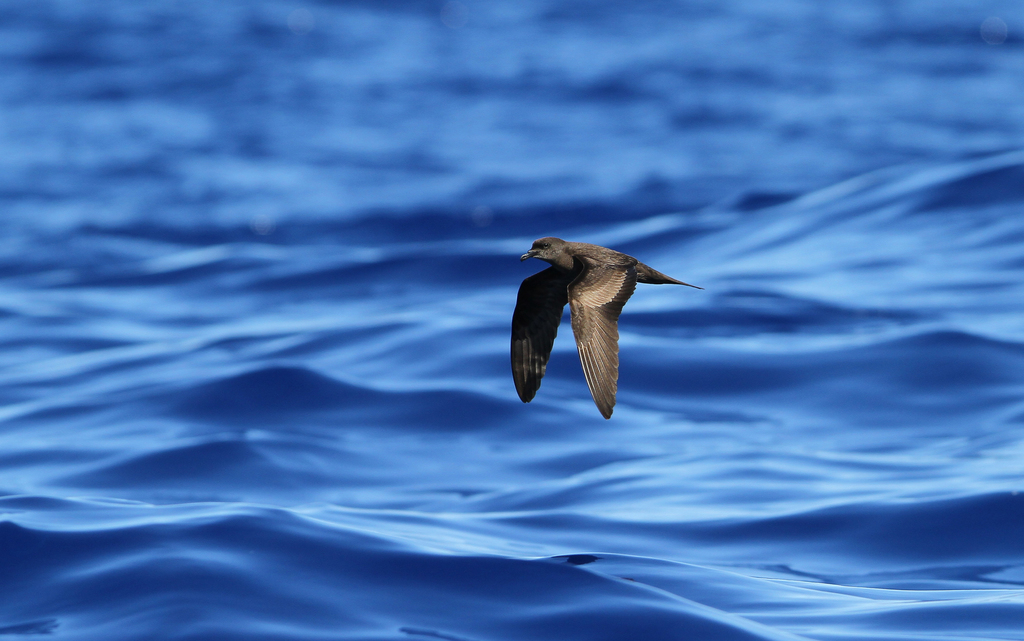
(c) Christoph Moning, some rights reserved (CC BY) · licence
Family: Procellariidae · Class: Aves · Order: Procellariiformes
Bulweria bulwerii (Bulwer's Petrel) is a California animal in the Procellariidae family.
Bulwer's Petrel is a small, dark seabird measuring 25-29 cm (10-11 inches) in length with a wingspan of 68-73 cm (27-29 inches). The species displays uniform dark brown to blackish plumage across the entire body, appearing nearly black at a distance. The bill is relatively short and straight with a pronounced hooked tip characteristic of petrels. In flight, the species exhibits long, narrow wings and a distinctly long, wedge-shaped tail that extends well beyond the feet. The legs and feet are dark, and the species lacks the white rump patch found in many other petrel species. Bulwer's Petrel has a fragmented global distribution, breeding primarily on oceanic islands in the Atlantic and Pacific Oceans. In California waters, the species occurs as a rare visitor, primarily during late summer and fall months. Records indicate occasional sightings off the California coast, particularly in the Channel Islands region and waters beyond the continental shelf. The species' core breeding range includes the Azores, Madeira, Canary Islands, and Cape Verde Islands in the Atlantic, with Pacific populations breeding on islands near Japan and Taiwan. This pelagic seabird inhabits open ocean environments, typically remaining far from shore in deep waters. During the breeding season, Bulwer's Petrel nests in rocky crevices, lava tubes, and burrows on oceanic islands. The species selects nest sites on steep cliffs and volcanic terrain, often at elevations ranging from sea level to 1,000 meters. Outside the breeding season, individuals remain entirely pelagic, following warm ocean currents and areas of high productivity. Bulwer's Petrel feeds primarily on small fish, squid, and surface-dwelling marine invertebrates. The species employs surface-seizing and shallow plunge-diving techniques to capture prey, often feeding during twilight hours when prey species move toward the surface. Breeding occurs annually, with pairs returning to the same nest sites. Females lay a single white egg in June or July, with both parents sharing incubation duties for approximately 44-46 days. The semi-altricial chick remains in the nest for 62-75 days before fledging. Adults exhibit strong site fidelity, often using the same burrow for multiple breeding seasons. Globally, Bulwer's Petrel is not considered threatened, though local populations face various pressures. The species is not federally listed in the United States, reflecting its status as a rare visitor rather than a breeding resident. Primary threats to the species include habitat degradation on breeding islands from introduced mammals, particularly rats and cats that prey on eggs and chicks. Light pollution from coastal development can disorient fledglings during their initial flights to sea. Climate change may affect prey availability and ocean productivity patterns that influence the species' foraging success. In California, the species' rarity makes population monitoring challenging, with most records originating from pelagic birding trips and research vessel observations.
Classification
Class: Aves · Order: Procellariiformes · Family: Procellariidae
Frequently asked questions
How is Bulweria bulwerii classified?
Bulweria bulwerii belongs to class Aves, order Procellariiformes, family Procellariidae.
What family does Bulweria bulwerii belong to?
Bulweria bulwerii is in the Procellariidae family.
What is Bulweria bulwerii?
Bulwer's Petrel is a small, dark seabird measuring 25-29 cm (10-11 inches) in length with a wingspan of 68-73 cm (27-29 inches).
Is Bulweria bulwerii found in California?
Yes. Bulweria bulwerii is recorded in California in The California Species Project's catalogue.
Related species
Other California species in the same genus, family, or bioregion.
Data from The California Species Project — 14,000+ California species with verified data from CNPS, CDFW, USFWS, and more.