Buprestis aurulenta
Golden Buprestid Beetle
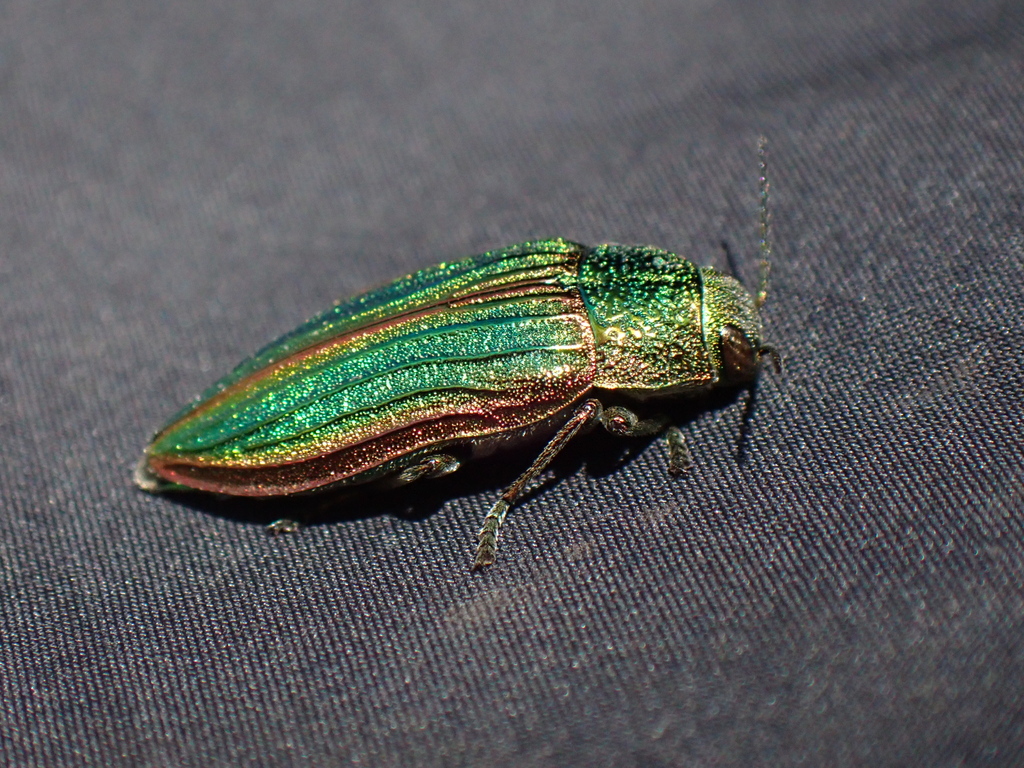
no rights reserved · CC0
Family: Buprestidae · Class: Insecta · Order: Coleoptera
Buprestis aurulenta (Golden Buprestid Beetle) is a California animal in the Buprestidae family.
The Golden Buprestid (Buprestis aurulenta) is a metallic wood-boring beetle in the family Buprestidae, subfamily Buprestinae. This species belongs to the subgenus Buprestis (Cypriacis) within the tribe Buprestini. Adults are medium to large-sized beetles, typically measuring 15-25 mm (0.6-1.0 inches) in length, with the characteristic metallic golden-bronze coloration that gives the species its common name. The elytra display a lustrous coppery-gold sheen with scattered punctures, while the pronotum shows similar metallic coloration with distinct sculptural patterns. Buprestis aurulenta occurs throughout western North America, with documented populations from British Columbia south through California and east to Colorado and New Mexico. In California, the species is widely distributed across forested regions from the Coast Ranges through the Sierra Nevada, typically at elevations ranging from sea level to approximately 2,500 meters (8,200 feet). The species shows particular abundance in coniferous forest ecosystems throughout its range. This beetle inhabits mature coniferous forests, primarily associated with Douglas-fir (Pseudotsuga menziesii), various pine species (Pinus spp.), and true firs (Abies spp.). Adults are commonly observed on recently dead or dying conifers, where they seek oviposition sites in sun-exposed wood surfaces. The species shows a preference for fire-damaged or drought-stressed trees, often appearing in significant numbers following forest fires or bark beetle outbreaks. Habitat selection appears closely tied to the availability of suitable host material in various stages of decay. Adult Golden Buprestids are active during warm, sunny days from late spring through early fall, with peak activity typically occurring from June through August (Burke et al. 2009). Females deposit eggs in bark crevices of dead or dying coniferous trees, where larvae develop as wood borers. The larval stage, known as flatheaded borers, tunnel extensively through the sapwood and heartwood, creating characteristic serpentine galleries. Development from egg to adult typically requires one to two years, depending on environmental conditions and host wood quality (Evans 2014). Adults feed on pollen and nectar from various flowering plants, often visiting buckwheat (Eriogonum spp.), rabbitbrush (Ericameria spp.), and other composite flowers. According to available data, Buprestis aurulenta maintains stable populations throughout its range and does not appear on federal or state listing schedules. The species shows no immediate conservation concerns. However, like many forest-dependent insects, populations may face long-term challenges from climate change, altered fire regimes, and forest management practices that reduce dead wood availability. The species' association with fire-damaged forests may provide some resilience to changing wildfire patterns, though the overall impacts of increasing fire frequency and severity on population dynamics remain unclear. Current population trends appear stable across most of the species' range, with no documented significant declines.
Classification
Class: Insecta · Order: Coleoptera · Family: Buprestidae
Frequently asked questions
How is Buprestis aurulenta classified?
Buprestis aurulenta belongs to class Insecta, order Coleoptera, family Buprestidae.
What family does Buprestis aurulenta belong to?
Buprestis aurulenta is in the Buprestidae family.
What is Buprestis aurulenta?
The Golden Buprestid (Buprestis aurulenta) is a metallic wood-boring beetle in the family Buprestidae, subfamily Buprestinae.
Is Buprestis aurulenta found in California?
Yes. Buprestis aurulenta is recorded in California in The California Species Project's catalogue.
Related species
Other California species in the same genus, family, or bioregion.
Data from The California Species Project — 14,000+ California species with verified data from CNPS, CDFW, USFWS, and more.