Buteo albonotatus
Zone-tailed Hawk
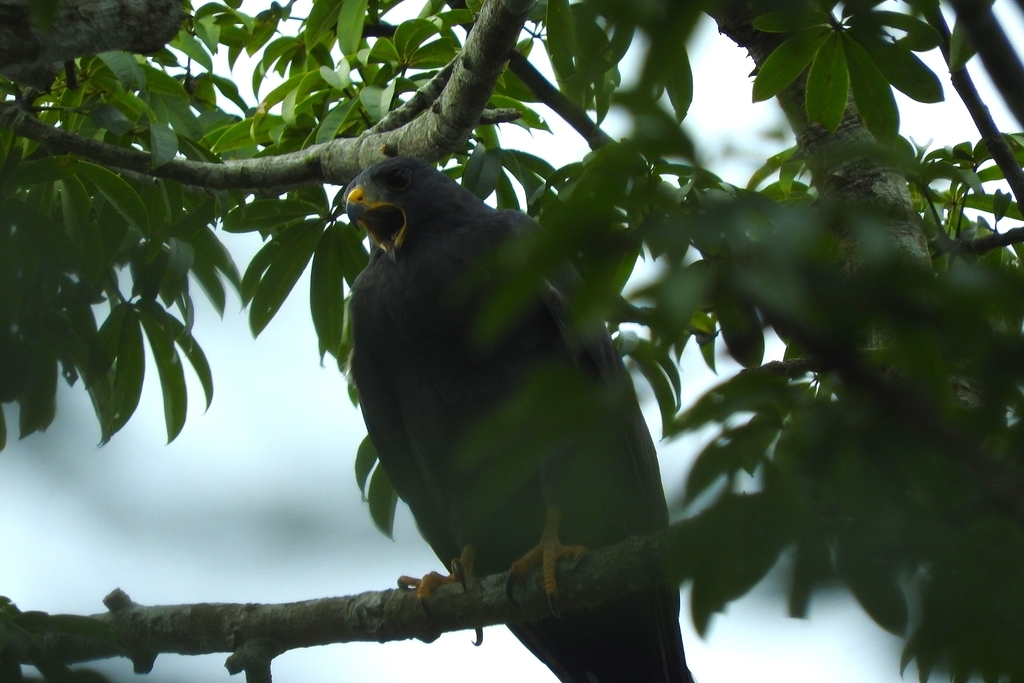
(c) Sebastián de Jesús Herrera Buenfil, some rights reserved (CC BY) · licence
Family: Accipitridae · Class: Aves · Order: Accipitriformes
Buteo albonotatus (Zone-tailed Hawk) is a California animal in the Accipitridae family.
The Zone-tailed Hawk (Buteo albonotatus) is a medium-sized raptor that mimics the Turkey Vulture in flight behavior and appearance. Adults measure 46-56 cm (18-22 inches) in length with a wingspan of 117-140 cm (46-55 inches). The species exhibits sexual size dimorphism, with females weighing 630-940 grams and males 415-650 grams. Adults are predominantly black with white banding on the tail that is most visible from below. The wings appear two-toned in flight, with darker flight feathers contrasting against lighter wing linings. Juveniles display more mottled plumage with white spotting on the underparts and multiple narrow tail bands. Zone-tailed Hawks breed across the southwestern United States, including southeastern California, Arizona, New Mexico, and western Texas, extending south through Mexico to South America. In California, the species occurs primarily in the Sonoran and Mojave Desert regions, with breeding documented in Riverside, Imperial, and San Bernardino counties. The breeding range extends north into parts of the Great Basin. Northern populations are migratory, wintering primarily in Mexico and Central America. The species inhabits riparian woodlands, desert washes, and rocky canyon areas with scattered trees for nesting. Elevation ranges from sea level to approximately 2,000 meters (6,500 feet) in mountainous terrain. Nesting sites are typically located in large cottonwoods, sycamores, or pines near water sources. The species shows preference for areas where wooded riparian corridors intersect with open hunting grounds including desert scrub, grasslands, and agricultural areas. Critical habitat components include perennial or seasonal water sources that support riparian vegetation and maintain prey populations during the breeding season. Zone-tailed Hawks are active hunters that employ a distinctive hunting strategy of soaring with Turkey Vultures to approach prey undetected. This behavioral mimicry allows them to hunt birds, small mammals, reptiles, and amphibians that might otherwise flee from raptors. Diet consists primarily of birds, including doves, quail, and songbirds, supplemented by rodents, lizards, snakes, and frogs. Breeding occurs from April through August, with pairs constructing large stick nests 6-30 meters above ground. Females lay 1-3 eggs, typically 2, which are incubated for 34-35 days. Nestlings fledge after approximately 42-49 days but remain dependent on parents for several weeks post-fledging. The Zone-tailed Hawk is not federally listed under the Endangered Species Act but faces habitat pressures in its limited California range. According to the North American Breeding Bird Survey, populations appear stable across most of the species' range, though California breeding populations remain small and localized. Primary threats include habitat loss from urban development, water diversions affecting riparian zones, and disturbance at nest sites. Climate change may impact water availability in desert riparian systems critical for breeding. The species benefits from riparian habitat restoration and protection of large trees suitable for nesting in desert watersheds. Conservation efforts focus on maintaining adequate water flows in desert river systems and preserving mature riparian forests from development pressures.
Classification
Class: Aves · Order: Accipitriformes · Family: Accipitridae
Frequently asked questions
How is Buteo albonotatus classified?
Buteo albonotatus belongs to class Aves, order Accipitriformes, family Accipitridae.
What family does Buteo albonotatus belong to?
Buteo albonotatus is in the Accipitridae family.
What is Buteo albonotatus?
The Zone-tailed Hawk (Buteo albonotatus) is a medium-sized raptor that mimics the Turkey Vulture in flight behavior and appearance.
Is Buteo albonotatus found in California?
Yes. Buteo albonotatus is recorded in California in The California Species Project's catalogue.
Related species
Other California species in the same genus, family, or bioregion.
Data from The California Species Project — 14,000+ California species with verified data from CNPS, CDFW, USFWS, and more.