Buteo jamaicensis
Red-tailed Hawk
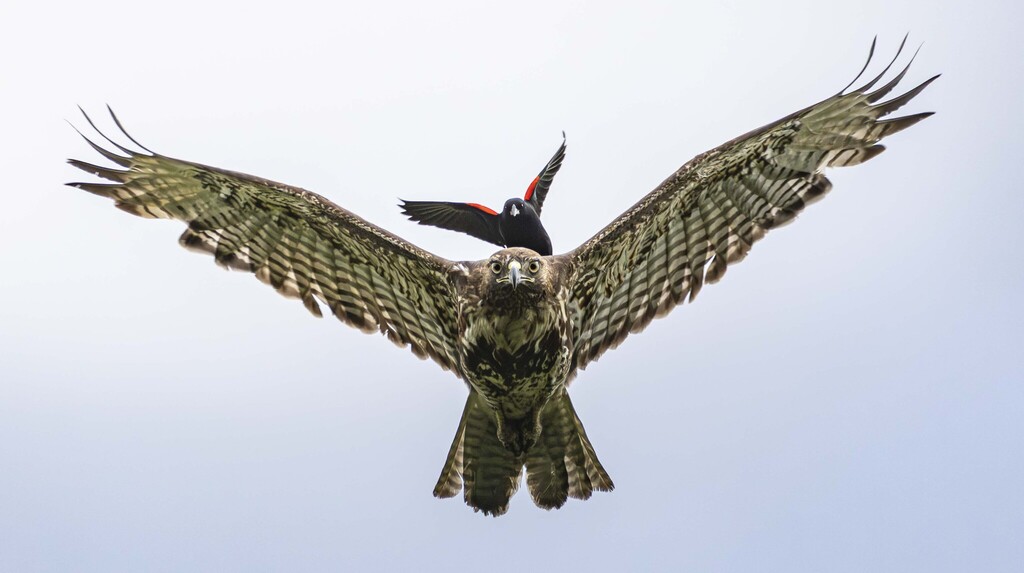
(c) Brooke J., some rights reserved (CC BY) · licence
Family: Accipitridae · Class: Aves · Order: Accipitriformes
Buteo jamaicensis (Red-tailed Hawk) is a California animal in the Accipitridae family.
The Red-tailed Hawk (Buteo jamaicensis) is a large, robust raptor and one of North America's most widespread and common hawks. Adults measure 45 to 65 cm (18 to 26 inches) in length with a wingspan ranging from 114 to 133 cm (45 to 52 inches). Females are typically larger than males, weighing 690 to 1,460 grams (1.5 to 3.2 pounds), while males weigh 690 to 1,180 grams (1.5 to 2.6 pounds). The species exhibits considerable plumage variation, but most adults display the characteristic rufous-red tail that gives the species its common name. The dorsal surface is typically dark brown with lighter mottling, while the ventral surface varies from light with a dark belly band to heavily streaked or barred patterns. Juveniles lack the red tail, instead showing brown tails with dark banding. Red-tailed Hawks occur throughout California, from sea level to elevations exceeding 2,400 meters (7,900 feet). The species inhabits all 58 California counties and is found across diverse geographic regions including the Central Valley, Coast Ranges, Sierra Nevada, Cascade Range, and Mojave and Sonoran deserts. This broad distribution reflects the species' adaptability to varied environmental conditions across the state. Red-tailed Hawks utilize an exceptionally wide range of habitats, making them one of California's most ecologically versatile raptors. The species occupies open woodlands, grasslands, agricultural fields, desert scrublands, riparian corridors, and urban environments. They prefer areas with a combination of open hunting grounds and elevated perches such as trees, utility poles, or cliff faces. In California's Central Valley, they commonly inhabit oak woodlands and agricultural landscapes, while in mountainous regions they occur in mixed conifer forests and oak-pine associations. Urban populations have established in parks, golf courses, and residential areas with sufficient green space. Red-tailed Hawks are opportunistic predators with a diverse diet consisting primarily of small to medium-sized mammals. Rodents comprise the majority of their prey, including ground squirrels, pocket gophers, voles, and rats. They also consume rabbits, reptiles, amphibians, birds, and occasionally carrion. Hunting occurs primarily from elevated perches, though they also employ soaring and hovering techniques. Breeding season extends from February through July, with peak nesting activity occurring from March to May. Pairs construct stick nests in tall trees, cliff faces, or human-made structures. Females typically lay 1 to 4 eggs, with incubation lasting 28 to 35 days. Young fledge after 42 to 46 days but may remain dependent on parents for several additional weeks. Red-tailed Hawks are not federally or state listed and maintain stable populations throughout California. According to North American Breeding Bird Survey data, the species has shown population increases in many regions over recent decades. The species benefits from habitat modifications that create edge environments, including agricultural development and forest management practices that maintain open areas. Primary threats include vehicle collisions, electrocution on power lines, and poisoning from rodenticides. Climate change may affect prey availability and breeding timing, but the species' adaptability suggests resilience to moderate environmental changes.
Classification
Class: Aves · Order: Accipitriformes · Family: Accipitridae
Frequently asked questions
How is Buteo jamaicensis classified?
Buteo jamaicensis belongs to class Aves, order Accipitriformes, family Accipitridae.
What family does Buteo jamaicensis belong to?
Buteo jamaicensis is in the Accipitridae family.
What is Buteo jamaicensis?
The Red-tailed Hawk (Buteo jamaicensis) is a large, robust raptor and one of North America's most widespread and common hawks.
Is Buteo jamaicensis found in California?
Yes. Buteo jamaicensis is recorded in California in The California Species Project's catalogue.
Related species
Other California species in the same genus, family, or bioregion.
Data from The California Species Project — 14,000+ California species with verified data from CNPS, CDFW, USFWS, and more.