Buteo lagopus
Rough-legged Hawk
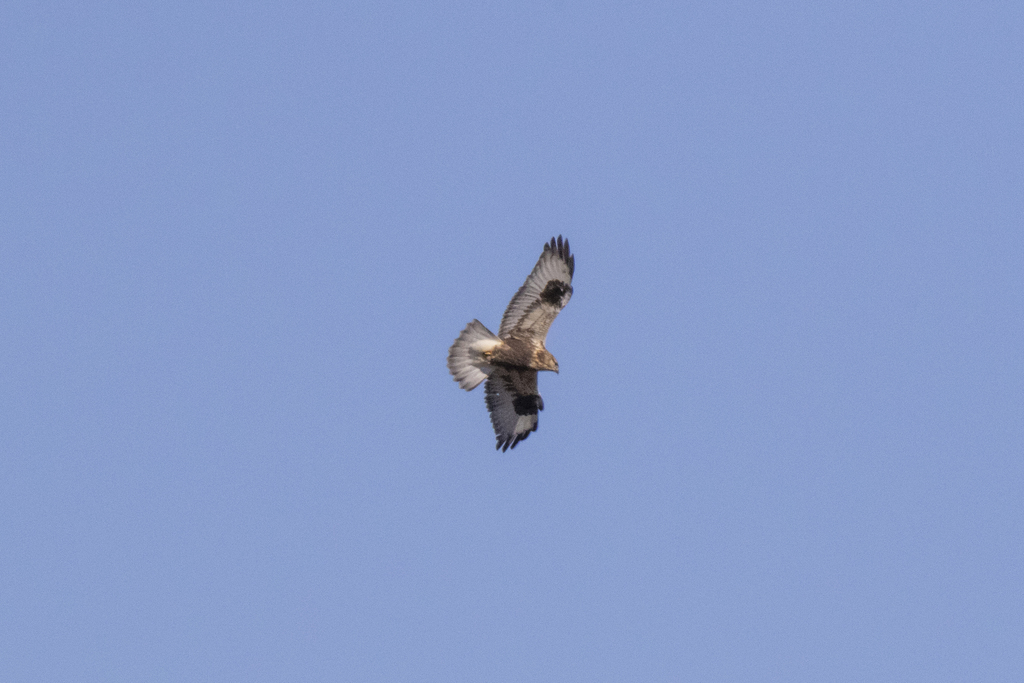
no rights reserved · CC0
Family: Accipitridae · Class: Aves · Order: Accipitriformes
Buteo lagopus (Rough-legged Hawk) is a California animal in the Accipitridae family.
The Rough-legged Hawk (Buteo lagopus) is a medium to large raptor measuring 46-59 cm (18-23 inches) in length with a wingspan of 122-143 cm (48-56 inches). Adults weigh 715-1,400 grams (1.6-3.1 pounds), with females typically larger than males. This species exhibits considerable plumage variation, occurring in light and dark morphs. Light morph individuals display whitish heads and underparts with dark carpal patches and a distinctive dark belly band. Dark morphs appear uniformly dark brown to blackish. Both morphs show characteristic white tail bases with dark terminal bands and feathered tarsi extending to the toes, distinguishing them from other Buteo species. Rough-legged Hawks breed in arctic and subarctic tundra across Alaska, northern Canada, and northern Eurasia. During winter, they migrate south across North America, with California representing the southern extent of their regular wintering range along the Pacific Coast. In California, the species occurs primarily in the Central Valley, northeastern counties including Modoc, Lassen, and Siskiyou, and sporadically in coastal and desert regions. Numbers vary considerably between years, with irruptive movements during years when prey populations crash in northern breeding areas. The largest concentrations typically occur in the Sacramento Valley and San Joaquin Valley, where extensive agricultural lands provide optimal foraging habitat. Wintering habitat in California includes open grasslands, agricultural fields, marshes, and desert scrublands. The species shows preference for areas with scattered perches such as fence posts, telephone poles, and isolated trees. Rough-legged Hawks utilize both perch hunting and extended hovering flight, requiring open terrain with adequate prey populations. They are frequently observed in areas managed for waterfowl and along irrigation canals where rodent populations concentrate. Rice fields, alfalfa fields, and cattle pastures provide particularly productive hunting grounds during the winter months. Rough-legged Hawks are specialized predators of small mammals, particularly voles, lemmings, and ground squirrels. In California wintering areas, they prey primarily on California voles, pocket gophers, and kangaroo rats. The species exhibits unique hovering behavior among North American Buteo hawks, remaining stationary in flight while scanning for prey below. Winter flocking behavior is common, with multiple individuals concentrating in productive hunting areas. Migration timing varies with weather patterns, typically arriving in California between October and November and departing by March. The species is not federally or state-listed, maintaining stable global populations estimated at 2-2.9 million individuals. However, climate change poses potential long-term threats to arctic breeding habitats. In California, habitat loss from agricultural intensification and urban development affects wintering areas. Wind energy development presents collision risks along migration corridors. Christmas Bird Count data from California indicates variable but generally stable wintering populations, with periodic fluctuations corresponding to prey availability in northern breeding areas. The North American Bird Conservation Initiative identifies the Rough-legged Hawk as a species of moderate conservation concern due to projected habitat changes in arctic breeding regions.
Classification
Class: Aves · Order: Accipitriformes · Family: Accipitridae
Frequently asked questions
How is Buteo lagopus classified?
Buteo lagopus belongs to class Aves, order Accipitriformes, family Accipitridae.
What family does Buteo lagopus belong to?
Buteo lagopus is in the Accipitridae family.
What is Buteo lagopus?
The Rough-legged Hawk (Buteo lagopus) is a medium to large raptor measuring 46-59 cm (18-23 inches) in length with a wingspan of 122-143 cm (48-56 inches).
Is Buteo lagopus found in California?
Yes. Buteo lagopus is recorded in California in The California Species Project's catalogue.
Related species
Other California species in the same genus, family, or bioregion.
Data from The California Species Project — 14,000+ California species with verified data from CNPS, CDFW, USFWS, and more.