Buteo lineatus
Red-shouldered Hawk
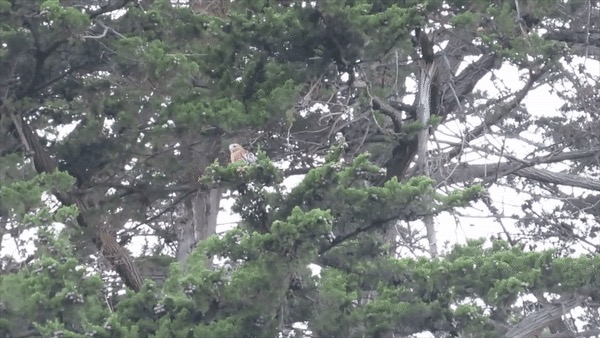
(c) Linzy L., some rights reserved (CC BY-SA) · licence
Family: Accipitridae · Class: Aves · Order: Accipitriformes
Buteo lineatus (Red-shouldered Hawk) is a California animal in the Accipitridae family.
The Red-shouldered Hawk (Buteo lineatus) is a medium-sized raptor measuring 38 to 61 cm (15 to 24 inches) in length with a wingspan of 94 to 111 cm (37 to 44 inches). Adults weigh between 460 and 700 grams (1.0 to 1.5 pounds). The species displays distinctive reddish-brown shoulders and upper wing coverts that contrast with dark flight feathers marked by prominent white crescents visible during flight. The underparts are barred with rufous and white, while the tail shows alternating dark and white bands. Juveniles appear browner overall with streaked underparts and less distinct shoulder coloration. Red-shouldered Hawks inhabit wooded areas throughout much of California, with populations concentrated in the Central Valley, coastal regions, and foothill areas up to approximately 1,200 meters (4,000 feet) elevation. The species occurs year-round as both resident and wintering populations, with some northern birds migrating south during winter months. In California, they are most abundant in riparian forests along major river systems including the Sacramento and San Joaquin rivers. This species requires mature forest habitats with closed or semi-open canopies, typically selecting areas near water sources such as streams, swamps, or wooded ponds. Red-shouldered Hawks prefer deciduous and mixed deciduous-coniferous forests, particularly those dominated by oak, sycamore, willow, and cottonwood trees. They utilize forest edges and adjacent open areas for hunting but maintain strong fidelity to wooded nesting territories averaging 25 to 40 hectares (62 to 99 acres). Red-shouldered Hawks are opportunistic predators that hunt from perches within the forest canopy, dropping down to capture prey on the ground or in shallow water. Their diet consists primarily of small mammals including rodents and rabbits, amphibians such as frogs and salamanders, reptiles, fish, and occasionally birds and large insects. Breeding occurs from March through July, with pairs constructing stick nests 6 to 20 meters (20 to 65 feet) high in the main fork of large trees. Females typically lay 2 to 4 eggs, which are incubated for 28 to 33 days. Young fledge after 35 to 45 days but remain dependent on parents for an additional 8 to 10 weeks. The Red-shouldered Hawk is not federally or state-listed in California, though populations have experienced regional declines due to habitat loss and fragmentation. According to the North American Breeding Bird Survey, California populations have remained relatively stable since 1970, unlike significant declines documented in other portions of the species' range. Primary threats include urbanization, conversion of riparian forests to agriculture, and forest management practices that reduce canopy cover. The species benefits from conservation efforts focused on protecting and restoring riparian corridors and maintaining mature forest stands. Climate change may affect future distribution patterns by altering precipitation regimes that influence prey availability in aquatic habitats.
Classification
Class: Aves · Order: Accipitriformes · Family: Accipitridae
Frequently asked questions
How is Buteo lineatus classified?
Buteo lineatus belongs to class Aves, order Accipitriformes, family Accipitridae.
What family does Buteo lineatus belong to?
Buteo lineatus is in the Accipitridae family.
What is Buteo lineatus?
The Red-shouldered Hawk (Buteo lineatus) is a medium-sized raptor measuring 38 to 61 cm (15 to 24 inches) in length with a wingspan of 94 to 111 cm (37 to 44 inches).
Is Buteo lineatus found in California?
Yes. Buteo lineatus is recorded in California in The California Species Project's catalogue.
Related species
Other California species in the same genus, family, or bioregion.
Data from The California Species Project — 14,000+ California species with verified data from CNPS, CDFW, USFWS, and more.