Buteo plagiatus
Gray Hawk
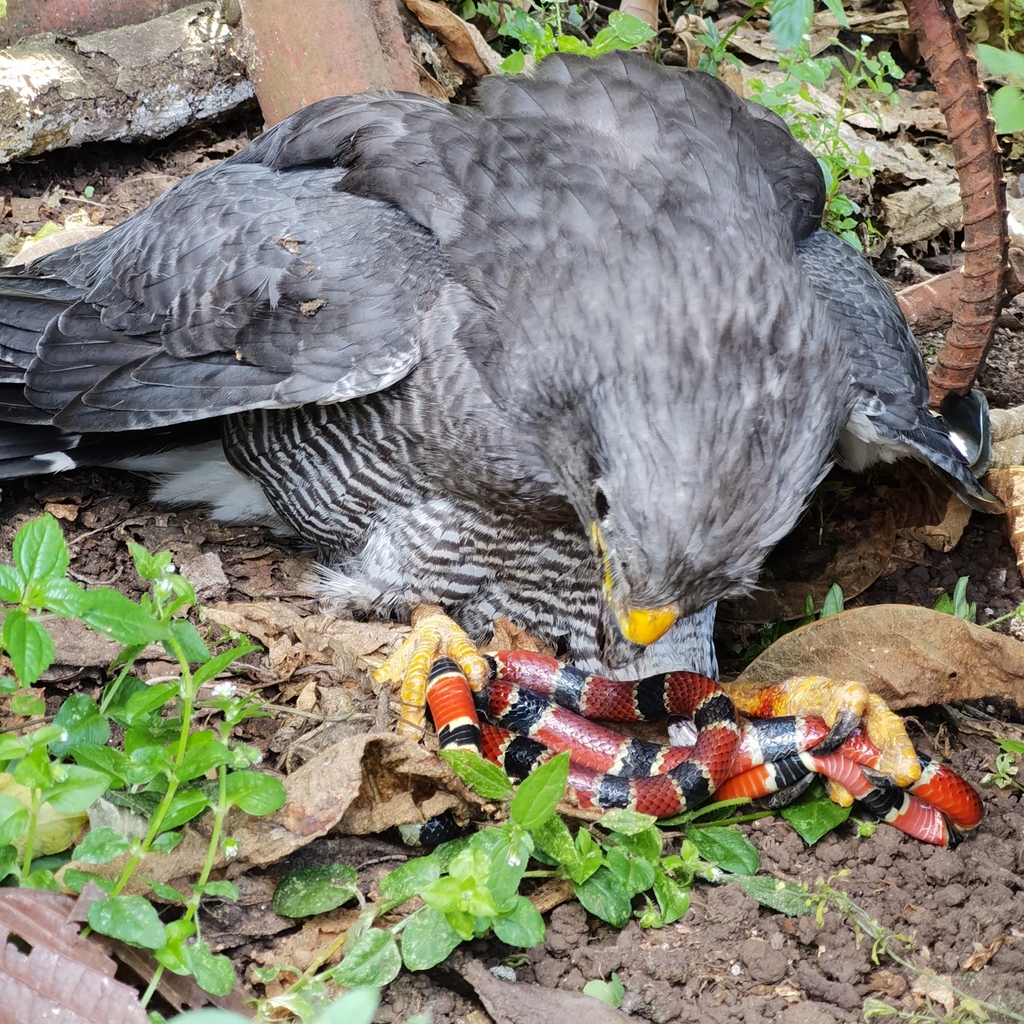
(c) Eduardo Chacón Madrigal, some rights reserved (CC BY) · licence
Family: Accipitridae · Class: Aves · Order: Accipitriformes
Buteo plagiatus (Gray Hawk) is a California animal in the Accipitridae family.
The Gray Hawk (Buteo plagiatus) is a medium-sized raptor measuring 36 to 61 cm (14 to 24 inches) in length with a wingspan of 74 to 99 cm (29 to 39 inches). Adults display distinct plumage with gray upperparts and white underparts marked by fine gray barring. The tail shows alternating dark and light bands, typically three to four dark bands with white interspaces. Juveniles differ considerably, showing brown upperparts with streaking and heavily streaked buff-colored underparts. The species exhibits sexual size dimorphism, with females averaging 20% larger than males, weighing 475 to 650 grams compared to males at 355 to 520 grams. Historically, Gray Hawks bred in riparian woodlands along major river systems in Arizona and extreme southwestern New Mexico. The species was extirpated from California by the early 20th century, with the last confirmed breeding record from the Colorado River valley in the 1940s. Current breeding populations in the United States are concentrated in Arizona's Sonoran Desert region, particularly along the Santa Cruz, San Pedro, and Gila river drainages. According to the Arizona Game and Fish Department, the state supports approximately 150 to 200 breeding pairs, representing the northern extent of the species' range that extends through Mexico into Central and South America. Gray Hawks require mature riparian forests with large cottonwoods (Populus fremontii) and willows (Salix spp.) for nesting. They typically select nest sites 6 to 30 meters above ground in the main fork or large horizontal branches of trees. The species shows strong fidelity to riparian corridors, rarely venturing more than 2 kilometers from permanent water sources. Suitable habitat includes gallery forests with canopy cover exceeding 50% and understory density that allows for hunting access. The species is primarily sedentary in its northern range, though some individuals may move seasonally to lower elevations. Gray Hawks are specialized lizard hunters, with reptiles comprising 70 to 90% of their diet according to prey analysis studies. Primary prey includes spiny lizards (Sceloporus spp.), whiptails (Aspidoscelis spp.), and collared lizards (Crotaphytus spp.). They also consume small mammals, birds, and occasionally amphibians and insects. Breeding occurs from March through July, with pairs constructing stick nests lined with green leaves. Females typically lay 1 to 3 eggs, with an incubation period of 32 to 34 days. Fledglings remain dependent on adults for 6 to 8 weeks post-fledging. The Gray Hawk is not federally listed but is considered a species of conservation concern due to habitat loss and degradation. Riparian habitat destruction has reduced available breeding areas by an estimated 90% throughout the southwestern United States since European settlement. Primary threats include groundwater pumping, urban development, livestock grazing impacts, and invasive plant species that alter riparian forest structure. The Arizona Game and Fish Department monitors breeding populations through annual surveys and habitat restoration efforts focus on preserving existing riparian corridors and removing invasive species such as salt cedar (Tamarix spp.).
Classification
Class: Aves · Order: Accipitriformes · Family: Accipitridae
Frequently asked questions
How is Buteo plagiatus classified?
Buteo plagiatus belongs to class Aves, order Accipitriformes, family Accipitridae.
What family does Buteo plagiatus belong to?
Buteo plagiatus is in the Accipitridae family.
What is Buteo plagiatus?
The Gray Hawk (Buteo plagiatus) is a medium-sized raptor measuring 36 to 61 cm (14 to 24 inches) in length with a wingspan of 74 to 99 cm (29 to 39 inches).
Is Buteo plagiatus found in California?
Yes. Buteo plagiatus is recorded in California in The California Species Project's catalogue.
Related species
Other California species in the same genus, family, or bioregion.
Data from The California Species Project — 14,000+ California species with verified data from CNPS, CDFW, USFWS, and more.