Buteo swainsoni
Swainson’s hawk
(c) Lyndsey, some rights reserved (CC BY) · licence
Family: Accipitridae · Class: Aves · Order: Accipitriformes
Conservation status: ST · G5 S4
Buteo swainsoni (Swainson’s hawk) is a California animal in the Accipitridae family.
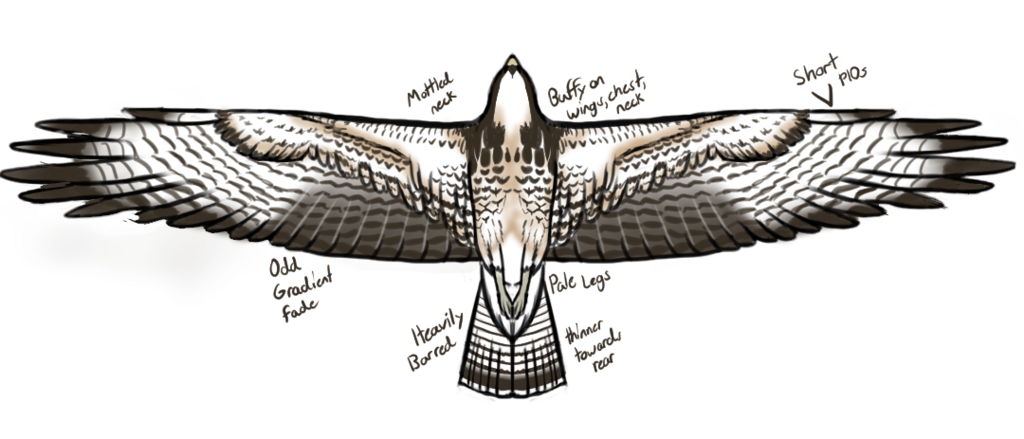
Swainson's hawk is a medium-sized raptor measuring 43 to 56 cm (17 to 22 inches) in length with a wingspan of 117 to 137 cm (46 to 54 inches). Adults weigh 0.5 to 1.4 kg (1.1 to 3.1 pounds), with females typically larger than males. The species exhibits significant plumage variation, with light, dark, and intermediate morphs. Light morph adults display brown upperparts, whitish underparts, and a distinctive dark brown bib across the chest. Dark morph individuals are chocolate brown throughout, while intermediate birds show varying degrees of brown and white. In flight, Swainson's hawks are distinguished by their long, narrow wings with dark flight feathers contrasting against lighter wing linings. Swainson's hawk breeds across the western United States and south-central Canada, with California populations concentrated in the Central Valley, foothills of the Sierra Nevada, and northeastern counties including Modoc, Lassen, and Siskiyou. According to the California Department of Fish and Wildlife, the species has been extirpated from much of its historical range in southern California. The breeding range extends from British Columbia through the Great Plains to Mexico, while wintering grounds are primarily located in South America, particularly Argentina's pampas grasslands. Breeding habitat consists of open grasslands, agricultural areas, and oak savannas with scattered trees for nesting. Swainson's hawks require large trees, typically 6 to 30 meters (20 to 100 feet) tall, including valley oaks, cottonwoods, and eucalyptus for nest sites. Foraging occurs in open areas with low vegetation, including pastures, hayfields, and fallow agricultural land. The species shows strong fidelity to traditional nest sites and foraging areas. Swainson's hawks are opportunistic predators, feeding primarily on small mammals during breeding season, including ground squirrels, pocket gophers, and voles. During migration and winter, they consume large quantities of insects, particularly grasshoppers and beetles. Breeding occurs from March through August in California, with pairs constructing stick nests in tree canopies. Females lay 1 to 4 eggs, typically 2 to 3, with incubation lasting 28 to 35 days. Young fledge after 38 to 46 days but remain dependent on parents for several weeks. The species undertakes one of the longest migrations of any North American raptor, traveling up to 17,000 km (10,600 miles) annually between breeding and wintering grounds. Swainson's hawk is listed as threatened under the California Endangered Species Act, designated in 1983 due to severe population declines. While not federally listed under the Endangered Species Act, the species is protected under the federal Migratory Bird Treaty Act, which prohibits take, possession, and harassment without permits. California breeding populations dropped from an estimated 17,000 pairs in the early 1900s to fewer than 400 pairs by the 1970s. Current estimates suggest 800 to 1,200 breeding pairs statewide. Primary threats include habitat loss from agricultural intensification and urban development, pesticide use reducing prey availability, and collision with wind turbines along migration routes. Conservation efforts focus on habitat protection, nest site management, and working with agricultural landowners to maintain suitable foraging areas.
Classification
Class: Aves · Order: Accipitriformes · Family: Accipitridae
Conservation status
ST · G5 S4
Frequently asked questions
How is Buteo swainsoni classified?
Buteo swainsoni belongs to class Aves, order Accipitriformes, family Accipitridae.
What family does Buteo swainsoni belong to?
Buteo swainsoni is in the Accipitridae family.
Is Buteo swainsoni protected or of conservation concern?
Buteo swainsoni carries the following status: ST · G5 S4.
What is Buteo swainsoni?
Swainson's hawk is a medium-sized raptor measuring 43 to 56 cm (17 to 22 inches) in length with a wingspan of 117 to 137 cm (46 to 54 inches).
Is Buteo swainsoni found in California?
Yes. Buteo swainsoni is recorded in California in The California Species Project's catalogue.
Related species
Other California species in the same genus, family, or bioregion.
Data from The California Species Project — 14,000+ California species with verified data from CNPS, CDFW, USFWS, and more.