Buteogallus anthracinus
Common Black Hawk
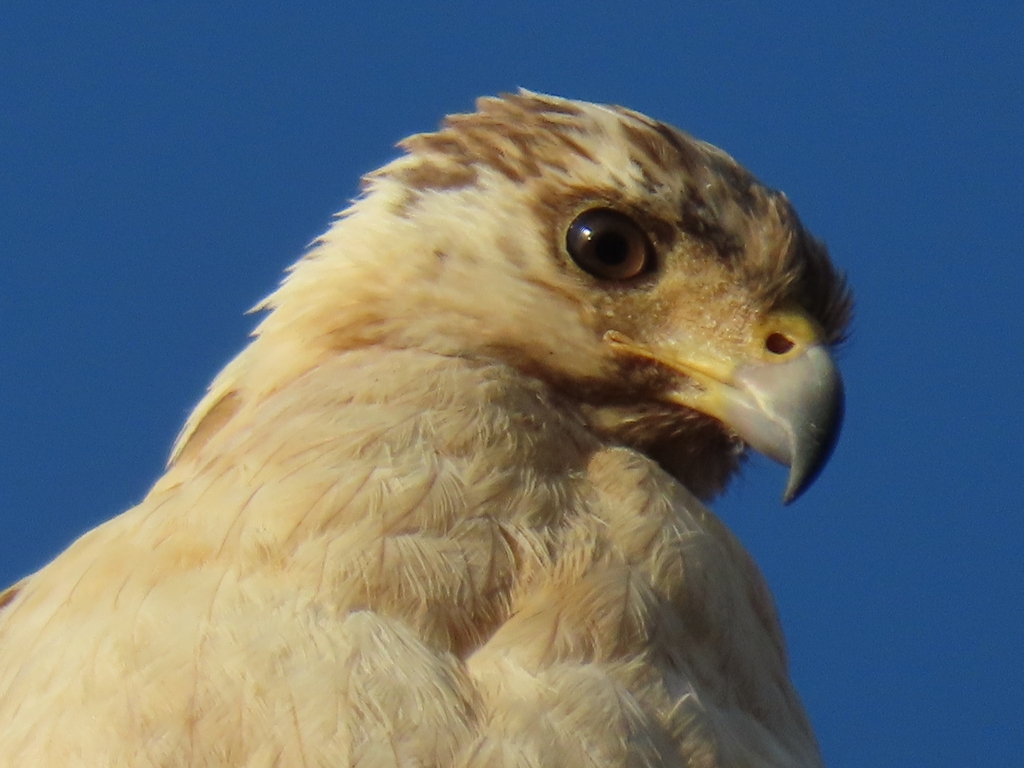
(c) Maria Janeiro, some rights reserved (CC BY) · licence
Family: Accipitridae · Class: Aves · Order: Accipitriformes
Buteogallus anthracinus (Common Black Hawk) is a California animal in the Accipitridae family.
The Common Black Hawk is a medium-sized raptor with distinctive broad wings and a relatively short tail. Adults measure 46 to 58 cm (18 to 23 inches) in length with a wingspan of 109 to 127 cm (43 to 50 inches). Body weight ranges from 630 to 1,100 grams (1.4 to 2.4 pounds). The species exhibits minimal sexual dimorphism, with females slightly larger than males. Adults display uniformly dark plumage, appearing nearly black from a distance, with subtle brown tones visible in good lighting. The tail shows a prominent white band across the middle and white tips. In flight, the species reveals distinctive white patches at the base of the primary flight feathers. Juveniles differ markedly from adults, showing heavily streaked brown and white plumage with multiple pale tail bands. The Common Black Hawk's range extends from the southwestern United States through Central America to northern South America. In California, the species is considered a vagrant, with documented sightings primarily in desert regions and along the Colorado River corridor. Most California records come from Imperial, Riverside, and San Bernardino counties, typically during fall and winter months. The nearest breeding populations occur in Arizona along riparian corridors of the Salt, Verde, and Gila rivers, approximately 200 km (124 miles) east of the California border. This species shows strong habitat preferences for riparian woodlands and wetland areas, particularly those dominated by large cottonwoods, willows, and sycamores. Common Black Hawks require proximity to permanent water sources and typically inhabit elevations below 1,200 meters (3,937 feet). The species favors areas with a mosaic of open water, emergent vegetation, and mature trees that provide suitable nesting sites and hunting perches. Common Black Hawks are opportunistic predators with a diet consisting primarily of fish, frogs, reptiles, and small mammals. According to the Arizona Game and Fish Department, fish comprise up to 70% of the diet in some populations, supplemented by crayfish, snakes, lizards, and occasionally small birds. The species employs a sit-and-wait hunting strategy, often perching motionless above water before swooping to capture prey. Breeding occurs from March through July, with pairs constructing large stick nests in the canopy of tall trees near water. Females typically lay one to three eggs, with an incubation period of 34 to 38 days. Young remain in the nest for approximately seven to eight weeks before fledging. The Common Black Hawk is not federally listed under the Endangered Species Act, and populations appear stable across most of its range. However, the species faces ongoing threats from habitat loss due to water diversions, urban development, and removal of riparian vegetation. In Arizona, populations have shown resilience through active management and habitat protection efforts along major river systems. Climate change poses additional challenges through altered precipitation patterns and increased frequency of drought conditions affecting riparian ecosystems.
Classification
Class: Aves · Order: Accipitriformes · Family: Accipitridae
Frequently asked questions
How is Buteogallus anthracinus classified?
Buteogallus anthracinus belongs to class Aves, order Accipitriformes, family Accipitridae.
What family does Buteogallus anthracinus belong to?
Buteogallus anthracinus is in the Accipitridae family.
What is Buteogallus anthracinus?
The Common Black Hawk is a medium-sized raptor with distinctive broad wings and a relatively short tail.
Is Buteogallus anthracinus found in California?
Yes. Buteogallus anthracinus is recorded in California in The California Species Project's catalogue.
Related species
Other California species in the same genus, family, or bioregion.
Data from The California Species Project — 14,000+ California species with verified data from CNPS, CDFW, USFWS, and more.