Butorides virescens
Green Heron
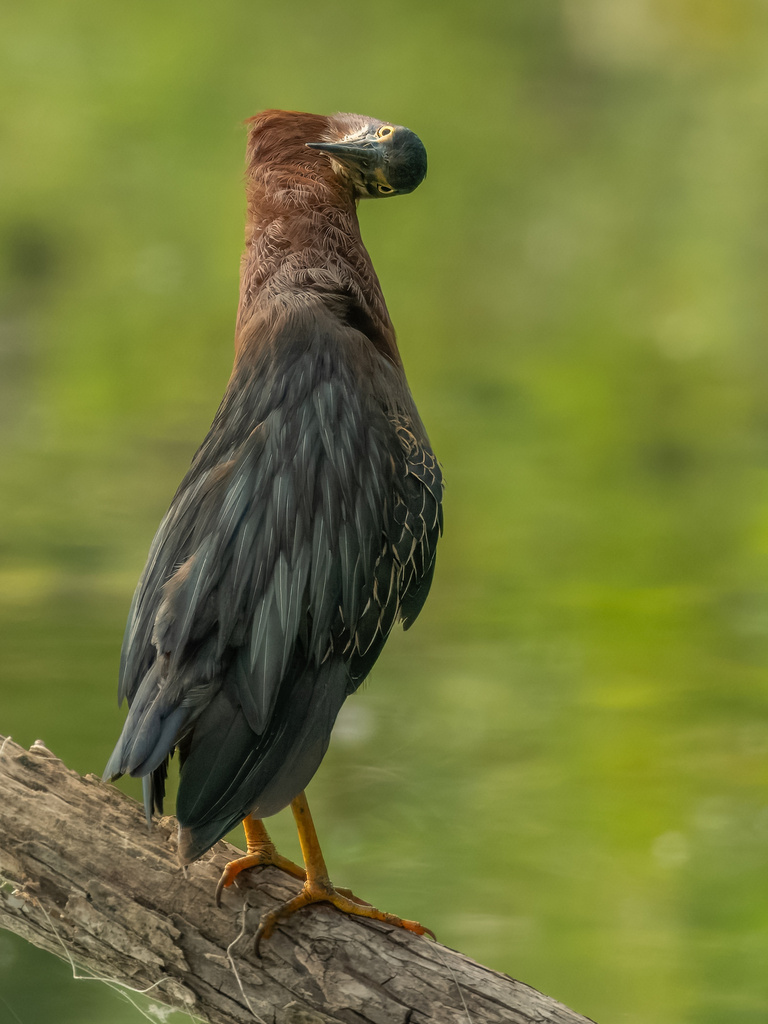
(c) cesar stastny, some rights reserved (CC BY) · licence
Family: Ardeidae · Class: Aves · Order: Pelecaniformes
Butorides virescens (Green Heron) is a California animal in the Ardeidae family.
The Green Heron is a small, stocky wading bird measuring 41 to 46 cm (16 to 18 inches) in length with a wingspan of 64 to 68 cm (25 to 27 inches). Adults weigh 210 to 250 grams. The species displays a dark greenish-blue cap and back, with chestnut-colored neck and sides. The throat and central neck stripe are white with dark streaking. During breeding season, the legs turn from yellow to bright orange. Juveniles are heavily streaked brown and white above with white underparts marked by dark streaks. The bill is dark above and yellow below, and the yellow eyes are particularly prominent. Green Herons breed throughout most of the continental United States and southern Canada, wintering from the southern United States through Central America and the Caribbean. In California, the species is a common year-round resident in suitable habitat throughout the state, from sea level to approximately 1,500 meters elevation in the Sierra Nevada foothills. Populations in northern California may migrate south during winter months, while southern California birds are largely sedentary. The species inhabits freshwater and brackish wetlands including marshes, ponds, lakes, streams, and irrigation ditches. Green Herons show strong preference for areas with dense vegetation cover along water edges, particularly willows, cattails, and other emergent plants that provide nesting sites and hunting perches. They adapt well to human-modified environments, utilizing golf course ponds, park lakes, and residential water features. Green Herons are solitary hunters that employ a patient sit-and-wait strategy, often remaining motionless on low branches or among vegetation before striking at prey. Their diet consists primarily of small fish, frogs, aquatic insects, crustaceans, and occasionally small reptiles and mammals. The species demonstrates tool use behavior, dropping twigs, leaves, or insects onto water surfaces to attract fish. Breeding occurs from April through August in California, with peak activity in May and June. Pairs construct platform nests of twigs in dense vegetation 1 to 6 meters above water. Females lay 3 to 5 pale blue-green eggs, which both parents incubate for 19 to 21 days. Young fledge after 21 to 23 days but remain dependent on parents for several additional weeks. The Green Heron is not federally or state listed and maintains stable populations throughout most of its range. According to the North American Breeding Bird Survey, populations have remained relatively stable since 1970, though some regional declines have occurred due to wetland loss and degradation. Primary threats include habitat destruction from urban development, water diversions, and pollution from agricultural runoff and urban stormwater. Climate change may affect the species through altered precipitation patterns and wetland hydrology. Conservation efforts focus on wetland protection and restoration, particularly maintaining riparian corridors and emergent vegetation essential for nesting and foraging.
Classification
Class: Aves · Order: Pelecaniformes · Family: Ardeidae
Frequently asked questions
How is Butorides virescens classified?
Butorides virescens belongs to class Aves, order Pelecaniformes, family Ardeidae.
What family does Butorides virescens belong to?
Butorides virescens is in the Ardeidae family.
What is Butorides virescens?
The Green Heron is a small, stocky wading bird measuring 41 to 46 cm (16 to 18 inches) in length with a wingspan of 64 to 68 cm (25 to 27 inches).
Is Butorides virescens found in California?
Yes. Butorides virescens is recorded in California in The California Species Project's catalogue.
Related species
Other California species in the same genus, family, or bioregion.
Data from The California Species Project — 14,000+ California species with verified data from CNPS, CDFW, USFWS, and more.