Caenurgina erechtea
Forage Looper Moth
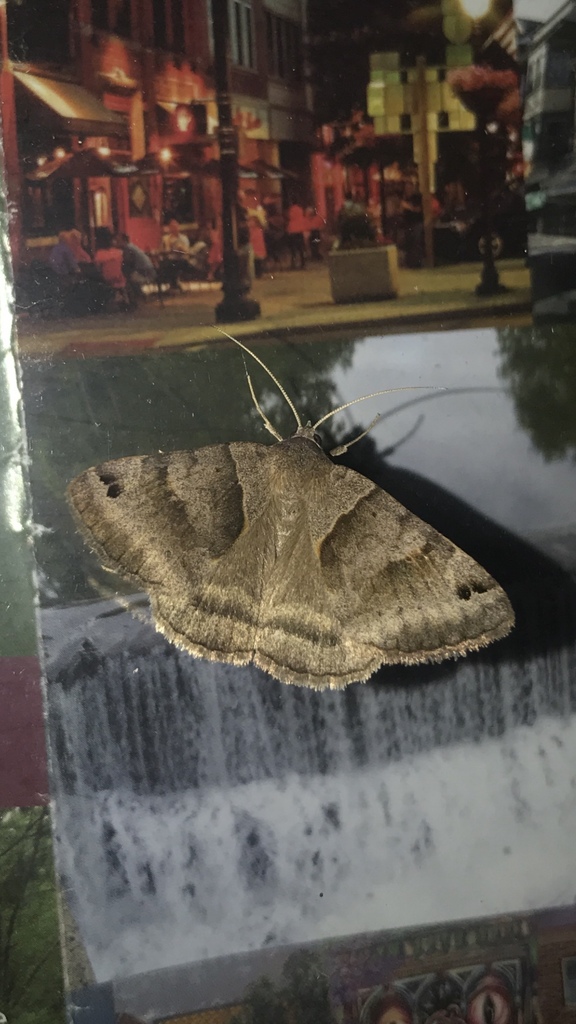
(c) Andrew Conboy, some rights reserved (CC BY) · licence
Family: Erebidae · Class: Insecta · Order: Lepidoptera
Caenurgina erechtea (Forage Looper Moth) is a California animal in the Erebidae family.
The Forage Looper Moth (Caenurgina erechtea) is a medium-sized noctuid moth in the family Erebidae. Adults have a wingspan of approximately 28 to 38 mm (1.1 to 1.5 inches). The forewings are typically grayish-brown to reddish-brown with distinctive wavy crosslines and a prominent reniform spot. The hindwings are lighter, often pale gray to whitish with darker marginal bands. Males possess feathery antennae, while females have thread-like antennae. The species can be distinguished from related Caenurgina species by the specific pattern of forewing markings and the configuration of crosslines. The Forage Looper Moth occurs across much of North America, from southern Canada south to Florida and west to the Rocky Mountains. In California, the species is found throughout much of the state, from coastal areas to inland valleys and foothills. The moth has been documented in counties including Los Angeles, Riverside, San Bernardino, Kern, Fresno, and extending north through the Central Valley and Sierra Nevada foothills. The species appears to be most common at elevations below 1,500 meters (4,900 feet). This moth inhabits a variety of open and semi-open habitats including agricultural areas, grasslands, prairies, old fields, gardens, and disturbed sites. Adults are attracted to artificial lights and are commonly encountered around residential areas and agricultural facilities. The species shows a preference for areas with abundant herbaceous vegetation and flowering plants that serve as nectar sources for adults. Adult Forage Looper Moths are nocturnal and most active during warm evenings from late spring through early fall. The species is multivoltine in warmer regions, producing two to three generations annually. Adults feed on nectar from various flowering plants including clover, alfalfa, and other legumes. Larvae, commonly known as loopers due to their characteristic arching locomotion, feed on a wide range of herbaceous plants. Primary host plants include legumes such as alfalfa (Medicago sativa), various clover species (Trifolium spp.), and other members of the pea family (Fabaceae). The caterpillars may also feed on grasses and other low-growing vegetation. Mature larvae pupate in the soil or leaf litter, with adults emerging after approximately two to three weeks. The Forage Looper Moth is not currently listed under federal or state endangered species legislation and appears to maintain stable populations throughout its range. The species is considered a minor agricultural pest due to larval feeding on alfalfa and other crops, though economic damage is typically minimal. In California, the moth benefits from extensive agricultural areas that provide suitable habitat and host plants. Climate change and habitat conversion may affect local populations, but the species' broad host plant range and adaptability to disturbed habitats suggest continued persistence. No specific conservation measures are currently needed for this species, though maintaining diverse agricultural landscapes and reducing pesticide use in sensitive areas would benefit this and other native moth species.
Classification
Class: Insecta · Order: Lepidoptera · Family: Erebidae
Frequently asked questions
How is Caenurgina erechtea classified?
Caenurgina erechtea belongs to class Insecta, order Lepidoptera, family Erebidae.
What family does Caenurgina erechtea belong to?
Caenurgina erechtea is in the Erebidae family.
What is Caenurgina erechtea?
The Forage Looper Moth (Caenurgina erechtea) is a medium-sized noctuid moth in the family Erebidae.
Is Caenurgina erechtea found in California?
Yes. Caenurgina erechtea is recorded in California in The California Species Project's catalogue.
Related species
Other California species in the same genus, family, or bioregion.
Data from The California Species Project — 14,000+ California species with verified data from CNPS, CDFW, USFWS, and more.